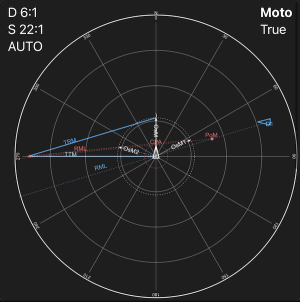
Rule 17 -- Vid of a close encounter....

Sorry, but the Colregs do not have a penalty section so infractions of them are not punishable. That is why I mentioned "...but might if there are applicable penalties enacted by subordinate authorities..." In your response, The Merchant Shipping (Distress Signals and Prevention of Collisions) Regulations 1996 are UK laws which "... give effect to the International Regulations for Preventing Collisions at Sea, 1972, as amended..." They are enforceable according to Section 2

Application​

2.—(1) These Regulations apply to the following vessels—

(a)United Kingdom ships wherever they may be, and other ships while within the United Kingdom or the territorial waters thereof; and

(b)seaplanes registered in the United Kingdom and on the surface of water anywhere, and other seaplanes on the surface of water in the United Kingdom or the territorial waters thereof.

(2) In this regulation “ships” include hovercraft.

I haven't looked to see what other countries have similar legislation but, since the Colregs do not specify penalties, that is left to individual countries to establish and enforce via legislation such as The Merchant Shipping (Distress Signals and Prevention of Collisions) Regulations 1996.
Yes, I'm shocked that UK Law doesn't apply internationally.

Your argument is that people ignore Colregs because there's no penalty for not following them. This is not true.

So, are you trying to be unduly argumentative or just plain silly?
 
Last edited:
Please don’t prat about pretending you’re being helpful. If you’re in sight of another vessel IRPCS apply and the ship expects you to comply.
You see its not always about Colregs which of course we obey when sailing with other small boats. Its also about judgement. Blindly following the book when the big guy over there may not have seen you ain't gonna save you. Im not scared of you coming at me on port tack and messing up but I can get damn scared of a big one on the horizon as its closing, irrespective of who's stand on or give way.
 
Last edited:
You see its not always about Colregs which of course we obey when sailing with other small boats. Its also about judgement. Blindly following the book when the big guy over there may not have seen you ain't gonna save you. Im not scared of you coming at me on port tack and messing up but I can get damn scared of a big one on the horizon as its closing, irrespective of who's stand on or give way.
There are few things more irritating than working out a plan to deconflict with a yacht only for them to 'help out' by altering course and all roads up messing up.

Odds are, it's not just you that the ship's worrying about: other yachts, fishing boats, other ships etc are all on the screen and your 'assistance' screws up the plan not only with you, but with all the other targets.

So, do everyone a favour: learn the rules, fit an AIS, and remember you have Rule 2 in your back pocket. Anything else is at best unnecessary and at worst deeply unhelpful.
 
I haven't looked to see what other countries have similar legislation but, since the Colregs do not specify penalties, that is left to individual countries to establish and enforce via legislation such as The Merchant Shipping (Distress Signals and Prevention of Collisions) Regulations 1996.
On the US side, there is similarly a schedule of fines associated with Colregs violations. Like you, I can't speak to how every country handles it, but for the US treaties are considered law, and Colregs are incorporated into the CFRs (Code of Federal Regulations). Thus enforcement of a Colregs violation would be little different from enforcing road traffic laws in a national park: if law enforcement sees it, they can ticket it. Now, how often it gets enforced is a different question!
 
Blindly following the book when the big guy over there may not have seen you ain't gonna save you.
Actually, I believe it would. I suggest a very careful re-read of the book, because if blindly following it would put you in danger, then you've forgotten large chunks of it.

Edit: To be fair, I think most would benefit from an annotated version, a sort of "mini-Cockcroft", as otherwise key elements are easily missed.
 
Last edited:
On the US side, there is similarly a schedule of fines associated with Colregs violations. Like you, I can't speak to how every country handles it, but for the US treaties are considered law, and Colregs are incorporated into the CFRs (Code of Federal Regulations). Thus enforcement of a Colregs violation would be little different from enforcing road traffic laws in a national park: if law enforcement sees it, they can ticket it. Now, how often it gets enforced is a different question!
Indeed, this is why Marsali's argument is nonsense.

MARPOL doesn't have a penalties section, but I wouldn't advise the C/E to break out the magic pipe.
SOLAS doesn't have a penalties section, but I wouldn't advise the shipowner ditch those annoying lifeboats.
Loadline doesn't have a penalties section, but I wouldn't recommend the C/O cut off the shipside railings since they only get rusty and need painting.
 
Indeed, this is why Marsali's argument is nonsense.

MARPOL doesn't have a penalties section, but I wouldn't advise the C/E to break out the magic pipe.
SOLAS doesn't have a penalties section, but I wouldn't advise the shipowner ditch those annoying lifeboats.
Loadline doesn't have a penalties section, but I wouldn't recommend the C/O cut off the shipside railings since they only get rusty and need painting.
You continue to miss the point I made so I will try and simplify it. Colregs, Marpol and Solas are all internationally recognized codes of conduct that have to be accepted and enabled by individual signatory countries through enacting their own legislation for those waters within their territorial jurisdiction. So, in the case of the UK, they enable enforcement of Colregs by way of The Merchant Shipping (Distress Signals and Prevention of Collisions) Regulations 1996 which you quoted. There will be similar legislation in the UK to cover Marpol and Solas but, without it, there are no penalties for infractions. So if you sail through territorial waters of a non-signatory country, and breach an aspect of Colregs or do likewise in international waters you suffer no official consequences unless you are a UK vessel and the authorities at home receive a complaint. Incidentally, The Merchant Shipping (Distress Signals and Prevention of Collisions) Regulations 1996 do not define what a United Kingdom vessel is so, unless there is case law which clarifies this I'm not sure if they apply to recreational vessels (other than vessels with an Official Number in the Registry), the errant behaviour which was the start of the discussion. There is no question these Regulations apply to vessels in your industry.

Do understand that I don't, as a recreational sailor, condone flouting Colregs or any other regulations.
 
You continue to miss the point I made so I will try and simplify it. Colregs, Marpol and Solas are all internationally recognized codes of conduct that have to be accepted and enabled by individual signatory countries through enacting their own legislation for those waters within their territorial jurisdiction. So, in the case of the UK, they enable enforcement of Colregs by way of The Merchant Shipping (Distress Signals and Prevention of Collisions) Regulations 1996 which you quoted. There will be similar legislation in the UK to cover Marpol and Solas but, without it, there are no penalties for infractions. So if you sail through territorial waters of a non-signatory country, and breach an aspect of Colregs or do likewise in international waters you suffer no official consequences unless you are a UK vessel and the authorities at home receive a complaint. Incidentally, The Merchant Shipping (Distress Signals and Prevention of Collisions) Regulations 1996 do not define what a United Kingdom vessel is so, unless there is case law which clarifies this I'm not sure if they apply to recreational vessels (other than vessels with an Official Number in the Registry), the errant behaviour which was the start of the discussion. There is no question these Regulations apply to vessels in your industry.

Do understand that I don't, as a recreational sailor, condone flouting Colregs or any other regulations.
You said:
"I suspect that one reason some folks choose to ignore the Colregs, even though they have been adopted into law in maritime countries such as the UK, is because the Colregs have no penalties for non-compliance."

I dispute this argument: there are penalties for non-compliance. That they are not listed in Colregs themselves is, I suggest, unimportant.
 
For my own edification, may I ask for responses to the following taken from an actual sailing event?

I am sailing from Channel Islands Nothwards to Britain.

On the horizon (that is about 5miles isn’t it ? - yes I know I should know) or a little closer I can see a large unknown ship to starboard. Big thing.

I have no AIS or radar.

I take compass readings over few minutes and see collision course, so if wind allows I alter course to starboard to avoid him.

Have I broken colregs?

Are my actions sensible or should I have carried on until we were much closer?

I think I did right, but I am not a master mariner.
 
For my own edification, may I ask for responses to the following taken from an actual sailing event?

I am sailing from Channel Islands Nothwards to Britain.

On the horizon (that is about 5miles isn’t it ? - yes I know I should know) or a little closer I can see a large unknown ship to starboard. Big thing.

I have no AIS or radar.

I take compass readings over few minutes and see collision course, so if wind allows I alter course to starboard to avoid him.

Have I broken colregs?

Are my actions sensible or should I have carried on until we were much closer?

I think I did right, but I am not a master mariner.
IMHO your better course of action having established a risk of collision exists would be to carry on for a while and, if your compass bearings continue to show the risk and the ship is not altering course, take the action you propose after, say, 5 minutes.

If the ship is 5NM away when first sighted and closing at 20 knots, the collision is 15 minutes away. So 5 minutes allows plenty of time for the ship to alter course and at the end of 5 minutes you would be quite justified in applying 17(ii) and taking avoiding action whilst still having plenty of sea room to manoeuvre a leisure yacht without anyone needing to experience any stress.
 
For my own edification, may I ask for responses to the following taken from an actual sailing event?

I am sailing from Channel Islands Nothwards to Britain.

On the horizon (that is about 5miles isn’t it ? - yes I know I should know) or a little closer I can see a large unknown ship to starboard. Big thing.

I have no AIS or radar.

I take compass readings over few minutes and see collision course, so if wind allows I alter course to starboard to avoid him.

Have I broken colregs?

Are my actions sensible or should I have carried on until we were much closer?

I think I did right, but I am not a master mariner.

5 miles you can do what you like. Decided in "Banshee-Kildare" 1887. Of course if you're in a hydrofoil and the other guy is doing 60 knots a future court might decide differently. 😁
 
....and it only applies if there's a "risk of collision" not if you're "on a collision course". Those are speicifically noted as being two different things. So if you know there's no.risk of collision you're golden. Have a short think about the implications of that - allows a lot of latitude. 😁

....and in a normal sailing boat under sail your course isn't degree perfect. So the first time you bounce off course there's no risk of collision and you do what you like. There's no obligation to put yourself back in a position where there's a risk of collision.

So Rule 17 doesn't require yachts to play chicken with 100,000 ton ships or require yachts to go out of their way to maintain a risk of collision. It's written that way, but it's never been interpreted that way.

Of course Rule 17 decides when you're allowed to take avoiding action as stand on vessel. It doesn't compel you to. You're allowed to stand on until the other vessel's action alone is no longer enough to prevent a collision. That should please the Rule 17 absolutists!
 
Last edited:
Strictly speaking, the dance would be:

1. Hey, they don't seem to be doing what they should.
2. Sound the warning signal from 34(d), and perhaps call on VHF.
3. Hmm.. they're still not responding.
4. Ok, let's alter course!

All of these steps of course need to happen before you reach the "ah, we're dangerously close" point, so the timeline is derived from that. None of the steps, particularly not any VHF calls, should be allowed to delay things to that point. This is why I say there should be no danger in following the book.

In your scenario you have roughly 15 minutes on the clock (edit: at best!), and in open waters I would be starting to be concerned. I would suggest step 4 should happen when there are at least around 9 minutes on the clock, so your warning signal might be sounded when there are 12 minutes left. (Of course, the other question is, how do you know their speed without other instruments?)
 
Last edited:
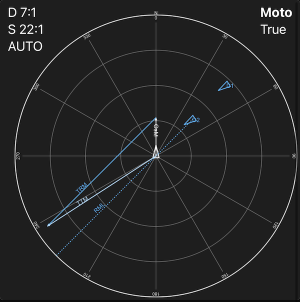
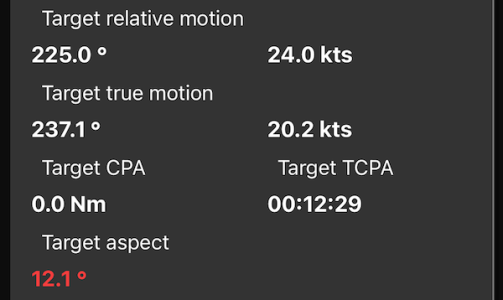
It occurs to me that there is less time than expected... If the other ship is steaming at 20 knots, you might have only 12 minutes on the clock. Here's an example, where you spot the ship 45° to starboard at 5 miles (own ship making 6 knots). The second plotted position is at the 6 minute mark.

Note that 12° aspect means you're pretty much seeing them bow-on. I should probably re-work this for a true "right angle" TSS scenario though...

1751751737158.png1751751754757.png
 
For my own edification, may I ask for responses to the following taken from an actual sailing event?

I am sailing from Channel Islands Nothwards to Britain.

On the horizon (that is about 5miles isn’t it ? - yes I know I should know) or a little closer I can see a large unknown ship to starboard. Big thing.

I have no AIS or radar.

I take compass readings over few minutes and see collision course, so if wind allows I alter course to starboard to avoid him.

Have I broken colregs?

Are my actions sensible or should I have carried on until we were much closer?

I think I did right, but I am not a master mariner.
Horizon may be 5 miles from a yacht but you will be able to see a large ship much further away than that. I would stand on until much closer - the decision you have to make is "can I cross ahead of the ship" which you don't have to do until you are within a few minutes of crossing.

That said your actions are also fine - at the point at which you took action you were too far away for Colregs to apply
 
You said:
"I suspect that one reason some folks choose to ignore the Colregs, even though they have been adopted into law in maritime countries such as the UK, is because the Colregs have no penalties for non-compliance."

I dispute this argument: there are penalties for non-compliance. That they are not listed in Colregs themselves is, I suggest, unimportant.
Final try. I said, above, "...To clarify, some people are ignorant of the consequences of ignoring/violating the Colregs because, when they Google "Colregs" they don't get linked to the local legislation. They are sent to the original International Colregs which make no reference to penalties. However ignorance of the law is no defence as they will likely find out if they keep ignoring/violating." You may think it unimportant but for someone who goes looking for "the Colregs" after hearing others speak/write about it, the first site that Google throws up is this IMO page: Convention on the International Regulations for Preventing Collisions at Sea, 1972 (COLREGs) and I maintain that it is unlikely that, without prompting, that person might then look up The Merchant Shipping (Distress Signals and Prevention of Collisions) Regulations 1996 to learn about the associated penalties under that legislation for UK vessels.
 
6 knots is ~3 m/s. For a cargo ship with a 30 m beam, that's 10 seconds to cross side to side, and about a minute to get a cable-length clear. In a narrow channel, where the ship's course is clear, a cable or two away is often sufficient. In open water I'd not want to be anywhere near that close, so assuming I consider a half mile as a "safe" CPA, then that means I'm deciding at least 5 minutes out (more, accounting for closing speeds).

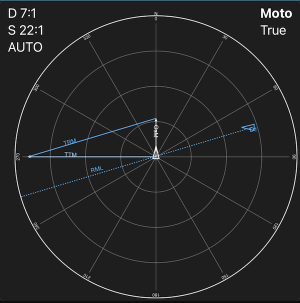
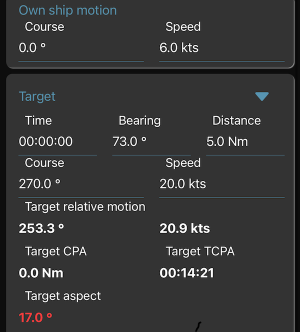
Below is another example, this time for a crossing with perpendicular headings. Note that at ~7 minutes out the distance would be down to 2.5 miles. At that time, to maintain a half mile CPA, you'd need to turn at least 65° (indicated by OsM1 in the third image).

However, these are simple calculations with nice precise numbers. If my idea of the other ship's course was off by 5°, then instead of that 65° turn opening up the CPA, it might return it back to 0! And here's the kicker... while the ship has an aspect of red 17° on course 270, it's only red 12° on course 265. Can you tell that by eye?

1751752712301.png1751752697541.png1751757012577.png
 
The solution is obvious. You guys all need faster boats. If your boat would sail at 12 knots it would take 5, not 10 seconds. BTW 20 knots is extremely rare for cargo these days, 13-14 knots is the max. It’s why they run into the banks in the Suez canal, the engines are too small. A fuel saving measure. Cruise ships are quite quick though.
 
....and it only applies if there's a "risk of collision" not if you're "on a collision course". Those are speicifically noted as being two different things. So if you know there's no.risk of collision you're golden. Have a short think about the implications of that - allows a lot of latitude. 😁

👍

A lot of these collision rows start because people are trying to give absolute judgements from rules that are framed (wisely) subjectively.


For my own edification, may I ask for responses to the following taken from an actual sailing event?

I am sailing from Channel Islands Nothwards to Britain.

On the horizon (that is about 5miles isn’t it ? - yes I know I should know) or a little closer I can see a large unknown ship to starboard. Big thing.

I have no AIS or radar.

I take compass readings over few minutes and see collision course, so if wind allows I alter course to starboard to avoid him.

Have I broken colregs?

Are my actions sensible or should I have carried on until we were much closer?

I think I did right, but I am not a master mariner.

Ships should make early alteration, it's prudent and easier for them, as others have mentioned, they normally do, AIS confirms this. Every now and again you get one that steams on regardless.

At five miles, with a fast moving target, you have to act. A danger of collision has started to emerge and you have maybe 15 minutes to decide a course of action. After a few checks, some thought and confirmations, the ship is probably at 4 miles and you have 12 minutes. Leave it another 3 minutes and he is 3 miles away and you have 9 minutes left, too close for me.

I would never use the VHF when singlehanded, there is not enough time and too much scope for misunderstanding. When making your clear alteration you have to watch the ship like a hawk, he may see you late and panic.

.
 
Top