Rule 17 -- Vid of a close encounter....

many years ago I spent quite a bit of time in the solent on the bridge of a frigate doing navigation training. Whilst not a big ship and thus plenty of space for us I'm glad it was pre AIS as I can just imagine how much that might increase the bridge team work load for very limited benefit. I'm also imagining the confusion as a yacht calls up and you then spend another frantic minute or two trying to establish which yacht it was as opposed to looking out the window. In restricted visibility AIS alongside radar would no doubt have a greater use but you would expect traffic to be much less. I tend to work on anticipation of shipping movements ... oh here comes the 1300 cross channel ferry, he'll be turning into Portsmouth, lets keep away from where they will be going, or they will be turning before they reach us, there's the IOW ferry going to Fishbourne he's going through the Swashway etc. that said this comes with experience.
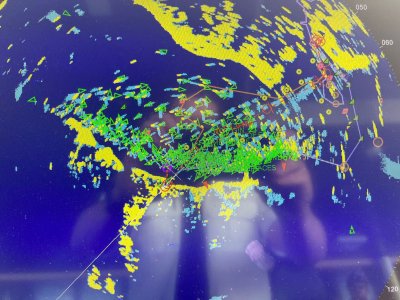
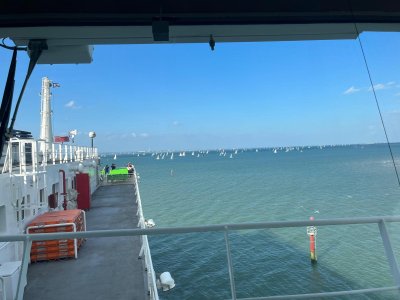
A comparison of the views from that very ferry you mention on RTI day. One, radar with AIS overlay (mostly class B of course) and a "look out of the window" version.
 

Attachments

  • rti1.jpg
    rti1.jpg
    596.5 KB · Views: 22
  • rti2.jpg
    rti2.jpg
    173 KB · Views: 22
I can't help thinking that life would be simpler all round if there was a blanket rule in the Solent and similar places that says something like vessels under 100 tons shall keep out of the way of vessels over 100 tons.

... but, but if there are two 100t vessels, that are neither over or under 100t what do they do if on a closing course? What do vessels do that are above or below 100t when they are on a closing course? Maybe we should have a set of rules to avoid collisions that apply to all vessels, and where necessary, special rules, to address specific local conditions. Mmmm!

Perhaps, at the end of the day, what is already in place works, based on the lack of collision incidents. It appears to me, that outside the Solent is where collisions happen more frequently. I guess the system as is works well.
 
... but, but if there are two 100t vessels, that are neither over or under 100t what do they do if on a closing course? What do vessels do that are above or below 100t when they are on a closing course? Maybe we should have a set of rules to avoid collisions that apply to all vessels, and where necessary, special rules, to address specific local conditions. Mmmm!

I don't think Stemar was proposing a fully fleshed out bye-law. ...but the gist of his statement makes a lot of sense. Somehow release small vessels from the obligation to stand on when ROW against 'huge' ships. (Definition TBD, mechanism TBD.)

One thing they could certainly do is have a bye-law right now that defines the entire Solent or an area of the Solent as a Narrow Channel. (Or not a Narrow Channel, it doesn't matter which.) No drawback to that whatsoever.

 
... but, but if there are two 100t vessels, that are neither over or under 100t what do they do if on a closing course?
That's the sort of thing that makes lawyers rich :)

Perhaps the precise wording could be something like "vessels up to and including 100 tons (or Xm LOA orwhatever) shall keep out of the way of vessels over 100 tons.

Actually, forget it, I've been bullied too many times by the IoW ferries to want to give them any extra leeway :sneaky:
 
I've just been talking to ChatGPT about rule 17 and it's come up with a perspective I've never heard before. I'm nowhere near my copy of Cockroft, and I have a feeling it doesn't answer this anyway.

So:

- Does rule 17 Apply only where there is risk of collision? Rule 17 says it applies "Where one of two vessels is to keep out of the way" and 'keep out of the way' is mentioned in places where risk of collision is not mentioned.

- Does Rule 17 apply only to the rules in Part 2 Section B. (Surely not?)

- Does Rule 17 apply only when both vessels are in sight of each other? (Surely not?)
 
- Does rule 17 Apply only where there is risk of collision? Rule 17 says it applies "Where one of two vessels is to keep out of the way" and 'keep out of the way' is mentioned in places where risk of collision is not mentioned.
Correct, specifically both risk of collision and also when in visual sight. (This is explicitly noted in Cockcroft.)
- Does Rule 17 apply only to the rules in Part 2 Section B. (Surely not?)
Correct, only to those rules. When not in visual sight, rule 19 applies instead.
- Does Rule 17 apply only when both vessels are in sight of each other? (Surely not?)
Correct.
 
I can't help thinking that life would be simpler all round if there was a blanket rule in the Solent and similar places that says something like vessels under 100 tons shall keep out of the way of vessels over 100 tons.
Oh? Is it because the Solent feels particularly... narrow?

Rule 9 catches plenty of flak for seeming vague, so a ruling that clearly designates an area to which it applies is helpful. Even so, one of the basic rules the courts apply is how the area is customarily navigated. If it's the general practice in the area for the smaller vessels to keep out of the way when a larger ship moves through, it's reasonably obvious that Rule 9 is (or should be) in play.
 
Correct, specifically both risk of collision and also when in visual sight. (This is explicitly noted in Cockcroft.)

Correct, only to those rules. When not in visual sight, rule 19 applies instead.

Correct.

Thanks.

So, ChatGPT concurred on those three points and made the point that if a risk of collision has to exist for Rule 17 to apply, then it follows as soon as the stand on vessel breaks Rule 17, Rule 17 no longer applies. If you never intended to get to the point where the collision would have occurred there was never a risk of collision in the first place, even if it appeared to the "give way" vessel that there was. Which is handy, but renders Rule 17 redundant as a way to make the stand on vessel behave predictably. You can always say "There was never a risk of collision because I always knew I was going to tack off."

I was mildly skeptical because, if Rule 17 doesn't apply in, say, a narrow channel or in fog then the "give way" vessel don't need to maintain course and speed. However, on reflection that's logical, because they're in a narrow channel or a separation zone and therefore the rules assume they aren't going to behave unpredictably anyway, or in the case of a fishing boat I guess the rules assume it should be allowed to behave unpredictably.) I'm less sure about Fog. I guess when the rules were written radar wasn't as good and it was assumed that behaving in a predicable fashion had no value if you couldn't be seen.

Quite a moment. Until today I have always thought Rule 17 applied to a) Any stand on vessel under any rule and b) Applied when "you were on a collision course" IMHO risk of collision is very different to being on a collision course.

A better way to describe rule 17 would be to say "If you want to stand on, you need to hold your course and speed, however on a whim you can **** off somewhere else, even if you're on a collision course." And all those elderly blokes mid channel with compasses on ships 5 miles away desperately maintaining a collision course are behaving totally needlessly. (...and I've sailed with a lot of them!)

Every day's a school day...

(I reserve the right to change my mind about any or all of this later when I get hold of my copy of Cockcroft. :))

EDIT: Yup, Cockroft is crystal clear on this and it's certainly unclear because because an attempt was made to clarify it. (And rejected!)
 
Last edited:
Ah, there is much greater nuance at play here. I would start by letting go the idea that "holding course and speed" means "holding course and speed".

Rather, it is taken to mean that you should keep doing what you are doing, assuming it is obvious to the other vessel. Yes, I understand this introduces some uncertainty! To illustrate, if you're following the course of a channel, you'd continue to follow the course of a channel. If you're heading into a berth, you'd continue heading towards the berth. This may mean that your compass heading and speed may change as appropriate to the manoeuvre. However, if you were intending to move into an open area to, say, swing your compass, that is not such an obvious manoeuvre, and you should avoid doing it until the risk of collision is resolved.

Similarly, just because your projected courses intersect at the same location does not necessarily mean risk of collision exists. Again, consider the example of following a winding channel or a traffic lane that bends.

Related to that last point, there is general presumption and precedent that risk of collision only comes into play once vessels are sufficiently close in terms of both time and distance that there's an actual danger of collision. If you wouldn't hold course just because your AIS starts alarming, then you shouldn't do it just because your compass indicates the same.

The risk must be timely, and for that I like to work backwards, for example:
  1. How much time/space do I need to take action if the give-way vessel doesn't?
  2. How much time do I allow the give-way vessel to do something after signalling them?
  3. How much time do I wait for the give way vessel to take action before signalling?
  4. How much time do I need to properly assess what the other vessel is doing?
Many collisions result from not allocating sufficient time to point 1. Point 4 can vary, from spending a few minutes with the radar and hand-compass to simply eyeballing it when racing.
 
Related to that last point, there is general presumption and precedent that risk of collision only comes into play once vessels are sufficiently close in terms of both time and distance that there's an actual danger of collision.

Well if Cockcroft is to be beleived it didn't start off as a general assumption. It was suggested the rule was amended to include it but an individual on the committee said he had always "assumed" it was the case so they didn't bother adding it. 🤦‍♂️ So unless you could his mind or read Cockcroft you wouldn't know. (And I'm certain none of this featured in the Cockcroft PDFs I've found online in the past so very early editions didn't feature it. It just so happens I recently found a newer elderly copy in a charity shop.)

The RRS do all this so much better. Mind you that leaves racers with far less to argue about!

Anyway, thanks, I've learned a lot today. Of course in 2 weeks time it will have evaporated from my mind and I'll go back to my understanding from 1995. 😁
 
The precedent goes back to Lord Esher's ruling in The Banshee, back in 1887, as below. Cockcroft does mention there was a proposal at the '72 Conference to specify it based on projecting forward course and speed, which was rejected.

Now at what period of time is it that the Regulations begin to apply to two ships? It cannot be said that they are applicable however far off the ships may be. Nobody could seriously contend that, if two ships are six miles apart, the Regulations for Preventing Collisions are applicable to them. They only apply at a time when, if either of them does anything contrary to the Regulations, it will cause danger of collision. None of the Regulations apply unless that period of time has arrived. It follows that anything done before the time arrives at which the Regulations apply is immaterial, because anything done before that time cannot produce risk of collision within the meaning of the Regulations.
 
but, but if there are two 100t vessels, that are neither over or under 100t what do they do if on a closing course
One would hope they hail each other and after a bit of recognition chatter utter the time honoured phrase... Red to Red Sir? Yes Red to Red ... many thanks.
 
One would hope they hail each other and after a bit of recognition chatter utter the time honoured phrase... Red to Red Sir? Yes Red to Red ... many thanks.
All too complicated for me (I have always applied ‘might is right’ in open sea) except for your post that seems so sensible.

I don’t know how legal eagles would take to it. I know little of nautical legal shenanigans.

I have not sailed the busy looking Solent much. It always seemed very complicated.
 
All too complicated for me (I have always applied ‘might is right’ in open sea) except for your post that seems so sensible.

I don’t know how legal eagles would take to it. I know little of nautical legal shenanigans.

I have not sailed the busy looking Solent much. It always seemed very complicated.
If you apply ‘might is right’ officers of the watch will consider you a menace and a pain in the rear.

They EXPECT you to follow IRPCS.

May I humbly suggest you watch AIS and see how when you are stand on in open waters ships tweak their course to avoid you. It’s EXTREMELY rare for a ship not to obey IRPCS.

If you don’t obey IRPCS what do you think a court is going to say?
 
If you apply ‘might is right’ officers of the watch will consider you a menace and a pain in the rear.

They EXPECT you to follow IRPCS.

May I humbly suggest you watch AIS and see how when you are stand on in open waters ships tweak their course to avoid you. It’s EXTREMELY rare for a ship not to obey IRPCS.

If you don’t obey IRPCS what do you think a court is going to say?
I agree with you.

My history is with uk waters all around and often without modern tech.

If I see a trawler or drifter and they do not respond to a hail, I consider them ‘might is right’ and I have simply avoided a situation by diverting a long way off.

unfortunately, as a perfectionist (a curse) I try to look three steps ahead; and that may mean two or three miles ahead (without AIS, radar etc).

The regs probably would not come into effect for me because I would avoid a potential situation two miles before it really needed contemplating.

I may not have have made myself clear in my previous post.

Avoiding a situation before it becomes a situation is the way I sail; so regs hopefully never enter the situation because no situation occurs.
 
May I humbly suggest you watch AIS and see how when you are stand on in open waters ships tweak their course to avoid you
The idea that a fully laden 1600' súper tanker is going to "tweak its course" to avoid me is, I respectfully put to you....hocum sir. And anyone going to sea thinking that is going to happen needs to have a long hard look at how they go about their sailing. I see a big ship, I get the hell out of its way, stand on or not.
 
The idea that a fully laden 1600' súper tanker is going to "tweak its course" to avoid me is, I respectfully put to you....hocum sir. And anyone going to sea thinking that is going to happen needs to have a long hard look at how they go about their sailing. I see a big ship, I get the hell out of its way, stand on or not.
Sorry but you’re wrong. They do it alter course. Not by much (it costs them fuel) but they certainly do alter to open up the CPA.

They always have but pre AIS it wasn’t obvious until you got closer. The joy of AIS is that you can see them applying IRPCS and taking appropriate action when there’s a risk of collision with a sailing vessel.

Please don’t prat about pretending you’re being helpful. If you’re in sight of another vessel IRPCS apply and the ship expects you to comply.

If you don’t they just curse quietly at another wind assisted boat making them watch carefully in case you make another irrational alteration of course.
 
Top