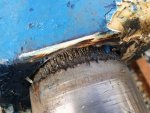
Rudder stock problem

michael_w

Well-Known Member
Joined
8 Oct 2005
Messages
5,872
Visit site
I've recently bought a 1997 Dehler 35 CWS which has been ashore for the past 5 years. The steering was very stiff and I asked the yard to drop the rudder with a view to having new bearings made. The stainless steel stock is showing rather odd damage/corrosion. I can't work out how it has happened or is it machining to help the foam core adhere?

I've asked the surveyor of his opinion too.

20210709_132639 copy.jpg

20210712_084733 (002) copy.jpg
 
It looks to me like electrolytic corrosion, caused by using copper-based antifouling next to the stock. Jefa Rudders specifically caution against this, and recommend using non-copper antifoul (Trilux, etc) in the immediate vicinity of the rudder stock - say for 75-100mm around it.

Electrolysis – Jefa Rudder
 
Crevice corrosion where there was once sealant?
Edit: example 5 in PVBs link looks very similar to your photo
 
That degree of corrosion is less likely to be from copper antifouling than from the stock being electrically connected with something else such as the prop shaft (as suggested in the Jefa examples). Don't think it is anything to do with the construction of the rudder except possibly crevice corrosion from the shaft sitting in damp where it goes into the blade. Often a weak point and entry point for water getting into the core. Worth digging that area out to see how sound the rudder is and also how far the corrosion goes down. Fixes to that area include building up a ring of epoxy if it is dry enough to take it (that is what I did) or setting an O ring in Sika.

Agree though with the view that non copper AF should be used around the shaft area and on the hull around the exit hole if the lower bearing housing is metal - either aluminium or stainless.
 
Some dehler use aluminium stocks which latterly some owners have sleeved in stainless as a bearing surface as a repair to a stock that's worn so check for that!
 
Looking at the photo the damage is not to a bearing surface. That stops at a guess 20mm higher where the stock goes into the lower bearing. more concerned about the state of the stock inside the rudder, hence the suggestion to dig into that area of the rudder shell.
 
There are no bonding wires, though the stock is connected to a linear pilot drive. Maybe an electrical leak?
 
There are no bonding wires, though the stock is connected to a linear pilot drive. Maybe an electrical leak?
Don't think that is likely. There has to be some other metal underwater if it is galvanic action. The damage is very localised and the rest of the stock up to the waterline is also wet if the bearings are water lubricated yet is undamaged. So important to find out whether it goes down the stock into the rudder.
 
Top