Rotten bad luck for Alex Thomson

I subscribe to the accident prone theory. It defies logic a little but some people seem immune to accidents but others chalk up regular ones, even if they're only walking down a normal street something happens to them.

On the last Vendee he hit something in the water breaking a foil..
How is that down to being accident prone? I seem to recall that nearly 1/3 of the boats hit something... containers?
 
On the last Vendee he hit something in the water breaking a foil..
How is that down to being accident prone? I seem to recall that nearly 1/3 of the boats hit something... containers?

More inclined to think those foils were breaking off rather than hitting things … not sure they like to tell the world they're not built strong enough!
 
More inclined to think those foils were breaking off rather than hitting things … not sure they like to tell the world they're not built strong enough!

Actually, that is BS.

Hearing from Alex face to face on this one, he said that he absolutely did hit something hence the break. The original foils were hollow. They learned from the experience and the new ones are essentially solid. So yes, the team is happy to tell the world and learn from experiences...same as this RDR, right?

Incidentally when they first tried the foils they sailed a course roughly Beaulieu River entrace to Cowes. Foils were retracted, speed was 20kts. They turned around, went back to Beaulieu, sailed the same course with the foils deployed...27kts.
 
In a different forum it may surprise you if you are not an aviator that light aircraft legally fly around in nil visibility at 100+ knots without radar, and, often, without the equivalent of a transponder. There has never been an accident as a consequence on the UK. What they do is legal.

The point is that the chances of hitting another boat is remarkably small, and, at least other skippers can see you, so it would take two both not keeping a watch for a collision to occur. I dont think that is actually unreasonable for the few that wish to push themselves to the challenge of long distance solo racing.

I would imagine the chances of being involved in a car accident are far higher.
 
light aircraft legally fly around in nil visibility at 100+ knots without radar, and, often, without the equivalent of a transponder.
What they do is legal.
It's worth pointing out that (civil) aircarft radar is never used for collision avoidance. It is very poor at seeing other aircraft as it is optimised to see rain and particularly thunderstorms - ie weather avoidance. It can show useful returns of coastlines but that is only of passing interest as opposed to any sort of nav function. Light aircraft are virtually never fitted with radar, it is the preserve of usually multi engined types intended for flight in airways.
It is actually ships that carry the "equivalent of a transponder" where they are still a relative novelty. Aircraft have been using transponders since WW2 and it's been unusual for any light aircraft not to have one for several decades.

This is because ships use onboard radar as a self-interpreted aid to nav and collision avoidance at short ranges with usually big targets whilelight aircraft often rely on remote ground stations to see them (hence the need for a transponder) and advise on collision avoidance. That said they are not mandatory even for flight on instruments outside controlled airspace tho it would be pretty unusual and frankly foolish not to. Primary radar (ie detection by pure radar reflection - no transponder) is remarkably ineffective - even military stations often can't see a light aircraft at 2000ft only 10 - 15 miles away. Ground clutter is as much a problem on land as at sea.
 
Last edited:
Old Bumbulum - yes, are of course essentially correct - I was explaining the arrangement in terms mariners could relate to.

I think in reality ground based radar is very rarely used for collision avoidance - but in fact primary radar does do a reasonable job, not that other than the military there is much primary radar. I also agree that almost no light singles have weather radar, although some do, and very few light twins, although again some do. Airborn radar can be used for collision avoidance, but I agree this isnt its intended function.

As for transponders there are a lot that do not have transponders, and almost no gliders have transponders (but they do have FLARM) which is similiar. The trouble with transponders (a little like AIS) is that unless you have a receiver then it isnt helpful (to any aircraft which doesnt have a receiver). Very few light aircraft have traffic avoidance fitted, so the reality is many fly with no means of "seeing" other traffic when in clouds (IMC) or indeed not in clouds other than the mark one eyeball which isnt very good, and since the vast amount of low level airspace in the UK is not controlled, they are not obliged to be in contact with any ground based service provider, and, in any event, there is often no ground based service provider able to provide a traffic service. Unlike AIS a position is ideally required in 3D, in other words height is as important, and many light aircraft's transponders do not report height (class A transponders).

I have traffic, and I would say outside controlled airspace I probably "see" a class C (or S) transponder on around 50% of all traffic as an approximate guestimate, and most of the traffic is difficult to spot even with TA., hence my earlier comment that the chances of a collision are actually remarkably small.

To be fair aircraft operate in 3D as I mentioned which reduces the risk still further, but perhaps the conjestion is higher than well off the coast. Someone worked out that you could fly around all year 24/7 with your eyes closed, without any information about other traffic and nver hit another aircraft - which is good news!

Sorry for the detailed reply but as you can tell I hope I also enjoy some avaiting!

(Oh and forgot to add that I think a lot of yachts and motor boats these days do have AIS (not just ships). In my marina the plotter will often show a dozen or more (and this is of course only when people switch it on) and I seem to find now that anything larger than about 40 foot more than 50% of the time will have AIS. AIS was my reference to the similiar technolgy for both aircraft and ships of some form of electronics that gives anyone with a receiver information on postion, speed (and in aircraft maybe height) and enable the computer to calculate things like collision risk and point of closest encounter). AIS and transponders are not mandatory on either light aircraft or pleasure vessels in the UK (small pleasure vessels that is), unless in the case of aircraft operating in controlled airspace. ADSB is the current watch word and may be the technology that aircraft all move to in due course.
 
Last edited:
I think there is a lot more to Alex than "Lets make until something breaks" , gung ho charger etc.

The more I get older the more I believe in there is always an opportunity in every obstacle . He will learn from this and may well save his life in the future.

I expect he was just very tired . Am surprised in a way because normally, in my experience , there is a sixth sense that starts knocking on the door .

My biggest cock-ups have been when I think I am absolutely right but things do not turn out that way.
 
......

The point is that the chances of hitting another boat is remarkably small, and, at least other skippers can see you, so it would take two both not keeping a watch for a collision to occur. I dont think that is actually unreasonable for the few that wish to push themselves to the challenge of long distance solo racing.....

A couple of Guadeloupeans out fishing for a living and lying to their lines may not see it in quite this light....

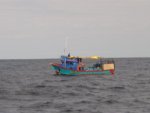
the pic?...200 miles offshore from Antofagasta, northern Chile.... sorry about the quality it was just on dusk..... no need to alter course... that was just as we came across them .... some 10 years earlier in fog inbound to Boca de Guafo passed half a mile off a stationary fishing boat on the 100 fathom line .... after 42 days without seeing a thing....apart from birds and fish....IMG_1753 (3).jpg
 
A couple of Guadeloupeans out fishing for a living and lying to their lines may not see it in quite this light....

the pic?...200 miles offshore from Antofagasta, northern Chile.... sorry about the quality it was just on dusk..... no need to alter course... that was just as we came across them .... some 10 years earlier in fog inbound to Boca de Guafo passed half a mile off a stationary fishing boat on the 100 fathom line .... after 42 days without seeing a thing....apart from birds and fish....View attachment 74360

Yes, but would you have hit either, and if yes, would they have seen you before you did?
 
In a different forum it may surprise you if you are not an aviator that light aircraft legally fly around in nil visibility at 100+ knots without radar, and, often, without the equivalent of a transponder. There has never been an accident as a consequence on the UK.

ANDp1LB.png
 
Someone worked out that you could fly around all year 24/7 with your eyes closed, without any information about other traffic and nver hit another aircraft - which is good news!

David Gunson (in "What Goes Up Might Come Down") says something along the lines of "We force all commercial traffic to fly in small areas of the sky, then we employ air traffic controller to stop them hitting each other as a result"
 
Jumbleduck - although I wasnt clear I was referring to a collision between aircraft. To be absolutely accurate some pendants argue there was possibly one once, albeit the exact circumstances are debatable. Of course the incident you refer to was CFIT (controlled flight into terrain) and there has been plenty of those at all phases of flight and for all sorts of reasons. In the case you refer to, (and I havent looked it up) it sounds very much like the pilot not following the instrument procedure for unspecified reasons which might have been as simple as a loss of situational awareness. Unlike boats, things happen and go wrong very quickly as you probably know when flying an approach at somewhere around 100 knots (typically for many light aircraft or more for larger aircraft).

and you are absolutely correct, and even for aircraft not flying airways this is also true. Many pilots will navigate using VORs (navigation beacons) or route via VRPs (visual reporting points). It seems very logical, but it creates choke points were aircraft tend to come together. It is also said to be true that when you are not in controleld airspace because you can chose what height you fly at, dont fly at 2,000 feet because (probably in consequence of pilot training) lots of pilots do. Any other height is better.

I guess sailing is the same. Is it a good idea to use certain WP or navigational features - probably not as everyone is doing the same, or at least be extra careful at these. I can think of a few channels between sand banks where everone comes together from all around because it is the only way to get through without going the long way around. One minute you are on your own, the next, the world and his wife (well almost :-)).
 
Last edited:
. . . I guess sailing is the same. Is it a good idea to use certain WP or navigational features - probably not as everyone is doing the same, or at least be extra careful at these . . . One minute you are on your own, the next, the world and his wife (well almost :-)).

We cruised the foggy coast of Maine in the days before GPS and affordable small boat radars.

Our initial strategy was to hop from bell buoy to whistle buoy to gong buoy as these could be identified at a distance and gave us reassuring way points. But everyone else had the same plan and I remember the 'safe' water mark in west Penobscot buoy on the way to Camden was like Piccadilly Circus in rush hour. Tried to find less 'obvious' waymarks after that.
 
Yes, but would you have hit either, and if yes, would they have seen you before you did?

No ...because we were keeping watches. Doubt if the one in fog would have seen us or got out of our way.... gave us a bit of a start... sailed into fog... turned on radar... 2 minute warmup... big fat echo 2 miles ahead and about a point to starboard... stationary.... doubt if anyone on her bridge... probably all hauling nets or whatever as is the norm....
 
No ...because we were keeping watches. Doubt if the one in fog would have seen us or got out of our way.... gave us a bit of a start... sailed into fog... turned on radar... 2 minute warmup... big fat echo 2 miles ahead and about a point to starboard... stationary.... doubt if anyone on her bridge... probably all hauling nets or whatever as is the norm....

It is interesting we have all sailed through areas littered with lobster pots, and all worked our way around them. For a bit of fun you can decide not to alter course at all, and it is surprising how close you may pass some, but how very rarely you ever actually hit one.

I know, I know, in the middle of the night when least expecting it etc etc .. .. ..

but the point is with neither pot nor helm looking the chances of a collision are surprisingly small.

Motor_sailor - good story and exactly my experience.
 
Jumbleduck - although I wasnt clear I was referring to a collision between aircraft.

I wonder how many GA pilots actually fly IFR alone in uncontrolled airspace? I get the impression that most prefer to stick to VFR or, if they have the rating, controlled airspace, but I never flew things with engines so my knowledge of that world is hazy. I've done a few descents through cloud in a glider, and never hit anything ... can't say it was the most relaxing experience I ever had, though.

There is some interesting discussion in one of Philip Wills' books about the negotiations which led to glider being allowed into some controlled airspace. Basically, the gliding side were able to show, statistically, that the increased risk of collision outside if they were excluded was more than the increased risk of collision inside if they were allowed in.

The sky is a big place. So is the sea, but every time I used to sail past the Cloch on the way to my Gareloch mooring the two Calmac Gourock-Dunoon ferries and the two Western Ferries ones always used to miss me by inches. That's Sod's Law.
 
Pendant mode on - since you ask and take an interest (pleased you do) dont forget lots of pilots confuse IFR with IMC. You can conform to IFR in VMC and of course in IMC - in other words in and out of cloud simply put. I think there is a quite a bit of IFR flying that takes place in GA especially in the UK. For short routes it is often much simpler to remain outside controlled airspace than be sent all around the houses. Also many small airports are outisde controlled airspace so pilots must transition through uncontrolled airspace to become IFR in controlled airspace. There is also plenty of instrument training that takes place, and these days even a PPL must do some instrument training in the syllabus.

In reality no one wants or should want to be bumping around in the clouds ideally. Sometimes it cant be helped, but at least in theory the reality is that you transition the clouds so you can be flying along in the sun shine above the clouds! Of course that isnt always possible. Many light aircraft have no way of dealing with ice, which is very dangerous, another good reason to avoid clouds. Some do. The twin I fly is fully deiced and copes with ice well, unless the icing is severe, in which event you definitely dont want to hang around in these conditions anyway.

As far as I am aware, gliders are not allowed in class A in the UK in any circumstances, whereas parachute drop planes can and do get a special clearance. Operating in class A without a transponder is a big no no for obvious reasons, as it is a known traffic enviroment only. Gliders almost never have transponders, they claim becasue of the weight, power and certification issues. They do have FLARM (sometimes) but that is of no use to ATC. Many pilots believe gliders cannot operate in or through cloud for all sorts of reasons (they think they can operate up to the base of the cloud) but this is not correct, although the glider pilot should have a cloud rating, whereas for powered aircraft the requirement is either an instrument rating or a restricted instrument rating in the UK (what use to be called and IMC rating).

I know, me to with traffic. I have had a few close encounters in both enviroments. I always look back and think if I had none nothing would they have hit me. Flying - they wouldnt, but there was one that was far too close for comfort, sailing there have been a few which would have resulted in a collision, but never in the "open" seas. Mind you, I really dont like to get too close to any ships when crossing the shiping lanes, so too close might as well be a collision! I think collisions in areas like the Solent due to the sheer density of other boats would happen often were it not for the vigilance of skippers, but as I mention, that is down to the density of the traffic, the fact it is a 2 dimensional playing field, neither of which tends to happen in aviation.

So the risks for sailors is higher but in the open ocean or outside busy boating areas I would still argue very very small.
 
Last edited:
Pendant mode on - since you ask and take an interest (pleased you do) dont forget lots of pilots confuse IFR with IMC.

I know, and I was quite careful in how I worded it!

As far as I am aware, gliders are not allowed in class A in the UK in any circumstances

From memory yes, that is correct, but I think that is because Class A is IFR only; gliders can't obey controllers's instructions and few glider pilots are IFR qualified. However, I think a suitably equipped motor glider with a suitably qualified pilot would be OK in Class A. In my day we could enter Class D without permission, but that was tightened up about the time I stopped flying. It's probably all different now that gliders and glider pilots all come under EASA.

... although the glider pilot should have a cloud rating ...

Again it may be different now, but in the pre-EASA BGA days there was no such thing. You just went up and tried it. I got as far as buying a horizon for my glider, but never fitted it, which is why I never tried to go up in clouds, just down.

I know, me to with traffic. I have had a few close encounters in both enviroments.

My best - or worst - was an RAF Tornado less than one of my wingspans (ie < 15m) away in the Cheviots.
 
Top