Rope Hernias

Babylon

Well-Known Member
Joined
7 Jan 2008
Messages
4,398
Location
Solent
Visit site
Washing running-rigging at home has resulted in the appearance of several hernias in a couple of 'ropes' - the red-flecked spinnaker halyard and the solid blue pole-uphaul.

Both are admittedly getting on a bit in age, and the gut-busts only seems to have occurred where the other sheathing was already chafed.

Time for new string...?
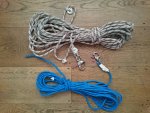
Rope Hernias.jpeg
 
Last edited:
I would replace. Mine never even get to that state. It's a cost I rather have then trying to lash down a sail flapping wildly with the boat going everywhere. But having said that I started Climbing before the Dinosaur’s walked the earth and have a morbid aversion to chafing on any line. I do keep the best of the oldies around for when you need an extra bit of line for a lashing or something like that.

Ok maybe it’s just me but I did learn from my grandpa, a fisherman, that lines need replacing before they break, not after as you end up losing gear and damaging equipment.

My mooring lines get replaced every year or as soon as there is chafing to be seen. But that’s my own opinion as I like to find my boat where I left it.
 
Last edited:
There are two schools of thought. You can go expensive with Dynema or you can go current and replace more often. As I don’t race, I tend to go with normal lines and replace when or as needed. But I would definitely go for 12 mm minimum, braid on braid for the halyard on a 27” If the mast allows, but again it’s my personal opinion and the mast fittings must allow for the diameter. Thicker is better for me. Easier on the hands.
 
Do not make the mistake of getting lines that are too thick. It just creates friction. Even quite thin lines have sufficient breaking load for a 27 ft boat so long as chaffe is prevented.
As for comfort on the hands, as soon as it gets a bit difficult put it on a winch. That is what they are for.

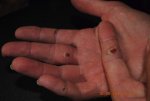
Oh & if you do not get it on the winch & it pulls then let it go ! unlike the author who decided that he could pull the cruising chute in easily:cry:
Cut hand.jpg
 
Last edited:
Just measured everything existing, which is all standard polyester braid-on-braid of different makes/vintages:

Main, stays'l and heads'l halyards 10mm
Clew-outhaul and two reefing-lines 10mm
Topping-lift and spinnaker halyard 8mm
Pole-uphaul 6mm
Sheets (main, stays'l and heads'l) 14mm

No need to go up in rope diameter for any of this, given the relatively small size of my boat and its sails, so its just a question of choosing between Marlowbraid and Liros (current range is Evo). Jimmy Green said Liros' minimum spec would be 8mm for my main halyards etc, so replacing at 10mm more than enough.

The other question is whether to have eyes spliced in for swivels? The two lines which currently need replacing as pictured above both only have bowlines under self-amalgamating tape. The advantage of repeating this arrangement (with mousing loops at each end) is that I can easily end-to-end these each season (if I go for spliced then can have the tail made a bit longer for long-term reversing and re-splicing by a rigger). I'm aware that there's more loss of strength with a bowline than a proper eye, but already up a size from minimum spec.
 
I just go with the soft-spoken and reclusive halyard knot. Mind you the optimal is sometimes subpar. I don't think I could splice a braid on braid in a fury but the halyard knot has served well and quietly so far. Mostly have to use a marlinspike to get it undone and some I just cut off. I find the bowline not ideal for a halyard. Too bulky and long with a bit hanginn off.
 
Washing running-rigging at home has resulted in the appearance of several hernias in a couple of 'ropes' - the red-flecked spinnaker halyard and the solid blue pole-uphaul.

Both are admittedly getting on a bit in age, and the gut-busts only seems to have occurred where the other sheathing was already chafed.

Time for new string...?

This is NOT because of age , it is a result of the milking motion of the machine. In fact, the risk is highest with new rope, which the manufacture will tell you. The risk varies with the machine, depending on the motion. One person's good experience with machine washing does NOT mean it is safe.

(This was brand new rope, as a part of a rope testing program in cooperation with a major manufacturer--not name dropping since they will all do this. The rope was daisy chained in this example, and herniated at about 1/2 of the loops.)
herniated+rope+low+res.jpg


If you can milk the cover open for splicing, the rope can herniate in a machine. It just depends.

How were they washed? A pillow case will generally prevent this by reducing the milking motion.

Climbing ropes are often washed in a machine, but the difference is that the cover is much tighter (nearly impossible to splice). A loose cover, easy for splicing, means this can happen.
 
Last edited:
Those rope hernias are sometimes caused by the sheath having shrunk in sunlight, resulting in it taking the tension.
If you cut the whipping off the end and pull some core out, then 'milk' the sheath to redistribute it, things will improve.
I would step back from buying new ropes until you've dealt with the chafe.
 
Those rope hernias are sometimes caused by the sheath having shrunk in sunlight, resulting in it taking the tension.
If you cut the whipping off the end and pull some core out, then 'milk' the sheath to redistribute it, things will improve.
I would step back from buying new ropes until you've dealt with the chafe.

This is a good point. If there is no damamge to the strands, there is no reason not to milk the core back in. Herniation by itself does not indicate damamge. And either take the shackles off (it's good to move the wear points anyway) or put them in socks.
 
This is NOT because of age , it is a result of the milking motion of the machine. In fact, the risk is highest with new rope, which the manufacture will tell you. The risk varies with the machine, depending on the motion. One person's good experience with machine washing does NOT mean it is safe.

(This was brand new rope, as a part of a rope testing program in cooperation with a major manufacturer--not name dropping since they will all do this. The rope was daisy chained in this example, and herniated at about 1/2 of the loops.)
herniated+rope+low+res.jpg


If you can milk the cover open for splicing, the rope can herniate in a machine. It just depends.

How were they washed? A pillow case will generally prevent this by reducing the milking motion.

Climbing ropes are often washed in a machine, but the difference is that the cover is much tighter (nearly impossible to splice). A loose cover, easy for splicing, means this can happen.
Yes, I've seen it with new ropes too.
Not just after machine washing, seen it from the action of a mainsheet going back and forth through blocks.
Pulled some core out and all was well.
 
I just go with the soft-spoken and reclusive halyard knot. Mind you the optimal is sometimes subpar. I don't think I could splice a braid on braid in a fury but the halyard knot has served well and quietly so far. Mostly have to use a marlinspike to get it undone and some I just cut off. I find the bowline not ideal for a halyard. Too bulky and long with a bit hanginn off.
I do not do any knot. I double the halyard over, pass it through te eye in the head of the mainsail then pass the free end through the loop. Then put a plastic stopper on the end of the free end to stop it pulling through. Then pull it all up tight. This means that I can get the head of the sail right to the pulley
 
This is NOT because of age , it is a result of the milking motion of the machine. In fact, the risk is highest with new rope, which the manufacture will tell you. The risk varies with the machine, depending on the motion. One person's good experience with machine washing does NOT mean it is safe.

(This was brand new rope, as a part of a rope testing program in cooperation with a major manufacturer--not name dropping since they will all do this. The rope was daisy chained in this example, and herniated at about 1/2 of the loops.)
herniated+rope+low+res.jpg


If you can milk the cover open for splicing, the rope can herniate in a machine. It just depends.

How were they washed? A pillow case will generally prevent this by reducing the milking motion.

Climbing ropes are often washed in a machine, but the difference is that the cover is much tighter (nearly impossible to splice). A loose cover, easy for splicing, means this can happen.

Last year I had a similar experience to that outlined by Thinwater. After many years of annually cleaning ropes in a washing machine (I used to wash them loose), I had a 3 month old one behave in this way. In my case the hernias didn't actually escape the outer and were like a snake that's swallowed a larger animal at about a dozen places along its length.

Jimmy Green sent it back to Liros but they never replied so JG kindly replaced it for me.
 
I've done studies, in cooperation with rope manufacturers, regarding washing rope. They tested the post-wash samples and they were always materially weaker. I guess I just don't see the point. They don't get dirty unless I leave them in a pile in the shade, and if that is the problem, the tails are easily washed in a bucket without unreeving them.

If you have squeeky ropes, treating them with wash-in water repellent (like Nixwax) is a permanent fix.

The only ropes I was are for ice climbing, because the water repellent treatment needs renewing after a few years. Also desert climbing (lots of grit). But not sailing lines. I will water-proof treat the furler lines for winter sailing.
 
Top