
Roller trailer launching/loading issues

Thank gus, that's a great idea, and something I should be able to do with the existing trailer!

Cheers,
Andy

Another couple of mods - the roller being plastic was prone to having the keel sliding on it rather than rotating the roller, so to the centre part of the roller I added a binding laver of rope to increase the diam and also then rubber bands cut from an inner tube to increase the grip. It now rolls a treat as it should. As for shallow slipways where the boat is lothe to roll off, I fixed up a small winch with a turning block at the rear which pulls the boat off the trailer very easily. I also have a wide plank secured on the trailer so I can walk down the trailer and keep my feet dry.
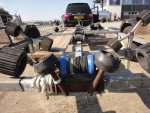
 
Another couple of mods - the roller being plastic was prone to having the keel sliding on it rather than rotating the roller, so to the centre part of the roller I added a binding laver of rope to increase the diam and also then rubber bands cut from an inner tube to increase the grip. It now rolls a treat as it should. As for shallow slipways where the boat is lothe to roll off, I fixed up a small winch with a turning block at the rear which pulls the boat off the trailer very easily. I also have a wide plank secured on the trailer so I can walk down the trailer and keep my feet dry.

Some more great ideas! Thanks Gus!
 
Interesting thread.

The big difference between the excellent notes provided by gus, and the issues raised by AP3 in his/her original post is the trailer type.

Gus has a full skeletal trailer, which allows for additional rollers, adjusted for height and rake in exactly the positions required.
AP3 only has, in effect, a single bar with an axle; a T trailer, if you will. These are lightly built and have little flexibility in terms of potential adjustment BUT loads of flexibility in terms of load resistance.

Where a T trailer had a significant overhang, with a loading beyond the last roller/point of support (in this case an outboard) the forces exerted on the frame behind the axle may well exceed the design limits. Add in the paraphernalia that your boat will doubtless collect, a full tank of fuel and water collected in the bilges your downforce behind the axle, at speed, going over a pot-hole or two and that bend is only going to get worse.

Other posters have suggested upgrading the axle-mounted rollers. This will reduce the loading behind the axle, if large enough and set correctly. Like wise the clever idea of lashing a board to ease access on the slipway. Can't do that with a T trailer. Be carful about doing too many "improvements" as you may discover that you have breached the manufacturers type approval. Then, if you are involved in an incident you will be driving an uninsured rig.

I'm sorry, but I have to agree with the posters who recommend replacement. If your all-up weight can be kept below 750 kgs then by all means go for un-braked, especially if you are dunking in salt water. https://www.degraafftrailers.co.uk/centre-keel-roller-boat-trailers.
 
I think you may be right Pump-Out. My pocket is starting to hurt already....

Cheers,
Andy

Interesting thread.

The big difference between the excellent notes provided by gus, and the issues raised by AP3 in his/her original post is the trailer type.

Gus has a full skeletal trailer, which allows for additional rollers, adjusted for height and rake in exactly the positions required.
AP3 only has, in effect, a single bar with an axle; a T trailer, if you will. These are lightly built and have little flexibility in terms of potential adjustment BUT loads of flexibility in terms of load resistance.

Where a T trailer had a significant overhang, with a loading beyond the last roller/point of support (in this case an outboard) the forces exerted on the frame behind the axle may well exceed the design limits. Add in the paraphernalia that your boat will doubtless collect, a full tank of fuel and water collected in the bilges your downforce behind the axle, at speed, going over a pot-hole or two and that bend is only going to get worse.

Other posters have suggested upgrading the axle-mounted rollers. This will reduce the loading behind the axle, if large enough and set correctly. Like wise the clever idea of lashing a board to ease access on the slipway. Can't do that with a T trailer. Be carful about doing too many "improvements" as you may discover that you have breached the manufacturers type approval. Then, if you are involved in an incident you will be driving an uninsured rig.

I'm sorry, but I have to agree with the posters who recommend replacement. If your all-up weight can be kept below 750 kgs then by all means go for un-braked, especially if you are dunking in salt water. https://www.degraafftrailers.co.uk/centre-keel-roller-boat-trailers.
 
Top