
Neeves
Well-Known Member
I did some very simple tests on galvanised chain.
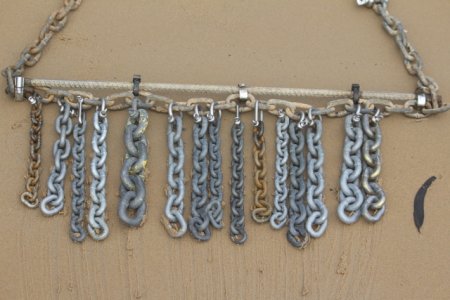
I took a few links of the chains I have and attached to a steel rod. I then suspended the rod between the two transoms of our cat such that the rod would be on the seabed at high or low tide and the movement of the cat (swing mooring) would ensure that the lengths of chain would sweep across the seabed. I monitored weekly, washed the chains in fresh water, air dried them and weighted each piece of chain, to determine wear. I repeated the test a number of times altering the position of the chains on the rod. When we used the cat I simply lifted the rod (with chains) and laid the rod on the trampoline. You can see the wear of the gal, specifically the bottom link on the left hand chain and most of the right hand chain. The fifth from left hand end I'd painted with domestic water based yellow paint for another test. The 6th from the right, 6mm, was an ungalvanised sample - it has a thin and complete layer of rust.
This is a close up of one of the chains. The gal is grey/black, the raw abraded chain is silver, with speckled rust. The wear is not in the crowns but there is no tension in the samples. The wear is in the 'long' of the links abrading on the silica sand seabed.
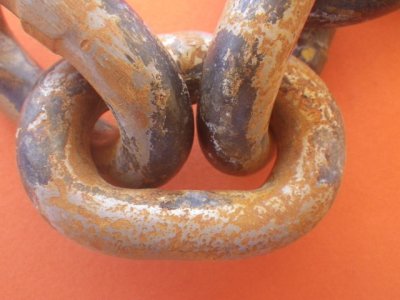
Both images are after about 4 weeks.
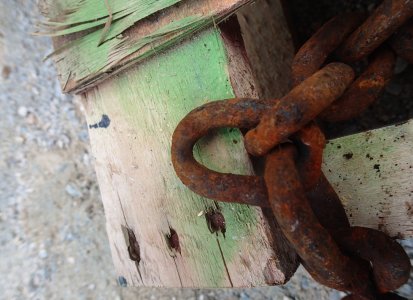
The test seemed to simply accelerate the process of chain abrasion in real life - but it is extraordinary how quickly the gal has been worn. Its also extraordinary how quickly the chain has corroded the brown colouration - underling - wear is both abrasion of the gal and eventually the steel but corrosion is evident as soon as the gal is lost. The idea that galvanising protects areas where a product is damaged - not evident with second image
I cannot measure the gal thickness on curved surfaces and the gal thicknesses will vary. These are all samples of chain from chandlers or chain makers - randomly galvanised - and chain galvanising can vary from 60 to 80 microns. 'Quality' of galvanising, how long the chain is in the zinc kettle will also vary. For my TDG coating I 'produce' a flat surface by slitting the links and then measuring the flat of a number of samples through a batch.
It might be behind a paywall but the testing of gal quality was reported in Practical Sailor
Armorgalv vs. Hot-Dipped - Practical Sailor
Jonathan
I took a few links of the chains I have and attached to a steel rod. I then suspended the rod between the two transoms of our cat such that the rod would be on the seabed at high or low tide and the movement of the cat (swing mooring) would ensure that the lengths of chain would sweep across the seabed. I monitored weekly, washed the chains in fresh water, air dried them and weighted each piece of chain, to determine wear. I repeated the test a number of times altering the position of the chains on the rod. When we used the cat I simply lifted the rod (with chains) and laid the rod on the trampoline. You can see the wear of the gal, specifically the bottom link on the left hand chain and most of the right hand chain. The fifth from left hand end I'd painted with domestic water based yellow paint for another test. The 6th from the right, 6mm, was an ungalvanised sample - it has a thin and complete layer of rust.
This is a close up of one of the chains. The gal is grey/black, the raw abraded chain is silver, with speckled rust. The wear is not in the crowns but there is no tension in the samples. The wear is in the 'long' of the links abrading on the silica sand seabed.
Both images are after about 4 weeks.
The test seemed to simply accelerate the process of chain abrasion in real life - but it is extraordinary how quickly the gal has been worn. Its also extraordinary how quickly the chain has corroded the brown colouration - underling - wear is both abrasion of the gal and eventually the steel but corrosion is evident as soon as the gal is lost. The idea that galvanising protects areas where a product is damaged - not evident with second image
I cannot measure the gal thickness on curved surfaces and the gal thicknesses will vary. These are all samples of chain from chandlers or chain makers - randomly galvanised - and chain galvanising can vary from 60 to 80 microns. 'Quality' of galvanising, how long the chain is in the zinc kettle will also vary. For my TDG coating I 'produce' a flat surface by slitting the links and then measuring the flat of a number of samples through a batch.
It might be behind a paywall but the testing of gal quality was reported in Practical Sailor
Armorgalv vs. Hot-Dipped - Practical Sailor
Jonathan
Last edited:



 .
.

