Rocna Vulcan 15kg vs Spade S80?

Status
Not open for further replies.

narcer

Well-Known Member
Joined
25 Feb 2005
Messages
171
Location
Mallorca
Visit site
Hi,
Due to upgrade my anchor v soon and after watching many videos of Steve Goodwin (s.v Panope) the favorite is looking like the Spade S80 for reliability and holding. However just wondered if anyone on here has had any direct experience with the Rocna Vulcan 15kg? Looks very similar to the Spade in design with maybe a better quality galvanizing job which will last longer? Steve has tested the Vulcan 20kg but I cannot find the test for the 15kg Vulcan and it seems as though the performance of the same type of anchor varies massively depending on the weight?
 
We have a 25kg Vulcan (named Spock, naturally). Excellent performance. We chose it over the Spade because of poor galvanising evident on the Spade anchors on boats in our marina. No regrets.
 
So the main reason you see a lot of experienced sailors use a Spade is it’s ability to reset very well. It’s when you get a severe wind shift that you want your anchor to hold. In straight forward gale / storm conditions many anchors will hold when set well to begin with and with good scope.

Spade performs well / for two reasons. 1. It’s got a load of lead in the tip. 2. It doesn’t have a roll bar which can trap mud, kelp or weed and prevent a rapid reset.

A Vulcan won’t suffer from no.2 like the traditional Rocna anchors do but it doesn’t have no.1.

There’s a good reason you’ll see a Spade on a Boreal.
 
A personal opinion - I don't think the general public of boat owners all have a fettish for anchors (they do not know what they are missing :) )

People buy anchors for a whole variety of reasons.

Go to the eastern Med and you will see lots of Bugels, primarily on German yachts. French yachts favour Spade. American yachts carry Fortress as a primary anchor (and you very seldom see other nationalities with Fortress evident). In France you see lots of Brittany anchors on bow rollers. If you visit a marina with a chandler stocking Rocna - you see lots of Rocna on the bow roller. I don't see many Spades in Australia but I do in Tahiti.

Draw you own conclusions as to how people choose their anchors - but it involves does the anchor fit, how much does it cost, is it available and what does my neighbour use (and say). No-one admits to buying a lemon.

There are few independent tests on Vulcan and as mentioned the Panope tests totally contradict market view of Rocna and any results are thus very questionable. But don't question the work - he has engendered much support and you will be hammered.

Peter Smith is no fool and Rocna was his interpretation, then, of another way to take the advantages of Spade and convert the concepts to an anchor easier to make. Once he was sure he was not infringing any patents he went a bit further and produced the Vulcan. He has added little to design of the Spade but has made it cheaper to make (or more profitable to sell). His major alteration to the Spade concept - in both the Rocna and Vulcan was to replace the lead with steel. Both Rocna and Vulcan, like Spade, are ballasted anchors. People do not complain at the replacement of lead with steel in Rocna, I see no reason why you would notice steel in the Vulcan.

If you need to re-galvanise your anchor - you do need to remove any lead. Its not difficult - but is a step unnecessary for anchors using steel as the ballast.

Spade did have a poor reputation for galvanising but then many Spade anchors were used by owners who used their yachts more frequently than many owners. Their anchors, Spade, saw much use and would thus lose their galvanising more quickly.

I have not tested a Vulcan - but the limited feed back suggest you will not tell the difference between a Vulcan, Spade, Excel, Rocna, Knox, Viking in terms of hold (of anchors of the same weight). Concave anchors tend to carry mud, so you need a good deck wash. Roll bar anchors, all of which are concave, seem to be much more prone to carrying mud than non roll bar anchors. If you anchor predominately in mud - I'd steer clear of roll bar anchors. Clogging of the fluke does mean that if the anchor is upset due to a change of tide or wind - it may have difficulty in re-setting (though owners of Rocna never admit to this (so it may be overstated OR people never admit to buying lemons)

Questions to ask your self. Does the anchor fit. How much does it cost (though over years the cost difference pales into insignificance). Can I buy it easily.

Forget tests that show anchors of different weights but of the same design perform differently. At the sizes we buy 10kg to 40kg - they will all perform similarly. Very small anchors 5kg and less may perform differently but a 15kg anchor will perform in the same way (but with lower ultimate hold) compared to a 20kg anchor. As Fortress clearly demonstrates an aluminium anchor performs similarly to a steel anchor of a similar design (genuine Danforth). We use an aluminium Spade and and aluminium Excel and cannot tell the difference in performance compared to their steel equivalents (same size) and we own both steel and aluminium versions.

I think that Vulcan, Spade and Excel clearly demonstrate that a roll bar is unnecessary. If you are looking to save money - Kobra (another - no roll bar) is a good choice.

If weight is an issue then the Excel and Spade come in an aluminium version (as mentioned - this is what we use) and if you want a lightweight steel anchor then Viking (roll bar) offers you a choice.

Steer clear of Mantus its a flawed design - but it does show the lemming effect, shows the power of the internet - but don't be critical - you will be hammered :)

I think you would be very happy, depending on your seabed, in choosing Rocna, Supreme, Knox, Excel, Spade, Vulcan, Viking, Ultra. Of the same weight they will offer you similar hold in a similar seabed, Viking can be lighter for the same hold.

With a clean slate I would invest my funds in a non roll bar anchor (because the roll bar is not essential) which limits choice to Spade, Vulcan, Excel and Kobra.

It merits note that Spade is used by the RNLI on their Shannon class boats (they carry 2) and both Spade and Excel are classified as Super High Holding Power anchors.

Take care, stay safe

Jonathan
 
I have owned my Rocna 15 kg for well over 10 years, bought before there was a UK importer. In use 6 months of most years is has had a lot of use in a wide variety of seabeds. Once set properly, ignoring failures in weed, tin cans and bundles of fishing net, it has never dragged. I have posted photos showing clear evidence that it has turned in big windshifts with absolutely no problem.
 
A personal opinion - I don't think the general public of boat owners all have a fettish for anchors (they do not know what they are missing :) )

People buy anchors for a whole variety of reasons.

Go to the eastern Med and you will see lots of Bugels, primarily on German yachts. French yachts favour Spade. American yachts carry Fortress as a primary anchor (and you very seldom see other nationalities with Fortress evident). In France you see lots of Brittany anchors on bow rollers. If you visit a marina with a chandler stocking Rocna - you see lots of Rocna on the bow roller. I don't see many Spades in Australia but I do in Tahiti.

Draw you own conclusions as to how people choose their anchors - but it involves does the anchor fit, how much does it cost, is it available and what does my neighbour use (and say). No-one admits to buying a lemon.

There are few independent tests on Vulcan and as mentioned the Panope tests totally contradict market view of Rocna and any results are thus very questionable. But don't question the work - he has engendered much support and you will be hammered.

Peter Smith is no fool and Rocna was his interpretation, then, of another way to take the advantages of Spade and convert the concepts to an anchor easier to make. Once he was sure he was not infringing any patents he went a bit further and produced the Vulcan. He has added little to design of the Spade but has made it cheaper to make (or more profitable to sell). His major alteration to the Spade concept - in both the Rocna and Vulcan was to replace the lead with steel. Both Rocna and Vulcan, like Spade, are ballasted anchors. People do not complain at the replacement of lead with steel in Rocna, I see no reason why you would notice steel in the Vulcan.

If you need to re-galvanise your anchor - you do need to remove any lead. Its not difficult - but is a step unnecessary for anchors using steel as the ballast.

Spade did have a poor reputation for galvanising but then many Spade anchors were used by owners who used their yachts more frequently than many owners. Their anchors, Spade, saw much use and would thus lose their galvanising more quickly.

I have not tested a Vulcan - but the limited feed back suggest you will not tell the difference between a Vulcan, Spade, Excel, Rocna, Knox, Viking in terms of hold (of anchors of the same weight). Concave anchors tend to carry mud, so you need a good deck wash. Roll bar anchors, all of which are concave, seem to be much more prone to carrying mud than non roll bar anchors. If you anchor predominately in mud - I'd steer clear of roll bar anchors. Clogging of the fluke does mean that if the anchor is upset due to a change of tide or wind - it may have difficulty in re-setting (though owners of Rocna never admit to this (so it may be overstated OR people never admit to buying lemons)

Questions to ask your self. Does the anchor fit. How much does it cost (though over years the cost difference pales into insignificance). Can I buy it easily.

Forget tests that show anchors of different weights but of the same design perform differently. At the sizes we buy 10kg to 40kg - they will all perform similarly. Very small anchors 5kg and less may perform differently but a 15kg anchor will perform in the same way (but with lower ultimate hold) compared to a 20kg anchor. As Fortress clearly demonstrates an aluminium anchor performs similarly to a steel anchor of a similar design (genuine Danforth). We use an aluminium Spade and and aluminium Excel and cannot tell the difference in performance compared to their steel equivalents (same size) and we own both steel and aluminium versions.

I think that Vulcan, Spade and Excel clearly demonstrate that a roll bar is unnecessary. If you are looking to save money - Kobra (another - no roll bar) is a good choice.

If weight is an issue then the Excel and Spade come in an aluminium version (as mentioned - this is what we use) and if you want a lightweight steel anchor then Viking (roll bar) offers you a choice.

Steer clear of Mantus its a flawed design - but it does show the lemming effect, shows the power of the internet - but don't be critical - you will be hammered :)

I think you would be very happy, depending on your seabed, in choosing Rocna, Supreme, Knox, Excel, Spade, Vulcan, Viking, Ultra. Of the same weight they will offer you similar hold in a similar seabed, Viking can be lighter for the same hold.

With a clean slate I would invest my funds in a non roll bar anchor (because the roll bar is not essential) which limits choice to Spade, Vulcan, Excel and Kobra.

It merits note that Spade is used by the RNLI on their Shannon class boats (they carry 2) and both Spade and Excel are classified as Super High Holding Power anchors.

Take care, stay safe

Jonathan
Hi Jonathan,

Panope has the Vulcan as best overall performer on his results table at present.

Which Mantus is flawed? M1 or M2 or both?
 
Hi Jonathan,

Panope has the Vulcan as best overall performer on his results table at present.

Which Mantus is flawed? M1 or M2 or both?

The M1 is flawed. It is a marvellous example of ignorance and hype over substance. All credit to its success - excellent marketing

I've never seen the M2 - cannot comment.

I lost faith in his work some time ago (even if he has invested much effort) so I'm not upto date with his results. As mentioned by others - Rocna seemed to be the most popular modern anchor but Panope did not rate it. He surely was not serious in placing CQR ahead of Rocna - these seemed a contradictions he did not or was unwilling to address. I'm also concerned he completely ignores decades of anchor testing and does not test for holding capacity (but maybe he has included hold in his recent tests). To me hold is the basis from which you build a good anchor - as without hold - your yacht will float away. He has developed a reputation which demands (to me) the need to explain anomalies.

Ask any Rocna owner would they go back to a CQR - they would roll around the pontoon in hysterics. CQR is a fine anchor - but performance has improved. Or read post 8 above.

Jonathan
 
Last edited:
Plus one for Rocna. We have never dragged on it (5 seasons West Coast of Scotland). We have had issues setting it kelp a few times but once it is set it is definitely set.
 
A personal opinion - I don't think the general public of boat owners all have a fettish for anchors (they do not know what they are missing :) )

People buy anchors for a whole variety of reasons.

Go to the eastern Med and you will see lots of Bugels, primarily on German yachts. French yachts favour Spade. American yachts carry Fortress as a primary anchor (and you very seldom see other nationalities with Fortress evident). In France you see lots of Brittany anchors on bow rollers. If you visit a marina with a chandler stocking Rocna - you see lots of Rocna on the bow roller. I don't see many Spades in Australia but I do in Tahiti.

Draw you own conclusions as to how people choose their anchors - but it involves does the anchor fit, how much does it cost, is it available and what does my neighbour use (and say). No-one admits to buying a lemon.

There are few independent tests on Vulcan and as mentioned the Panope tests totally contradict market view of Rocna and any results are thus very questionable. But don't question the work - he has engendered much support and you will be hammered.

Peter Smith is no fool and Rocna was his interpretation, then, of another way to take the advantages of Spade and convert the concepts to an anchor easier to make. Once he was sure he was not infringing any patents he went a bit further and produced the Vulcan. He has added little to design of the Spade but has made it cheaper to make (or more profitable to sell). His major alteration to the Spade concept - in both the Rocna and Vulcan was to replace the lead with steel. Both Rocna and Vulcan, like Spade, are ballasted anchors. People do not complain at the replacement of lead with steel in Rocna, I see no reason why you would notice steel in the Vulcan.

If you need to re-galvanise your anchor - you do need to remove any lead. Its not difficult - but is a step unnecessary for anchors using steel as the ballast.

Spade did have a poor reputation for galvanising but then many Spade anchors were used by owners who used their yachts more frequently than many owners. Their anchors, Spade, saw much use and would thus lose their galvanising more quickly.

I have not tested a Vulcan - but the limited feed back suggest you will not tell the difference between a Vulcan, Spade, Excel, Rocna, Knox, Viking in terms of hold (of anchors of the same weight). Concave anchors tend to carry mud, so you need a good deck wash. Roll bar anchors, all of which are concave, seem to be much more prone to carrying mud than non roll bar anchors. If you anchor predominately in mud - I'd steer clear of roll bar anchors. Clogging of the fluke does mean that if the anchor is upset due to a change of tide or wind - it may have difficulty in re-setting (though owners of Rocna never admit to this (so it may be overstated OR people never admit to buying lemons)

Questions to ask your self. Does the anchor fit. How much does it cost (though over years the cost difference pales into insignificance). Can I buy it easily.

Forget tests that show anchors of different weights but of the same design perform differently. At the sizes we buy 10kg to 40kg - they will all perform similarly. Very small anchors 5kg and less may perform differently but a 15kg anchor will perform in the same way (but with lower ultimate hold) compared to a 20kg anchor. As Fortress clearly demonstrates an aluminium anchor performs similarly to a steel anchor of a similar design (genuine Danforth). We use an aluminium Spade and and aluminium Excel and cannot tell the difference in performance compared to their steel equivalents (same size) and we own both steel and aluminium versions.

I think that Vulcan, Spade and Excel clearly demonstrate that a roll bar is unnecessary. If you are looking to save money - Kobra (another - no roll bar) is a good choice.

If weight is an issue then the Excel and Spade come in an aluminium version (as mentioned - this is what we use) and if you want a lightweight steel anchor then Viking (roll bar) offers you a choice.

Steer clear of Mantus its a flawed design - but it does show the lemming effect, shows the power of the internet - but don't be critical - you will be hammered :)

I think you would be very happy, depending on your seabed, in choosing Rocna, Supreme, Knox, Excel, Spade, Vulcan, Viking, Ultra. Of the same weight they will offer you similar hold in a similar seabed, Viking can be lighter for the same hold.

With a clean slate I would invest my funds in a non roll bar anchor (because the roll bar is not essential) which limits choice to Spade, Vulcan, Excel and Kobra.

It merits note that Spade is used by the RNLI on their Shannon class boats (they carry 2) and both Spade and Excel are classified as Super High Holding Power anchors.

Take care, stay safe

Jonathan

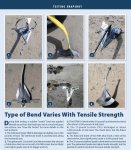
The RNLI currently use a traditional admiralty pattern fishermans and Lewmar Deltas. They only use anchors with a Lloyds approval and none of the most popular spades can pass the bend or break tests at present. The original CQR, the worlds most badly copies, (Thin electro plating, cheap steel and no lead inside the nose to help it reset), is now back in production for Lewmar and along with the Lewmar claw, a copy of a Bruce is one awesome anchor in storm. I only know of one genuine made in Scotland patented and Lloyds approved CQR that got bent, although it was crushed under the keel of a steel trawler. For more info see the pictures and test reports of just how easy it is to bend most modern anchors on Facebook. Don't miss the new test results for a 180 degree veer, as the spades did not reset.
(1) Anchoring and anchorages | Facebook

Rocna Resetting Failures and evaluation of Vulcan and Mantus (morganscloud.com)
 

Attachments

  • 291565271_10216853048678249_3281856483211812896_n.jpg
    291565271_10216853048678249_3281856483211812896_n.jpg
    120.6 KB · Views: 38
The RNLI currently use a traditional admiralty pattern fishermans and Lewmar Deltas. They only use anchors with a Lloyds approval and none of the most popular spades can pass the bend or break tests at present. The original CQR, the worlds most badly copies, (Thin electro plating, cheap steel and no lead inside the nose to help it reset), is now back in production for Lewmar and along with the Lewmar claw, a copy of a Bruce is one awesome anchor in storm. I only know of one genuine made in Scotland patented and Lloyds approved CQR that got bent, although it was crushed under the keel of a steel trawler. For more info see the pictures and test reports of just how easy it is to bend most modern anchors on Facebook. Don't miss the new test results for a 180 degree veer, as the spades did not reset.
(1) Anchoring and anchorages | Facebook

Rocna Resetting Failures and evaluation of Vulcan and Mantus (morganscloud.com)

I think you are completely out of date.

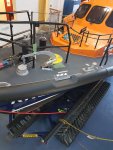
This is a Spade on the current Shannon Class RNLI lifeboat. They carry 2 Spade anchors, the second is in a locker. The picture is courtesy of Barmouth RNLI

The Epsilon is Lloyds approved for SHHP as is Manson's Supreme and Rocna was approved by RINA. Anchor Right's Excel is classified as SHHP and if Spade is on the Shannon Class boats then it is also approved. Fortress and Ultra are also both rated SHHP, both by ABS. The only one missing from the list would be Vulcan (and Rocna's certification may not have been renewed - its an expensive exercise.

IMG-20220607-WA0008.jpeg


The attachment you provide is abstracted from Practical Sailor and is an article I wrote, all the pictures are mine. It would be considerably more honest if you linked to the article instead of posting misleading images.

Anchor Tests: Bending More Shanks - Practical Sailor

The article had some benefits.

The Super SARCA was re-engineered with BIS 80 shank

The aluminium Anchor Right was completely re-engineered with a more beefy HT alloy shank

Fortress replaced the shank of their anchor, free of charge, with their no questions asked warranty.

The anchor that survived completely undamaged was the Anchor Right steel Excel with the BIS 80 shank.

Jonathan
 
Last edited:
I think you are completely out of date.

This is a Spade on the current Shannon Class RNLI lifeboat. They carry 2 Spade anchors, the second is in a locker. The picture is courtesy of Barmouth RNLI

The Epsilon is Lloyds approved for SHHP as is Manson's Supreme and Rocna was approved by RINA. Anchor Right's Excel is classified as SHHP and if Spade is on the Shannon Class boats then it is also approved. Fortress and Ultra are also both rated SHHP, both by ABS. The only one missing from the list would be Vulcan (and Rocna's certification may not have been renewed - its an expensive exercise.

View attachment 137957


The attachment you provide is abstracted from Practical Sailor and is an article I wrote, all the pictures are mine. It would be considerably more honest if you linked to the article instead of posting misleading images.

Anchor Tests: Bending More Shanks - Practical Sailor

The article had some benefits.

The Super SARCA was re-engineered with BIS 80 shank

The aluminium Anchor Right was completely re-engineered with a more beefy HT alloy shank

Fortress replaced the shank of their anchor, free of charge, with their no questions asked warranty.

The anchor that survived completely undamaged was the Anchor Right steel Excel with the BIS 80 shank.

Jonathan

Yes that's a UK manufactured spade, I hope folks will not think it is a Rocna, Excel or any other spade. I only posted the one link as pictures are far more effective than words. Link of the day:
Spade Anchor UK - UK & Ireland Website - Official Spade Anchor Distributor - Dealer (spade-anchor.co.uk)
The reason I thought the RNLI were using a Lewmar was that their basic training manual has a picture of one on page 47. Umm, second link:
maritime-sar-2017 (1).pdf

I did think about buying one but could not find a good used one, so I'm going to stick with the 2 genuine CQR's, (35lb storm and 15lb working), steel Danforth and a folding grapnel for the time being, although I do dream of a stainless Bruce claw anchor for Christmas.

PS: The small 22 lb Excel bent, but the bigger one did not, but I don't think the yellow UK Spades bend.

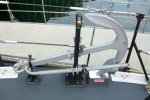
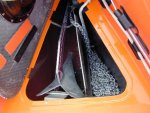
Finally the picture below on the right is of a Lewmar Delta in the bow of an Ataltic 85 RIB. I thought they were using it for their offshore boats, but was wrong. The Delta is not as good as the genuine CQR, BUT the RNLI don't use second hand anchors and the CQR was out of production for quite some time, apart from all the bad copies.
 

Attachments

  • RNLI fishermans.jpg
    RNLI fishermans.jpg
    9.8 KB · Views: 11
  • Atlantic 85 - Anchor Stowage (open).jpg
    Atlantic 85 - Anchor Stowage (open).jpg
    29.7 KB · Views: 12
Last edited:
I’ll bow to Jonathan’s knowledge on all things anchor, but I do need to comment on the incorrect facts that TNLI has written - not least that it is a “Spade” with capital S as that is a specific make, they are not Uk manufactured and the Uk distributor is in Jersey
 
I’ll bow to Jonathan’s knowledge on all things anchor, but I do need to comment on the incorrect facts that TNLI has written - not least that it is a “Spade” with capital S as that is a specific make, they are not Uk manufactured and the Uk distributor is in Jersey

I think Spade are exclusively made in Tunisia. I find the idea something of a joke that a French designed anchor, managed by a French business would have any made in the UK. It was a significant slap in the face for Lewmar and a major coup that Spade had the Shannon boats equipped with Spades. I have nothing against Lewmar - but they took their eye off the ball - and those Spade anchors are prominent on the foredeck an d will be there for years.

He states few or no modern anchors are Classification Society approved - most are approved (or have been approved)

He offers 6 photos of bent anchors without bothering to find out how and why they were bent.

Last I heard genuine Bruce anchors have not been made for years by Bruce - if you buy a new one - its a copy

Lewmar transferred production of CQRs (and Deltas, designed by Simpson Lawrence and their Bruce copy) to China. The Chinese CQR copy only have a passing resemblance to the original. Their Epsilon (Lloyds approved as SHHP) also made in China

He spruiks Danforth - I wonder if he actually has a genuine model.

Jonathan
 
I’ll bow to Jonathan’s knowledge on all things anchor, but I do need to comment on the incorrect facts that TNLI has written - not least that it is a “Spade” with capital S as that is a specific make, they are not Uk manufactured and the Uk distributor is in Jersey

Stewth cobber, you really do get some nit pickers in some threads, OK I should have used a small s, not a big one, but I did think Jersey was in the UK. One demerit to myself for not checking where it is made. Tunisia is a village near Sheffield:
Quote from the Spade UK web site for those interested in where something is made:

Alain was a retired engineer and was turned away by anchor manufacturers when he tried to sell his patents to fund his cruising life, so he set up a factory in Tunisia himself and his anchor is now famous the world over. He became the “Dyson” of the anchor world.
 
I think Spade are exclusively made in Tunisia. I find the idea something of a joke that a French designed anchor, managed by a French business would have any made in the UK.

He states few or no modern anchors are Classification Society approved - most are approved (or have been approved)

He offers 6 photos of bent anchors without bothering to find out how and why they were bent.

Last I heard genuine Bruce anchors have not been made for years by Bruce - if you buy a new one - its a copy

Lewmar transferred production of CQRs (and Deltas, designed by Simpson Lawrence and their Bruce copy) to China. The Chinese CQR copy only have a passing resemblance to the original. Their Epsilon (Lloyds approved as SHHP) also made in China

He spruiks Danforth - I wonder if he actually has a genuine model.

Jonathan

So which anchor apart from the UK spade, (Hope I'm right about the small s), Lewmar CQR or their Bruce copy has a direct, not an equivalent Lloyds approval for offshore use.
 
Status
Not open for further replies.
Top