Robert Tucker Caleo II

miracze

New Member
Joined
26 Dec 2021
Messages
13
Visit site
Hi,

does any one have any experience with Caleo II motor sailor (CALEO II )? I love the layout, but I'm concerned if she would move without engine. I don't realy care about speed (looking for liveaboard cruiser idealy with deck saloon), but I don't want to spend fortune on diesel.
Any other advices are welcome.
 
Welcome to the forum

Slightly odd request - it is specifically a motor sailor so needs a big engine. will probably sail OK off the wind in a good breeze, but 700 sqft sail for 12 tons is not a lot so if you want to make decent passages, particularly in windy and tidal waters such as in Northern Europe expect to do a lot of motoring. Better on long ocean passages, particularly with the addition of extra offwind sales. Good liveaboard if you don't intend much sailing!
 
Hi,

does any one have any experience with Caleo II motor sailor (CALEO II )? I love the layout, but I'm concerned if she would move without engine. I don't realy care about speed (looking for liveaboard cruiser idealy with deck saloon), but I don't want to spend fortune on diesel.
Any other advices are welcome.
Are you looking at one, or thinking of building?

By the way, welcome to the forum
 
I have a small motor sailer which sails moderately well. Mine wont go that well to windward, but gentlemen dont beat to windward. However mine has 37sqm for nominal 5 tons which would make 90 sq m scaled up to 12 tones, so Calleo at 65 sq m is meagrely canvased even for a motor sailer.

So Caleo would be fine for slow downwind passages but not very sprightly, and this might suit liveaboard needs. However the hope to save money on fuel by sailing is defeated by the truth about sailing - it will cost a lot unless you are happy to be a live-aboard on a decaying wreck moored somewhere inaccessible.

A second hand one would probably have worn out sails so sail even less well than new, and I guess new sails would be of the order of £5000 to £7000 at a guess.

Dont let me put you off and could be a good floating home giving some freedom of location, but you need a steady income somehow
 
Thanks for welcomes and answers.
I plan to maintain steady income. The whole idea is, that I'm software engineer in small company, we're used to work remote since begining and because of COVID I haven't seen living customer for about 2 years now. So I plan to work from boat, spending few days / weeks in one location and then move to another (for first year or so with whole-year marina berth rental, so I could freely fly to home country if something went wrong in the work). So I have strict requirements for space and layout so I can manage decent homeoffice and I don't care much about speed (also I can wait for good weather to move on).
I'm thinking about buying this one: 1994 Steel Ketch 39 “Blue Vigil” -
Other boats I've been looking on are SeaStream 34 or Nauticats 38. But used Nauticats I found cost significantly more and SeaStreams has little bit worse layout.
 
That looks a well put together and equipped boat and will do what you want it to do. Be aware though that steel boats can be hard work to keep up and do not like being neglected - I expect this boat is "cheap" compared to similar size and equipped boats for that reason. A Seastream is far too small and cramped and Nauticats are expensive because they are simply better and more desirable boats - although of course when they get to this age, condition is all.

What you plan doing in terms of work and moving about in the Med is certainly possible IF you are an EU citizen, but less possible if you are non EU because of travel restrictions. However it is becoming increasingly difficult and expensive compared with the past and many have found that not only is on line working from a boat in hot climates difficult, but desirable places to moor up are becoming more difficult to find and marina berths more expensive. Do lots of research and talk to people before making such a big step as buying a boat like this is a big commitment and once you have it very difficult to sell and get out!
 
Welcome to the forum.

The boat has a sail area/displacement ratio of 13.46 which is a bit better than the Fishers and comparable to the Nauticat 33 with the taller rig.
I think she would sail well enough for her type and even be somewhat weatherly with a draft of just over 5" and within context of the ketch rig. She is fairly beamy which should translate to a stiff boat and her generous displacement will provide a softer ride at sea and a suitable base for a full time liveaboard.

I regards to steel boats. I have some experience with these, both in terms of surveying, sailing, repair/restoration and maintenance. With proper construction and a good paint system the ongoing maintenance is no worse than GRP and steel construction has been around a lot longer than plastic, is well understood and can be easily repaired and modified.
It should be noted that steel boats rarely rust trough from the outside, but rather from inside, where it is much more difficult to assess the condition of the steel structure. Stay away from anything with exterior wood over mild steel, including rail caps, rub rails, etc, but, above all, teak over steel decks.
For living aboard, especially in colder climes/weather, the hull must be insulated to avoid excessive condensation.

Best of Luck.
 
Hi,

thanks for answers, much appreciated. I've ended up taking trip to look on the boat. It looks in much worse condition, then on the brokers photos. There is severe rust and ceiling (especially around hatches) could use replacement.
I'm thinking about making an offer and take care of the rust by my self as current owner is not able to take care of the repairs. Can you please point me to rough estimates about the rust repair costs so I can think my initial offer? I want to do professional survey before buying so the real damage should be discovered, but I would like to get some baseline for the initial offer.
Actual photos are here: Vigil damage

Thanks a lot.
 
Some of those photos are very different to the broker's photos of the same areas.
Did you have a look in the bilges?
The broker only has some photos of the bilge in way of the engine.
As Laminar Flow has noted above, steel boats generally rust from the inside out - very often the outside can look fine, but the bilges are very rusty.
Do you know if an ultrasound thickness survey has ever been done of the steel work?
If not, and if you do get a surveyor to do a survey for you, this will be an important part of the survey.

There is severe rust and ceiling (especially around hatches) could use replacement.
Re the ceiling, is this steel or wood? Do you see areas that need to be welded? If so, that is a lot more work than simply cleaning the rust and painting it.
Some of the rusty areas in the photos do look rather rusty - some others seem to be rust stained, and a little rust staining on white paint goes a long way.
 
That is typical of a "abandoned" ex pat owned boat. Boats go downhill very fast when left unused in that part of the world, even more so when they are steel. If you are serious about taking on such a boat then get a survey before you even think of making an offer so you know the full extent of the work required. If you are doing the work yourself it is likely to be a full time job for a significant period of time and probably quite a lot before it is OK to put back in the water.

Steel construction is attractive to people who have the necessary knowledge and particularly craft skills to carry out maintenance and repairs themselves as the majority of "costs" are labour rather than materials. I guess if you have those skills perhaps you would not be asking the questions here. As you have discovered a more user friendly boat such as a Nauticat with similar accommodation and level of equipment, but without the up front repair costs and ongoing maintenance will likely have an asking price 2 or 3 times this boat. This gives you an idea how unattractive it is to potential buyers.

It is impossible to even hazard a guess as to the likely cost of repairs based on the photos which is why I suggest you get an experienced steel boat surveyor first and then find out what sort of facilities and skills are available locally if you want to get some professional help. This will give you a much clearer idea of whether it is worth taking the boat on.
 
Some of those photos are very different to the broker's photos of the same areas.
Did you have a look in the bilges?
The broker only has some photos of the bilge in way of the engine.
As Laminar Flow has noted above, steel boats generally rust from the inside out - very often the outside can look fine, but the bilges are very rusty.
Do you know if an ultrasound thickness survey has ever been done of the steel work?
If not, and if you do get a surveyor to do a survey for you, this will be an important part of the survey.


Re the ceiling, is this steel or wood? Do you see areas that need to be welded? If so, that is a lot more work than simply cleaning the rust and painting it.
Some of the rusty areas in the photos do look rather rusty - some others seem to be rust stained, and a little rust staining on white paint goes a long way.
I've looked in the bilges. Engine bilge looks very clean (it has pilot house above). Aft bilge is little bit rusty, can be seen on photo New item by Mí Ra . Keel bilge looked also clean, but it was very narrow steel plow like addon around which there was spayed foam. So no view on the hull material. Haven't seen chain locker, neither space bellow tanks.
I haven't found any spots which would need welding.
Ultrasound thickness has been done in 2019, but the broker mentioned, that the surveyor used wrong measurement method - New item by Mí Ra
Ceiling is some kind of insulation plates. I suppose they are somehow glued directly to steel (New item by Mí Ra ).


That is typical of a "abandoned" ex pat owned boat. Boats go downhill very fast when left unused in that part of the world, even more so when they are steel. If you are serious about taking on such a boat then get a survey before you even think of making an offer so you know the full extent of the work required. If you are doing the work yourself it is likely to be a full time job for a significant period of time and probably quite a lot before it is OK to put back in the water.

Steel construction is attractive to people who have the necessary knowledge and particularly craft skills to carry out maintenance and repairs themselves as the majority of "costs" are labour rather than materials. I guess if you have those skills perhaps you would not be asking the questions here. As you have discovered a more user friendly boat such as a Nauticat with similar accommodation and level of equipment, but without the up front repair costs and ongoing maintenance will likely have an asking price 2 or 3 times this boat. This gives you an idea how unattractive it is to potential buyers.

It is impossible to even hazard a guess as to the likely cost of repairs based on the photos which is why I suggest you get an experienced steel boat surveyor first and then find out what sort of facilities and skills are available locally if you want to get some professional help. This will give you a much clearer idea of whether it is worth taking the boat on.
I suppose I will be able to do the job DIY, I have some skills, but not with boats in particular. I was thinking about standard procedure - make offer, then pay the surveyor and then renegotiate. I have survey from 2019 which says everything is serviceable and in good condition. Can the boat really turn to crap in less then 3 years if abandoned? The reality looks very different then in the brokers photos, but no damage seems to be structural.
 
Making an offer prior to an expert survey on such a boat is a risk unless you are confident about the work required. Better to have an informed view of the likely cost as a basis for your offer. also you need to see the contract before you make your offer to ensure that you can pull out without any restrictions. Some contracts tie you in with conditions. The asking price is already "low" reflecting the condition of the boat and its lack of attractiveness in the market so maybe better to have your justification for the offer you are making.

Yes, boats can go downhill really fast in that aggressive climate. Contrast the original photos of a neat and tidy boat with no signs of rust and ready to go with what you actually saw - a tip inside and rust breaking out all over the superstructure, including around critical bits like the stanchion bases. When you own a boat like that you have to deal with such damage immediately which is OK if you live on board but not good if you leave it unattended for long periods of time.
 
To be sure, the level of rust on and around the deck is minimal and looks a lot worse than it likely is. I'm rather more surprised at the thickness, or rather lack of it. of the hull plating. 3mm or 1/8 seems a bit on the light side for a vessel of her size. I would have expected to see something in the range of 4mm-5mm for hull sides and deck (4mm) and more for bottom plates and keel. With plating that thin, there is not much margin for waste or deterioration.
 
Ceiling is some kind of insulation plates. I suppose they are somehow glued directly to steel (New item by Mí Ra ).

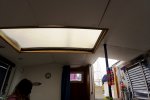
If you zoom in on the photo you provided, the panels appeared to be fastened with screws (under plastic caps), which are probably either tapped into angle bar structure that stiffens the roof, or screwed into timber battens that are fastened to flat bar structure.
It would probably be a worthwhile exercise if you take down a few random panels to inspect the condition of the steelwork behind - it should all be in good condition, as it should be fairly dry there, but you do not want to find out any nasty surprises later on.

Caleo interior photo.JPG
 
To be sure, the level of rust on and around the deck is minimal and looks a lot worse than it likely is. I'm rather more surprised at the thickness, or rather lack of it. of the hull plating. 3mm or 1/8 seems a bit on the light side for a vessel of her size. I would have expected to see something in the range of 4mm-5mm for hull sides and deck (4mm) and more for bottom plates and keel. With plating that thin, there is not much margin for waste or deterioration.
According to original plans there should be 4mm exactly as you are suggesting. So either the boat went down in thickness for 1mm over the years or the measurements are wrong as broker suggested. He told me, that some other buyer consulted the survey with boatyard, which constructed the boat a they told him, that the surveyor used wrong measurement method and that the measurements are wrong.
 

Attachments

  • Screenshot 2022-04-11 181915.png
    Screenshot 2022-04-11 181915.png
    70 KB · Views: 3
It is impossible to even hazard a guess as to the likely cost of repairs based on the photos which is why I suggest you get an experienced steel boat surveyor first and then find out what sort of facilities and skills are available locally if you want to get some professional help. This will give you a much clearer idea of whether it is worth taking the boat on.

I'll hazard a guess, based on quite a few decades' experience both of boats and of life, that the cost will exceed any guess that might be hazarded!
 
Top