roaringgirl
Well-Known Member
I suspect that leeward shroud slackening was a major contributor to the eventual failures. I'm going to tension all to the point there's no slack on leeward when heeled to avoid load cycling.


is it possible to get a side on photo of the edge to see how the tang assembly was formed to accommodate the cable ends and also a side on photo of the remaining insitu tang to see how the remaining cables 'fair' on to the tang please?
Are you motoring or attempting to sail to the riggers?
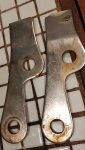
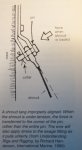
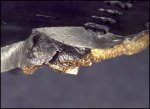
Yes, I agree. The best thing would be to replace with a t-bar or ball joint. This isn't going to happen in Tahiti, so I think I should tighten the lowers good and hard to minimise the movement that has clearly caused fatigue.Interesting that the link you provided above includes this image. It appears to be similar to the arrangement described.View attachment 136549
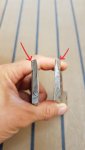
The one on the right in this photo is slightly different, there are two cracks growing from top and bottom. Can you see a groove stress-raiser that has initiated the cracks as with the port side?I went up to jury rig the starboard side today, to pre-empt the failure. When I took the pins out of the shrouds, the inner plate of the tang fell out, as it had also cracked right through. The crack-creep pattern across the crack face is *exactly* the same as that seen on its port-side counterpart. I had to leave the outer part of the tang up there as I can't get it off without removing the spreader. Now the shrouds are attached to the soft shackle, it's obvious that the angle the tang makes with the mast is too large. I think this, and the shroud lowers being too loose are what led to the failure.View attachment 136615
They are beach marks. You need an electron microscope to see striations (if you are lucky!)Classic fatigue failure striations
Would it be right to think that it is poor manufacturing technique that has directly lead to this Vic, in that they have formed the bend over a 'sharp' edge as opposed to having given it a nice radiused form such as appears to be the case with the other (lower )bend on the outer tang. And is possibly something to watch for when buying new or surveying existing equipment? Though I tend to think / recall that its quite common practice........The one on the right in this photo is slightly different, there are two cracks growing from top and bottom. Can you see a groove stress-raiser that has initiated the cracks as with the port side?
Yes, the groove that is present is a stress raiser. I have a wonderful old book that gives values for stress raisers and ones of the type that are visible in the pic in post#5, sharp, narrow V shapes, can increase the stress locally by very big numbers, maybe up to x 15! Line stress raisers like the ones here usually cause multiple initiations, as seen in the one on the right in post #27. If the loading had been fair this would be less of a problem but applying tension in bending at the groove has led to the fatigue.Would it be right to think that it is poor manufacturing technique that has directly lead to this Vic, in that they have formed the bend over a 'sharp' edge as opposed to having given it a nice radiused form such as appears to be the case with the other (lower )bend on the outer tang. And is possibly something to watch for when buying new or surveying existing equipment? Though I tend to think / recall that its quite common practice........
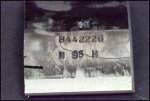


Is the rigging tension suggested independent of hull and deck design and the differences in stiffness? I would have thought tie rods and stiffening materials would deform or stretch differently from old fashioned plain grp. I do get the need to avoid slackness although this is near impossible to achieve on some older designs due to flexing.The lowers tangs finally arrived and I fitted them today. The spreaders had to come off, so for much of the day I was aloft with 6 of the 8 stays loose around me!
All the reading I've done says that I should tighten the cap shrouds to 15-20% of their breaking strain, which is measurable as 3-4mm stretch over a 2m section. There's no f-ing way I can tighten it past 1mm extension without sliding some big poles over the spanners!

Riggers have always recommended sailing in moderate winds to windward and watching the leeward cap shroud and lowers for sag. If you are getting sag, they ain't tight enough.My rigger friend advocates using some longer levers to get to 15% on the cap shrouds. He sent me the Selden rig tuning guide, which says the same, so I will do it tomorrow!
