Rigging a taickle

tjbrace

Well-Known Member
Joined
8 Mar 2007
Messages
623
Location
West Mersea, UK
Visit site
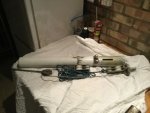
I have dismantled my backstay tensioner to repaint the aluminium tube container but I cannot work out how to rereeve the line.
There are 2 multisheave block assemblies each with 4 sheaves. Each of these assemblies is configured like 2 fiddle blocks stuck side by side.
There is a becket on the lower assembly and the pulling end of the line comes out of the tube towards the lower end of the whole thing.
Can anyone suggest the path for the line?

Thanks T.
 
I don't know so much about such things however to at least bump the tread... It does seem to me that 2 blocks each with 4 sheaves is too much. Essentially the more sheaves the more power advantage (more purchase) however the more sheves the more friction to the point where we seldom see more than 4 or occasionally 6 purchase. Perhaps I have misunderstood your description. Cascade of blocks seems more common for back stay.
However back to your question you have to identify the sheave where the running (tail) line enters that becomes a definite. then the becket will be probably near the centre of one block. Lines must cross over at some point but the aim is to run the lines such that there is minimum cross over but also so that the lines of most movement balance with the lines of minimum movement (closer to becket) so that blocks do not tilt under uneven load. ol'will
 
I have dismantled my backstay tensioner to repaint the aluminium tube container but I cannot work out how to rereeve the line.
There are 2 multisheave block assemblies each with 4 sheaves. Each of these assemblies is configured like 2 fiddle blocks stuck side by side.
There is a becket on the lower assembly and the pulling end of the line comes out of the tube towards the lower end of the whole thing.
Can anyone suggest the path for the line?

Thanks T.

Does this help?

https://www.harken.co.uk/article.aspx?id=12855
 
Thanks for your help.
William. - this kit came with the boat and yes you have grasped the picture from my description. Your guidance is great and I think I can now picture the reeved taickle. As to the power, well I didn’t give a complete picture as the taickle is further doubled with a separate block and a wire link. It is massively built though.
Dom. - thanks for the link. Harken show an 8:1 taickle, but the sheaves they show are side by side whereas mine are arranged like fiddle blocks. So I can’t really use that as guidance.
 
Go on then, I'll bite...

...what's the reason for the loony spelling? :confused:
It was how Essex oldies that I knew pronounced it but I guessed the spelling as they didn’t write. Could have been tayckle! Now I’m one of them. Also they had gaff mainsails pronounced garf. Actually, one of the oldies was from Suffolk .
 
Last edited:
I was wondering about that spelling too - but why would anyone pronounce it any other way than as it is spelt, tackle, as in rugby?
It's new to me - block and tackle pronounced as written ever since I first heard about them.

Do people talk of fishing or wedding taickle too, or is this just a marine thing?
 
Do people talk of fishing or wedding taickle too, or is this just a marine thing?

:biggrin-new: ;)

I asked about the spelling used here despite having read an article in Yachting Monthly or Practical Boat Owner in recent years, which described contemporary crewmen of Thames sailing barges, using the pronunciation "tayckle".

While users of dialect ought not to feel obligated to expunge their idiosyncrasies on the basis of today's instantly available standardised spellings, I didn't feel any respect for the chaps described in the magazine, who were definitely not old-time hard-living lightly-educated rustics, admirably skilled in their field; they were modern professionals, just being pretentious for the day!

Against that, I found Mr TJBrace to be charmingly convincing as a regional fellow using what he believed to be correct spelling. :encouragement:
 
Last edited:
You have a choice: either have the two sets of blocks parallel (as per the photo) or at right angles* (so the axes of the sheaves would be perpendicular). The former is easier to rig but you may end up with falls touching each other, the latter is harder to get your head round but will give a better result.

For parallel blocks: take the working end an pass it down (relative to the table) through one of the smaller sheaves of the upper set, work your way round the smaller sheaves and then the larger sheaves, finally exit upwards through a large sheave in the lower set. If the choice of final sheave (left or right) is important then your first sheave should be on the same side.

For perpendicular blocks I would suggest starting at the other end. Untie the bitter end from the becket, pass the line in through the exit, work in a square around all of the large sheaves, then all of the small sheaves, finish at the becket. None of the falls should be crossing any others.

*This will end up looking a bit like the 5:1 purchase example shown in the Harken link in a previous post (but upside down). https://www.harken.co.uk/content.aspx?id=3891
 
Top