Rib to sportboat

Would also say that the Normal Noblesse 655 drove well but highlighted limitations of small boat in the water around Dartmouth

 
Can anyone explain why a RIB would have better handling than an all rigid boat with the same hull form? It seems to be widely accepted, and almost gospel for RIB owners, but I've not heard any solid technical reasons as to why that would be the case. I asked on a RIB forum once and was told the tubes bounce off the water to cushion the ride, but i'm expecting more sensible answers on here! :encouragement:


I've always assumed that it was because the hull is much narrower and deeper than the equivalent beam non-inflatable and that the tubes are mainly here to give it stability and buoyancy at low speed and rest (no promises that's a sensible answer).
 
Can anyone explain why a RIB would have better handling than an all rigid boat with the same hull form? It seems to be widely accepted, and almost gospel for RIB owners, but I've not heard any solid technical reasons as to why that would be the case. I asked on a RIB forum once and was told the tubes bounce off the water to cushion the ride, but i'm expecting more sensible answers on here! :encouragement:

Ah I can climb on my hobby horse :)
I think the most "solid technical reason " is the deep ness of the V ,ie Deadrise .There may be others happy to hear?
Rib,s have excessive deadrise ,deep at the transome, mid section ,and a fine entry @ the bow sections .
This means they can part the waves more than ride over and crash/slam down .

A simple analogy is to think of a knife and a shoe box in a test tank , moving through.One will be smooth ,t,other bouncy.
A hull is a compromise twixt the two.

The deeper the V the greater wetted area, the more friction /drag .This means more Hp is needed to push it along at a given speed ,not a problem in Outboards these days .
Another performance /planning factor is weight ,or power to weight ratio ,again hardly a problem with a pair of Yam 350 Verado,s .
So it's the plastic hull form really and the easy ability to match the power to get the right power/weight ratio .
The tubes re performance ,I think just instilled confidence in the operator .
Other small light none tubed hulls like Cap Camerat,s and White Shark , Bigger Bostan Whalers like Outrage 320 etc ,also have a high deadrise , and are outboard able , plenty of power to overcome the wetted area of the deeper V

Once you start -morphing - going down the cabin /accomodation /inboard diesel route ,dare I say it fly bridge ,then you pile on the Kg ,s
Now to get it to plane restricted by a given Hp of the inboard * ,to get lift to plane builders start to flatten the aft sections
If they prat about with the weight distribution as well -shoving the E room further astern to create the fashionable and sellable owners mid cabin ,then again to get the interior volume the mid and rear sections are flattened at the expense of ride /seakeeping .
With a rib none of this applies
* bigger inboard diesel engines cost more ,bigger tanks etc -weigh more -final price has to be competitive ,so sacrifice some deadrise in the name of lift -so we can make do with engines on the " edge "
 
In addition RIB hulls are generally much thicker, fuel tanks are generally below the waterline and as there's no need to design around accommodation etc the centre of gravity and buoyancy are very low.
 
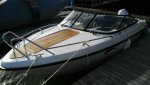
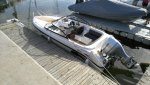
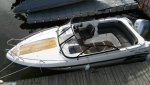
By way of closure just to say we bought an AMT 200 DC at the boat show yesterday
From your first post asking for suggestions to actually buying the thing in less than one month.
That's probably a forum record of some sort... :D
Well done, and all the best for enjoying some great time with her! :encouragement:
 
Sea trial at Sal Marine Lymington today and thoroughly enjoyed it. Will take delivery February next year
IMG-20160930-WA0014.jpgIMG-20160930-WA0013.jpgIMG-20160930-WA0012.jpg[]
 
Last edited:
It has an anchor point at both fore and aft and comes with one anchor and chain. Will wait and see if worth having two for convenience
 
Top