Rewiring and expense

gasdave

Well-Known Member
Joined
30 Nov 2009
Messages
372
Location
me Scottish Borders, boat Clyde
Visit site
I accept that the gold standard for a boats wiring systems should be based on stranded tinned cabling and annealed tinned crimps with heatshrink covering, etc..
However this is all very expensive, although I also accept that some of the cost may be recovered in the sustainability if you keep your boat long enough. If the general consensus is that this is the only way to go then I may certainly consider it (although I note that my local electrical chandlers doesn't stock tinned cabling because no-one is prepared to pay for it!).

So my questions are:-

1. What do you all do when it comes to a re-wiring project, i.e. the real world?

2. Can anyone recommend a good supplier of cabling and crimps suitable for marine use?

Thankyou :)
 
2. Can anyone recommend a good supplier of cabling and crimps suitable for marine use?
QUOTE]

Good question.

Over the last 30 years we have supplied around 10,000 switch panels to production boat builders. We have always used tri-rated cable, untinned, and have never had a problem, that is with panels with upto 30 years at sea. Would not use automotive cable, that seems to have a shorter life.

Crimps, we always use non-insulated, you can check the crimping, and just a reputable supplier / manufacturer. Use covers that can be fitted after the crimp. Crimps are the bigger problem, they become brittle and break after around 20 years. Depends on fittment area and use, many are still fine after 30 years, but some are starting to fail after 20 years.

Farnell, RS, CPC or similar can supply at a good qaulity and resonable price.

Brian
 
I have just replaced the wire feeding the masthead light which has been there since 1981. Apart from some slight blackening on the earth wire at the mast head end, it was working fine. The mast foot end of the wire was unblemished.

I was pulling another wire through, and I decided to replace it with a heavier guage while I had the mast down. I guess it might well have gone on for another few years.

Regards

Ian
 
So my questions are:-

1. What do you all do when it comes to a re-wiring project, i.e. the real world?

2. Can anyone recommend a good supplier of cabling and crimps suitable for marine use?

Thankyou :)

My boat was first wired using non-tinned wire about 25 years ago. I have never experienced any wiring related problems (Except the ones I caused!) Most of the wiring I have added was untinned, including several in the mast. I replaced one of these last year when I changed my masthead light and was pleased to see that the cable was all in good condition after about 12 years.

My solar panels are wired with tinned, heavy stuff that cost lots of ££££. I bought that from Merlin, along with various crimps an connectors.
 
Use the same size cable for everything

When I wired up our boat I used the same size cable for everything (except the starter motor and alternator). This has the benefit that all connectors are the same size and I only need to carry one size in the spares kit. I used 2.5mm cable, which might seem a bit OTT for things like NMEA cables but it does have the advantage that it's a decent size for working with the crimps etc. I can't bear fiddling around with piddling little fittings! That was in 1987 and the cabling is all in mint condition today.
 
The best place I found for tinned wire was SeaScrew. Having said that I mixed and matched with non-tinned obtained from a local auto factors who had a better range of colours. Hasn't been in long enough to see if I made a mistake or not.
 
A compromise might be to use untinned cable internally but tinned cable to external fittings which are not sealed, eg nav lights.

Even then you'll wonder why you are paying for tinned cable to connect to plain brass terminals in the lights!
 
I am re-wiring my own vessel currently and am using tinned wire with sealed adhesive lined heat shrink crimp connectors.

I think we must have more suppliers of tinned wire here in the US? We have Cobra, Berkshire, Ancor and Pacer to name a few. I am paying little more for UL 1426 tinned marine wire than I would for wire that is un-tinned but that meets all the other parameters for stranding, temp, jacket etc..

These are some of the parameters that are tested to meet UL 1426 on this side of the pond:

tinned marine wire:

Boat Cable UL 1426 / Low-Voltage Primary/Battery Wire/Cable to SAE J1128, SAE J1127, & SAE J378:

* 11 Physical Properties of Insulation and Jacket
* 12 Conductor Corrosion
* 13 Heat-Shock Test
* 14 Flexibility Test
* 15 Deformation Test
* 16 Cold-Bend Test
* 17 Vertical Flame Test (Insulated Conductors)
* 18 Cable Flame Test (Completed Cable)
* 19 VW-1 Flame Test
* 20 Relative Permittivity Test
* 21 Dielectric Voltage-Withstand Test and Alternatives
* 22 Insulation Resistance Test at 60.0̊F (15.6̊C)
* 23 Insulation Resistance Test at Elevated Temperature


It would be a good idea if not using "marine rated wire" to at least match the specs for jacketing, temp and stranding.


The wiring in my boat is 30 years old and while some of it is in perfect condition lots of it is badly oxidized and black thoughout the entire length. With a high quality un-tinned, fine stranded wire and the use of adhesive lined heat shrink crimps you should not need tinned wire to get a long service life.

The adhesive lined crimps are the same technology that we use here for well pumps. These adhesive lined heat shrink crimps power large well pumps at up to 200+ feet below water and don't leak. My well pumps "Stakon" connectors are well over 20 years old on a 240 foot deep well. As long as you use a finely stranded wire with the proper jacketing, but also use quality adhesive lined crimps, you should be fine.

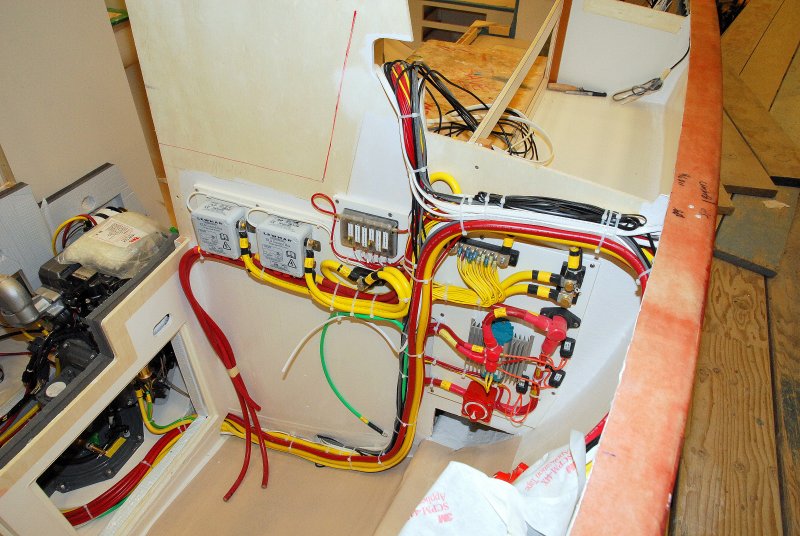
Many high quality builders here in the US only use heat shrink crimp. This is a photo of a Morris Yachts panel..

A Morris Yachts Panel 100% tinned marine wire and 100% adhesive lined heat shrink crimps:
121820712.jpg

A close up:
121820713.jpg

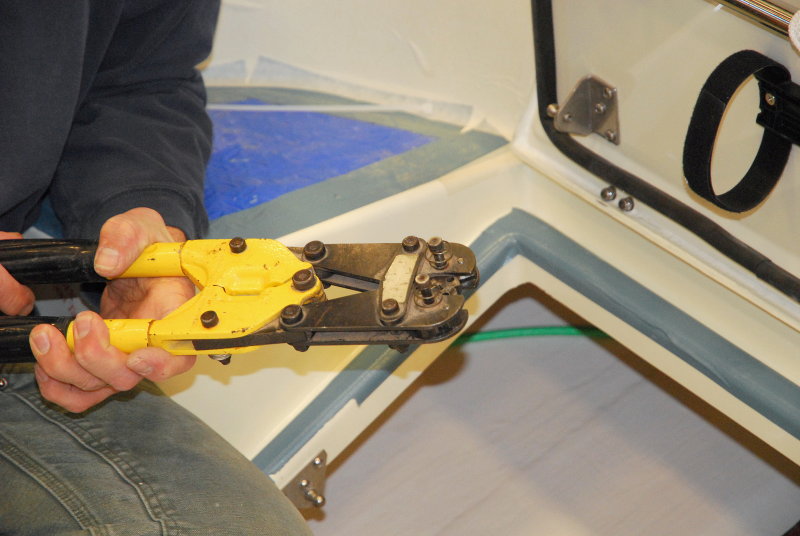
Morris uses the proper tools. This is the crimp tool for 6 & 8 GA lugs:
121820714.jpg


One of the absolute most important aspects of marine wiring is the terminations. You need to use the proper crimper for the terminals you are using and it needs to be used correctly. Many crimpers are asymmetrical meaning the crimp lug only fits into it one way. Do it backwards and the wire will eventually pull out. Also from manufacturer to manufacturer the OD's of the crimp lug can vary by a wide margin so it is best to check with the manufacturer (not the re-seller) as to which crimp tool to use. The crimpers I use cost $650.00 & $1200.00 (US) respectively and that does not include my battery lug crimp tool which is about $300.00. You don't need crimpers that expensive but you do need a good quality crimper that meets the crimps specs of the terminals you are using.

In my experience, having wired lots of boats, the pre-made heat shrink crimps produce a repeatable seal nearly every time vs. the DIY made ones which can be a roulette toss and tough to seal around the termination end.

Find a reputable manufacturer then a source (preferably not marine) that sells them at a reasonable price. I pay about $0.12 - 0.38 each. I would guess you could find similar pricing over there..


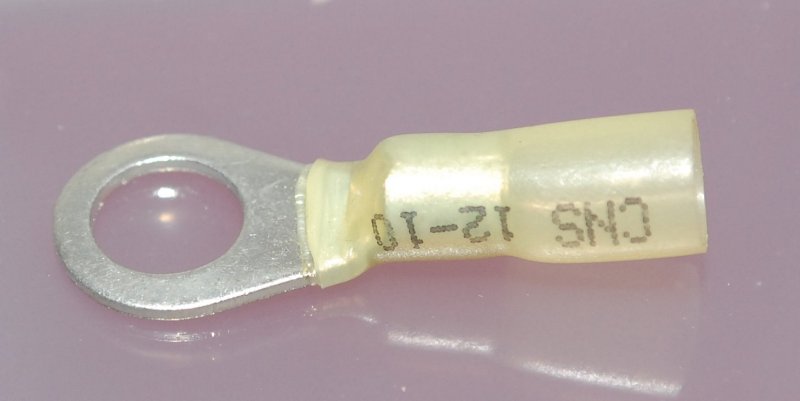
These are the adhesive crimps I use, same ones Morris does. They are made by a US company called FTZ, are very high quality, and seal perfectly nearly every time. I think I get one bad one out of about 150 crimps. I use a Loupe to inspect the seal when done shrinking it to confirm its integrity.
93394806.jpg


In short tinned is not a absolute necessity but if not using it I would hermetically seal the wire ends with adhesive heat shrink crimp lugs. Viv talks about crimps becoming brittle this is possibly due to exposure to moist air and the oxidation of the bare copper or work hardening of the wire due to improper stranding and/or the lack of proper strain relief.. If the joint is sealed and properly strain relieved this is not a problem.
 
Last edited:
The one thing I would hate is going to all the effort of rewiring and then find things started to fail due to corrosion. I am using tinned wire and connectors all from the same supplier as they will match galvanically (sp). I get them from Merlin. My boat is wooden and therefore always 'damp' and sea water tends to destroy anything metal that isn't well protected. Prior to my rewisre the engine wouldnt start and I traced it to the main red cable to started having been completely corroded through. Apart from that the cable looked new and it almost made me miss the tide exiting Strangford Lough.
Give me a PM in 20+ years and I will let you know how well the wire has stood up:D
 
I have used tinned wire exclusively on my own boat and either heatshrink tinned connectors or tinned connectors with separate heatshrink. Battery cables as well. Just a few days ago I worked on a trailered boat that was 15 years old. Even though not in the water all the time the wire which was not tinned was black with corrosion several feet from the connections. There was no heatshrink. I think with the labour involved to rewire the small extra cost of tinned wire and heatshrink connectors (or tinned connectors with heatshrink) is worthwhile. I see many older boats and the problems always seem to be with untinned wire and no heatshrink on the connectors.
 
. I think with the labour involved to rewire the small extra cost of tinned wire and heatshrink connectors (or tinned connectors with heatshrink) is worthwhile.


On my own boat the material price difference for an entire re-wire, every single wire on the boat, panel, buss bars, OCPD's, etc. for adhesive lined crimps is a $84.00 difference over just insulated crimps for over 400 terminals. $84.00, on a 3.5K materials cost re-wire, is peanuts in the long run..
 
1. What do you all do when it comes to a re-wiring project, i.e. the real world?

For what it's worth, I had cause, last weekend, to do some fiddling around with Jumbie's wiring. The domestic stuff is all (just about) original, from 1986, and uses standard domestic 2-core flex and crimps. I had been following recommendations here, so looked at the bits I was fiddling with very closely. There did not appear to have been any corrosion or other deterioration of joins or wire.

That was all in the cabin, so rather less exposed to salt, so perhaps it is worth going to tin covered extremes outside. I strongly suspect that it's yet another bit of nautical fetishism. Sealing joints properly is, of course, essential.
 
Thanks to all for the advice so far.

Having just compared the Merlin and Furneaux Riddall sites I am amazed at the difference in prices - approx. 3-fold for tinned cabling and heatshrink terminals! :eek: At the FR prices I could well be tempted down the tinned route after all.

On the basis that there's no such thing as charity for boat owners, what's the catch? Surely the quality can't be three times lower?
 
Thanks to all for the advice so far.

Having just compared the Merlin and Furneaux Riddall sites I am amazed at the difference in prices - approx. 3-fold for tinned cabling and heatshrink terminals! :eek: At the FR prices I could well be tempted down the tinned route after all.

Depends what you're rewireing - I used Merlin pre-made Lifeline 4AWG (adhesive heatshrink) cables for battery wiring - much faster than making them in-situ.
Perhaps you could use that for the high-current stuff, and compromise on the low-current domestic side (except VHF ;-)
 
I'm starting with the mast at this stage as it is already down, the lights don't work (although I accept that this may be due to something as simple as corroded connections) and the existing cabling is 23 years old anyway.

Placed an order with FR for this today so waiting to see what the stuff is like. I reckon if I do it properly it will more than likely do for another 15 - 20 years at least. My intention is to get around to the rest of the boat next winter once I've had some time to get to know her as this is my first season. I'm just at the stage of thinking about / planning my rewire now so if the FR kit is reasonable that should be a useful saving.

Regarding cabin lights in my Sadler 26, anyone got any experience of rewiring these as it involves dealing with cabling behind Sadler's solid headlining? The loom currently seems to run along the internal gap where the hull and coachroof join, which is not necessarily easy to open in itself. Presumably the wires to the cabin lights come off at the appropriate places to disappear behind the coachroof. I'm guessing I will need to use a mouse line again to swap them?
 
You will have no probs with FR quality. All the local marine elecricians use them. They are good value because they sell alot, that keeps prices low. I particulary like their Spiro LED lights.
 
Regarding cabin lights in my Sadler 26, anyone got any experience of rewiring these as it involves dealing with cabling behind Sadler's solid headlining? The loom currently seems to run along the internal gap where the hull and coachroof join, which is not necessarily easy to open in itself. Presumably the wires to the cabin lights come off at the appropriate places to disappear behind the coachroof. I'm guessing I will need to use a mouse line again to swap them?

I haven't worked on the 26 but the general construction principle of your boat is the same as my 34. As you have found, easy rewiring is not something that the builders thought through. There are a couple of places where it is possible to access the between deck space. The surround on the saloon hatch can be removed, as can a small length of wood that runs from the instrument pod across towards the chart table on a 34. Not sure if the latter is on the 26 but I guess it will be. Otherwise it's a matter of pulling lines through with the old wiring, or using a drain spring to push new ones through. I have also found old shroud cables to be useful for this purpose.
 
Regarding cabin lights in my Sadler 26, anyone got any experience of rewiring these as it involves dealing with cabling behind Sadler's solid headlining? The loom currently seems to run along the internal gap where the hull and coachroof join, which is not necessarily easy to open in itself. Presumably the wires to the cabin lights come off at the appropriate places to disappear behind the coachroof. I'm guessing I will need to use a mouse line again to swap them?

I was wrestling with this on Jumblie last weekend. What started as a simple job (replace 5W incandescent galley lamp with 8W fluorescent) became a four hour marathon when I discovered that whoever had fitted the old light (not Victoria) had broken all but two strands of the copper feed to the port side cabin lights. This explained why they were a bit on the dim side.

Unfortunately the wiring runs, as in your case, between side decks and lining, and removing the lining (3/4" marine ply!) would mean dismantling most of the woodwork on that side of the cabin.

Stuff it, I thought, and ran a new surface mounted wire to the new lamp - the feed on to the next two in the chain were fine. It's fairly unobtrusive, being under the side deck.
 
Top