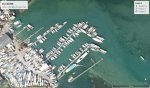
reversing out of my temporary berth, Konsort.

Zip out before the wind and prop walk take effect, then when they do, you'll be pointing west, so do a U turn where there is more room. Its the only way for my heavy displ long keeler which has a mind of her own going astern and even the substantial prop walk from the KIWI prop cannot be relied upon.
 
getout.jpg
I have been sailing my Konsort for 6 years
I do not think I would fancy reversing between the 2 big boats on the exit in nne, almost certain to get blown on to the southerly one
I would put my fenders on the starboard side just in case I got blown onto the neighbour
Reverse out, the Konsort will naturally want to swing bows downwind anyway
Reverse up to the Northerly corner, then give her a good blast of forward power as soon as she starts to bite going foward swing the tiller over and head for the exit
 
I had prop walk on our boat so reversing out was difficult. What I worked out was I needed to get water flowig over the rudder so I tied a spring from a midship cleat to a cleat by the bows. I ran the engine at 1,200 revs for about four minutes until there was a good flow over the rudder and released the spring. The boat went straight back with little affect from any wind because the boat was going quite fast.
 
I had prop walk on our boat so reversing out was difficult. What I worked out was I needed to get water flowig over the rudder so I tied a spring from a midship cleat to a cleat by the bows. I ran the engine at 1,200 revs for about four minutes until there was a good flow over the rudder and released the spring. The boat went straight back with little affect from any wind because the boat was going quite fast.

Was the control due to the fact the engine was running at 1200 revs and the acceleration gave you speed needed for the rudder to work or due you think it was because the 4 minutes of stationary reverse established a flow over your rudder that gave control, or a combination of both? I have read about this once before (on here) in a thread by 'jimmy' when discussing a boat handling course he went on. What I am wondering is just how critical is the stationary time in reverse? I guess part of the magnitude of a stern kick is caused by moving water initially reacting against stationary water i.e. when first put in reverse, so it is less once the flow is well established. I'll need to try this on the Rival.
 
I have a boat that cannot be steered astern, she is quickly affected by windage on the bow and her engine is very slow to accelerate.

In a situation like yours I would be guaranteed to end up facing the dead end.

If the wind was not too strong and the channel not too narrow, I might be able to make a tight turn to starboard with the tiller held over to port and using bursts of ahead and astern power.

If there was any doubt, I'd attach the 25lb lead weight I carry on board to a line from the bow and use that as a sort of temporary anchor. In a few minutes the boat will turn and face the wind. Then motor slowly ahead, recover the line and weight as I go. (If singlehanded, I'd lead the line back to the cockpit via snatch block.) It's very easy, there's no rush and the boat is always under control. I used this technique a couple of weeks ago in La Turballe when I had been given a berth at the downwind end of the channel with a sort of guard-of-honour of Merry Fishers all with outboards raised ready to gouge my topsides!

This technique, and many other others, for getting out of awkward berths is perfectly illustrated in John Goode and Dick Everitt's booklets "Handling Under Power". Out of print now but worth trying to find.
 
Does anyone who sails a reasonably handy boat like a Konsort ever actually do all this messing about with ropes across the aisles thing in a marina? Seems remarkably unnecessary to me...

I do it, but then my boat has all the handiness of a satanically possessed supermarket trolley. Rigging up the ropes doesn't take that long, and I prefer it to elaborate networks of springs. But you're right - In a Konsort I would probably just go for it. Particularly if it was someone else's fully insured Konsort.
 
If I were really worried, I would get up at six in the morning when there is usually little or no wind, and make an immaculately tidy exit, if necessary, taking up a temporary berth on the outside. The trouble is, that there will be nobody around to watch.
 
I have to do this a lot and can have the tide with or against me. My technique is engine warmed up,stern line to shore on starboard side allowing enough rope to exit berth. When you are halfway out hold hard on stern line ,stern pulls to starboard release more line then quickly recover line continuing in reverse. When almost up against the boats to your stern put into forward, tiller hard over to starboard full throttle. This kicks the stern around to starboard throttle back and motor on out.It is a bit scary but it works for me. You could always go out to port as already suggested then go down to the vacant berths further down from your spot and do a u turn.
 
Dave
You can see from the sheer variety of replies that there is no obvious safe way of getting out by yourself. It's stupid to run the risk of damaging your boat - and maybe some more expensive boats. Call out the boatyard and for sure they will help with either hands to warp you round or using the boatyard boat to guide you out. As my old grandpappy didn't use to say "Big balls equals big bangs."
 
Call out the boatyard and for sure they will help with either hands to warp you round or using the boatyard boat to guide you out.

In this particular instance I'm sure you are correct. More generally I don't think you can assume ANY assistance will be available. FWIW I would rig lots of fenders to STB and back out as fast as I could. ONLY THEN would I decide whether I could manage a powerful forwards exit .....or accept that I was into a long drawn out multipoint turn in the blind ally.

(Sadler 29)
 
Last edited:
Well you have a lot of advice to chew over, write down what you choose to do as a method statement, highlite the risks, that should be enough, if you do ask for help, give them a copy of your method statement, so they know exactly what your moves will be, if possible alert your neighbour each side.
When do you intend to make your move? Don't forget to let us all know how you got on and method. Fair winds to you.
 
Well I thought I might get a few contributions :). Genuine thanks to all. I will endeavour to update after the event which is a couple of days away. Hopefully the update will be rather boring. Glad I posted coz it is good to hear there are so many different interpretations of what to do, in that sense my anxiety about not knowing the right way seems okay .
 
>Was the control due to the fact the engine was running at 1200 revs and the acceleration gave you speed needed for the rudder to work or due you think it was because the 4 minutes of stationary reverse established a flow over your rudder that gave control, or a combination of both?

Prop walk is caused by little or no water flowing over the rudder so the prop takes control, ours was so bad that if you let it walk you would end up backing into a berth two berths along. To stop that you must have water flowing fast over the rudder before moving. So keeeping straight is a combination of both the time needed to get it flowing fast using and using 1,200 revs. Any less revs would cut down the flow and allow some prop walk. Does that answer the question? A way to keep straight when reversing into a berth is to blip the throttle, so the prop can't takeover, but you can only use that in litle or no wind and tide.
 
... Does that answer the question? ...

Thanks, I will need to try this out and will make a point of doing that early next season on the Rival. In calm conditions I can get her to go backwards but it has taken a few attempts in open water, the normal state of affairs is the stern kicking strongly to port.

I guess if I set her up with just a spring from her beam cleat going forward and reverse against that she will stay along side with some astern power applied, then it is just a matter of slipping the line and letting her shoot out backwards. When you are alongside, on the spring and stationary, but applying astern power, if you move the rudder, does the stern respond and move away from / into the pontoon?
 
>I guess if I set her up with just a spring from her beam cleat going forward and reverse against that she will stay along side with some astern power applied, then it is just a matter of slipping the line and letting her shoot out backwards. When you are alongside, on the spring and stationary, but applying astern power, if you move the rudder, does the stern respond and move away from / into the pontoon?

Yes the rudder works immediately you let the spring go and the boat goes straight back. If single handed you can move the rudder slightlyly to get slightly off the pontoon to stop the fenders on the beam being pushed up i.e. using the rudder to get very slighly bows in towards the ponton. If two handed one person can hold the boat off the pontoon and release the spring and jump on as the boat begins to move. That was my job Jane always drove the boat. Hope that helps. When you start doing it you will be amazed about the difference it makes, prop walk gone.
 
Last edited:
>using the rudder to get very slighly bows in towards the ponton

Sorry that's wrong I wasn't thinking straight. What happens as the water flow picks up is the stern get pulled toward the pontoon by the spring and the bows away from the pontoon for the obvious reason the boat's beam. So you need to straighten the boat when leaving but if there is a boat very close to you on the next pontoon put a fender or two out on that side.
 
Well to update......... a very uneventful and satisfactory exit was made, (no crew for this bit). I think my anxiety had shrunk the turning space available in my mind, and to be honest I was using the forum to get my rusty head into the problem which was a good thing. No lines to shore to help the turn just a slow steady reverse and then carrying on in reverse until the top of the aisle before a slow turn to port to head out forwards. Thanks for everyone's input. Hoped it would be a boring update :)
Wind was lighter than expected too.
 
Top