michael_w
Well-Known Member
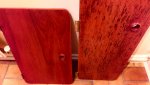
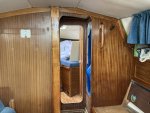
My boat has got rather weathered veneer by the companion way. What's the best way of restoring it to it's former sate?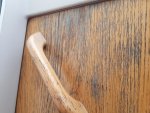



+1. Needs patience and care but can be done. You may not be able to get an even colour all over, so may have to apply some woodstain, although in such a visible location little opportunity to experiment so you may have to accept a certain amount of inconsistency in colourNot difficult. Firstly mask off surrounding area and apply Paint Panther paint/varnish stripper (other brands are available). Once stripped, clean with white spirit. The black areas will be mildew in the grain so treat with bleach based mold and mildew spray from the supermarket. If the staining is persistent, treat with oxalic acid cleaner (instant hull cleaner works for me). Allow to dry. Sand very lightly with the grain using fine sandpaper. Reclean with white spirit. Final sand with fine wire wool. Clean again with white spirit and allow to dry. Recoat with the topcoat of your choice. Personally, I use Ronseal ultra hard satin coat. Five good coats minimum and it should look a lot better.

A good reply. I would add, before using a bleach solution, wipe the whole area over with a damp cloth and see if all the veneer absorbs a little water. If it does not, then some of the original finish is still present. Also I prefer to use the cheapest supermarket own brand of bleach as you can alter the amount of water used for dilution and it is also without any added perfume.Not difficult. Firstly mask off surrounding area and apply Paint Panther paint/varnish stripper (other brands are available). Once stripped, clean with white spirit. The black areas will be mildew in the grain so treat with bleach based mold and mildew spray from the supermarket. If the staining is persistent, treat with oxalic acid cleaner (instant hull cleaner works for me). Allow to dry. Sand very lightly with the grain using fine sandpaper. Reclean with white spirit. Final sand with fine wire wool. Clean again with white spirit and allow to dry. Recoat with the topcoat of your choice. Personally, I use Ronseal ultra hard satin coat. Five good coats minimum and it should look a lot better.


A very minor point; black stains on oak may be iron staining, not mildew, especially if found around fixings. As far as I know, that is difficult/impossible to remove.Not difficult. Firstly mask off surrounding area and apply Paint Panther paint/varnish stripper (other brands are available). Once stripped, clean with white spirit. The black areas will be mildew in the grain so treat with bleach based mold and mildew spray from the supermarket. If the staining is persistent, treat with oxalic acid cleaner (instant hull cleaner works for me). Allow to dry. Sand very lightly with the grain using fine sandpaper. Reclean with white spirit. Final sand with fine wire wool. Clean again with white spirit and allow to dry. Recoat with the topcoat of your choice. Personally, I use Ronseal ultra hard satin coat. Five good coats minimum and it should look a lot better.
As it is a lacquer, the usual paint strippers will never work, like removing varnish or paint. They are chemically totally different products. As you said, lacquer is tough stuff, but used on so many wood products that are commercially made.Concerto, indeed that lacquer is excellent however it is almost impossible to remove if it becomes necessary.
I have tried almost everything (except thinners) and Morrells advised coarse sanding. Next is a heat gun. Tough stuff.
No criticism to your excellent advice to OP.

A good reply. I would add, before using a bleach solution, wipe the whole area over with a damp cloth and see if all the veneer absorbs a little water. If it does not, then some of the original finish is still present. Also I prefer to use the cheapest supermarket own brand of bleach as you can alter the amount of water used for dilution and it is also without any added perfume.
To adjust the colour with a wood stain, use a water based stain like Liberon, not a spirit based stain. It is far more controlable and leaves a softer edge when colouring. Use multiple coats of stain to slowly change the colour. You cannot lighten the colour with wood stain, that should be done using a bleach solution.
Most internal wood surfaces of any boat are usually not varnished. Boat builders us a 2 part lacquer as it is fast drying and multiple coats can be applied in a day and is not sticky whilst drying to attract dust. In my Fulmar's interior I used exactly the same as Westerly used. It is Morrells 450 acid catalyst high build up low odour lacquer with 30% sheen. It is only available in a 5 litre pack with catalyst and 5 litrs of thinners from their trade counters. It has to be pre ordered for collection the following day and will cost about £60 including VAT. It is recommended to be sprayed, but it can be brushed. I used a good quality synthetic brush. It sets quite quickly so I only mixed a maximum of 60ml at a time. The brush was suspended in thinners during the day and overnigh, but washed out properly if not being used for more than a day.
Morrells | 450 Low Odour High Build Acid-Catalyst Lacquer