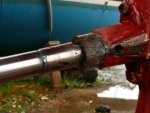
Replacing the Cutlass Bearing

RE Cimo and Foxy

Watching the local engineer belting seven barrels of wotsit out of a reluctant cutlass at £40 squids an hour I knew there had to be a less frustrating way..

Good luck Talulah. Get the camera ( and cutlass) out !
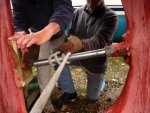
 
Yup thirded, just did mine the same way and have long stern tube and tiny prop aperture. Once I had the bits, took about five mins. Wish I took some photos and would have been easier to explain. Good luck!

Using a puller is great (and quick) if the shaft is already out. On the V27 either the engine has to come out first or rudder off and drill a hole through the skeg. Both take time (including reinstatement). By using a long holesaw the job can be done with the shaft in-situ - 1 hour tops. The holesaw only cost about £20 to make up and will save hours of graft if the shaft is a pig to get out.
 

Attachments

  • cutless2.jpg
    cutless2.jpg
    88.7 KB · Views: 3
  • cutless1.jpg
    cutless1.jpg
    81.6 KB · Views: 3
It will cost you a fiver at B+Q tp buy a metre of 12mm threaded studding, some nuts and copious washers.
Takes less time to do than to read through my post !

NICE ONE!

I did mine last year but I have a Vetus housing at the stern end of the cutlass that comes off, allowing a very large pair of pipe grips to be put around the exposed end of the cutlass..... and thank goodness, with a few 'heavies' who wanted to prove their manhood, it came loose and out.
As already mentioned.. if you have grub screws or similar retaining it, check them out first.

best of luck.
S.
 
Are you sure that the housing cannot come off? If it like the one shown in PeteE's photos in post #22. you can see two bolts above and below the stub where the shaft comes out. Undo these ans the housing should unscrew from the end of the shaft tube. It is usually a common right-hand thread. Getting it back on can be a problem as the nuts on the inside may not be captive (Why do some companies build boats in such a way as to make repair impossible???) and you need to devise some method of holding them while the bolts are re-fitted. Check also for grub screws.

I see mention of fitting the cutless with silicon or epoxy. Why?? (See earlier comment about repairability) The bearing should be an interference fit in the housing and needs only the grub screw to hold it.

By the way I did this job three years ago and ended up needing a needing a new shaft (it was worn), new tube (the end broke off inside the housing where the thread had been cut too deeply) and new housing. The old housing been designed for a white metal bearing and a cutless bearing casing had been machined down to fit. There was no stock size cutless that would fit, nor one in the current catalogue that could take the reduction in shell thickness that machining would involve. I hope your job will be simpler!
 
Epoxy, clearance fit and white metal replacements

Are you sure that the housing cannot come off? If it like the one shown in PeteE's photos in post #22. you can see two bolts above and below the stub where the shaft comes out. Undo these ans the housing should unscrew from the end of the shaft tube. It is usually a common right-hand thread. Getting it back on can be a problem as the nuts on the inside may not be captive (Why do some companies build boats in such a way as to make repair impossible???) and you need to devise some method of holding them while the bolts are re-fitted. Check also for grub screws.

I see mention of fitting the cutless with silicon or epoxy. Why?? (See earlier comment about repairability) The bearing should be an interference fit in the housing and needs only the grub screw to hold it.

By the way I did this job three years ago and ended up needing a needing a new shaft (it was worn), new tube (the end broke off inside the housing where the thread had been cut too deeply) and new housing. The old housing been designed for a white metal bearing and a cutless bearing casing had been machined down to fit. There was no stock size cutless that would fit, nor one in the current catalogue that could take the reduction in shell thickness that machining would involve. I hope your job will be simpler!

Maritex bearings have been fitted for over 15 years bedded on epoxy as a clearance fit for a number of reasons. This is on a wide range of vessels many of which are Lloyds class vessels.
For vessels where the shaft can be supported you can check alignment of the carrier, which is often out on older boats. It should be possible to spin the new bearing in the carrier on the shaft.
There is no need for a press or hammer.
They are far easier to remove, heat epoxy and it softens, or in GRP stern tubes a sharp chisel can split the bond.
Our advise is this is the preffered method of fitting for our bearings if you want to press them in you can but there is no advantage and many drawbacks.

Silicon I would not advise using as a bearing should offer support to prevent a shaft bending, silicon will give and allow deflection.

Maritex is available as a straight replacement for a white metal bearings as it can be supplied with very thin walls to any finished outside diamater. Our calculator lets you see if a bearing size is feasable.
http://www.h4marine.com/Downloads/Maritex AQUARIUS General Calculator REV 20090222.xls
 
Sounds like Maritex would have been a better type of bearing to use to replace the worn-out Cutless, involving one less new component, but I had never heard of it and the engineers that were supplying the bits did not mention it. I did think of some kind of composite solid material as I have an acquaintance in Greenock who used to be in the news developing such materials.

Thanks for the info. It may come in useful in future.
 
The Cutlass bearing is out ;-)
Many thanks for everyone's suggestions and here's a bit of feedback.

Method 1 - Pushing out from inside the boat or using studding with a socket down the inside to create a home made extractor.
This approach wasn't successful as the stern tube is a male fit into the cutlass bearing housing. The stern tube and cutlass bearing in effect bump into each other each having an outside diameter of 47mm. (1 7/8").

Method 2 - Slide hammer.
Unsuccesfull. There was only the tiniest of lips for the slide hammer to go against.
I heated up the cutlass bearing housing and sprayed water on the inside to cool the bearing and did manage to get the bearing to move a couple of mm. The slide hammer from Screwfix was rubbish. The end fittings just bent far too easily so you could only get a grip for a couple of blows and that was it.

Method 3 - Recipricating saw
Success. Cut the bearing lengthways a few time. Take a pointed chisel/punch and bend the cutlass bearing in on itself. Then extract.
 
Get the yard to do it .... they do them all the time, they take a tenth of the time and the cost is negligible ... just had mine done (in Gosport) and it saves a lot of blood, sweat and knuckles ... and they know what they're doing, which is more than I did! ... All for an easy life!
 
Get the yard to do it .... they do them all the time, they take a tenth of the time and the cost is negligible ... just had mine done (in Gosport) and it saves a lot of blood, sweat and knuckles ... and they know what they're doing, which is more than I did! ... All for an easy life!

How negligible was the cost please ?
 
It was part of a job ....

Strip out stern gear. Clean & descale prop and rope cutter (v.bad!) .. Extract worn cutless bearing and replace with new. Buff prop (like new!). Fit new hull pear anode (large). Sand down rusted stem band to clean metal. Apply rust converter.

Labour: £265
Materials: £70.51

Seemed reasonable to me ... in the scale of boat ownership costs!
 
But why do they make these bearings like this?

Not all are that design, I can't believe how easy mine was to replace.
Unscrewed the grub screw and end section which exposed an inch or so of bearing. I then had options as to how to twist it out, Stilson or Mole grip.

PICT0441.jpg
 
Having had similar problems to the OP removing my cutlass bearing, I finally, after removing grub screws and setting up a puller, cut out all the cutlass bearing rubber material, filled the cutlass bearing casing with ice cubes, left it for a few minutes....and then when I operated the puller it came out like a dream.
Encouraged by this approach, I lightly oiled the outside of the new bearing, put it in a sealable plastic bag and left it in the freezer overnight, took the bag in a cooly-box surrounded by ice cubes to the boatyard and simply gently tapped it in.
 
They don't all work like that.
We supply cutless bearings that we advise are fitted as a clearance fit bedded on epoxy, to remove in a stern tube either heat stern tube or get a sharp chisel and break the epoxy bond, the bearing slides out.

Fitting as a clearance fit allows you to confirm carrier alignment, the bearing should spin on the shaft and in the carrier, press fitting was used before good epoxies were developed.

I can see that working for a P bracket but how about a boat like mine with a shaft log and an epoxy stern tube.
 
Top