Replacement deep cycle batteries

Also with AGMs, they don't tolerate well frequent partial charging and to realize full life need to be fully charged on a regular and frequent basis. If not able to do this it is very likely your expensive AGM batteries will have a short life span. Since they cost about four times a FLA battery that would be an expensive loss for me.

Four times the price?? You've been robbed! My boat has Exide AGMs, about £140 each - https://www.tayna.co.uk/EK950-Exide-Start-Stop-AGM-Car-Battery-017-P9443.html
 
Four times the price?? You've been robbed! My boat has Exide AGMs, about £140 each - https://www.tayna.co.uk/EK950-Exide-Start-Stop-AGM-Car-Battery-017-P9443.html

Sorry was typing too fast and made math error. Corrected numbers highlighted.

First, I could not be robbed since I don't buy AGM batteries. Then lets compare apples to apples.

I buy 220 amp hour 6V batteries for £74 each. I buy rebranded generics that come from a top manufacturer. I could get Trojan T105s for just a few pounds more but they were out of stock when I needed batteries.

So a pair of 6V 220 amp hour, deep cycle batteries in series for £148 works out to £0.67 per amp hour at 12V and I have a real, deep cycle battery, not a car battery. Your Exide AGM car battery works out to £1.47 per amp hour. That works out to 2.2 times more cost per amp hour.

So OK, not four times more, just a little over double. But again, comparing a true deep cycle battery with a car battery. Not the same.

Of course I am comparing my cost in the US against your cost in the UK but my past research shows AGM prices to be similar over here so the same results apply.
 
Last edited:
So OK, not four times more, just a little over double. But again, comparing a true deep cycle battery with a car battery. Not the same.

Of course I am comparing my cost in the US against your cost in the UK but my past research shows AGM prices to be similar over here so the same results apply.

Your past research in the US counts for little over here in the UK - or indeed in most of Europe. As Richard10002 has pointed out, Trojan T105s are about £130 here, almost the same price per Ah as the AGM batteries on my boat.
 
Your past research in the US counts for little over here in the UK - or indeed in most of Europe. As Richard10002 has pointed out, Trojan T105s are about £130 here, almost the same price per Ah as the AGM batteries on my boat.

You are correct, I did a lot of checking before buying my T105s in the UK back in 2012. I found a detailed XLS file to help make a choice and it was VERY clear that T105s weren't my best choice. Then I found the hidden sheet containing battery data based on US prices. I updated it to use current UK prices and T105s leapt out as best value for my setup and expected use. US data was way out of line wrt UK data.

Could you let me have details of make and type of your AGMs? T105s might not be best choice if I need to replace them in some remote area. I've noticed that they are over-priced in some areas. They are still going strong but I like to be prepared and compare battery specs. in advance. The main problem is that most manufacturers don't like to publish any detailed performance data.
 
Last edited:
You are correct, I did a lot of checking before buying my T105s in the UK back in 2012. I found a detailed XLS file to help make a choice and it was VERY clear that T105s weren't my best choice. Then I found the hidden sheet containing battery data based on US prices. I updated it to use current UK prices and T105s leapt out as best value for my setup and expected use. US data was way out of line wrt UK data.

Could you let me have details of make and type of your AGMs? T105s might not be best choice if I need to replace them in some remote area. I've noticed that they are over-priced in some areas. They are still going strong but I like to be prepared and compare battery specs. in advance. The main problem is that most manufacturers don't like to publish any detailed performance data.

Based on the link he posted, the Exide batteries are 95 amp hour car batteries. The T105s are 220 amp hour true, deep cycle batteries. The Exide is 12V so you need two of the T105s but you will still end up with 220 amp hours deep cycle vs 95 amp hours of car battery. So even if the T105s are £130 each in the UK for two at £260 lbs your cost is £1.18/amp hour vs the Exide UK price of £1.47/amp hour.

So using UK prices the T105s are still cheaper per amp hour AND you are getting a true, deep cycle battery vs a car battery. Please note there is a significant difference in the construction of car and deep cycle batteries. Deep cycle batteries have heavier, thicker plates, greater separation and a deeper sump (not sure of this term) under the plates. In general deep cycle FLA batteries tolerate partial charging and deep discharging much better than car batteries OR AGM batteries.

Not sure about over there, but in the US even some of the more honest manufacturers will tell you in the brochures that AGM batteries need to be recharged and FULLY charged to realize their full life. If you keep your boat tied up at a dock plugged into shore power and day sail or weekend sail then you can follow the charging requirements of AGMs. If your boat is off the grid then maybe not so much unless you have a power boat and run the engines a lot.
 
Last edited:
....In general deep cycle FLA batteries tolerate partial charging and deep discharging much better than car batteries.....
That is correct.

....In general deep cycle FLA batteries tolerate partial charging and deep discharging much better than.....AGMs
That is not correct.

.... in the US even some of the more honest manufacturers will tell you in there brochures that AGM batteries need to be recharged and FULLY charged to realize their full life.....
EVERY Lead Acid manufacturer says the same thing.
Lifeline AGMs is one of the few manufacturers whose 37 page brochure tells you everything about batteries and charging - note there is no product information in this huge brochure.

Justin Godber from Lifeline also says online: (Google him)

AGM batteries ARE a lead acid battery. So are GEL batteries. They all just contain the electrolyte in different ways. There are three types of lead acid batteries: Wet Cell batteries, GEL Cell batteries and AGM batteries.....here is the part you have been waiting for. ALL batteries need to be fully recharged to avoid sulfation build up on the plates....I can send links for Trojan Battery, Deka Battery, Odyssey Batteries, etc…They all state the same thing. Batteries must be fully recharged to avoid damage and premature failure.
 
That is correct.


That is not correct.


EVERY Lead Acid manufacturer says the same thing.
Lifeline AGMs is one of the few manufacturers whose 37 page brochure tells you everything about batteries and charging - note there is no product information in this huge brochure.

Justin Godber from Lifeline also says online: (Google him)

AGM batteries ARE a lead acid battery. So are GEL batteries. They all just contain the electrolyte in different ways. There are three types of lead acid batteries: Wet Cell batteries, GEL Cell batteries and AGM batteries.....here is the part you have been waiting for. ALL batteries need to be fully recharged to avoid sulfation build up on the plates....I can send links for Trojan Battery, Deka Battery, Odyssey Batteries, etc…They all state the same thing. Batteries must be fully recharged to avoid damage and premature failure.

First, of course all the batteries under discussion are lead acid batteries, that has never been in question. However there are significant differences in construction and function. That's why I use the terminology FLA for Flooded Lead Acid and AGM for Absorbed Glass Matt but yes both use lead and acid.

And you are partially correct when you disagreed with my statement "In general deep cycle FLA batteries tolerate partial charging and deep discharging much better than.....AGMs" because I left out an important part. AGM batteries actually do well with deep discharges IF they are the fully recharged afterwards. The same with partial charging. AGMs will tolerate both of these IF they are fully charged on a regular basis. They also do not do well if left stored in a partial state of charge.

And I agree that FLAs also do better if fully charged on a regular basis. What I said was FLAs tolerate partial SOC better than AGMs and that is well documented.
 
AGMs will take a higher rate of charge IF you have the charger or alternator that can manage......
You keep making this claim which is also not correct.

AGMs do have a High Charge acceptance because their internal resistance is much lower than FLAs, but you don't NEED a large charger or alternator to take advantage.

Charge Acceptance Rate is the amount of current that a battery will accept at a given voltage and given state of charge. AGMs will accept much more current than Flooded Lead Acid batteries. This means that you can happily put more than 100 amps into a 100 Ah Lifeline AGM battery, whereas Trojan only recommend 10 amps, so Lifelines can charger very much faster than Trojans.


So if an FLA is accepting 50 amps from a 100 amp charge source an AGM may accept the full 100 amps in the initial boost stage of charging, so that part of the charge cycle will be faster.

Another advantage of AGMs is the faster charging rate due to the Coulombic efficiency, or Charge Efficiency of AGMs. Battery Charge efficiency is different to Charge Acceptance Rate, but it is a subject not often explained or understood.

Battery Charge Efficiency is how much of that current is actually converted to stored Ah. This is one of the values you have put into a good battery monitor to help it more accurately calculate the Ah stored in the battery. A typical default value is 85%. Wet Lead Acids can be anywhere from 70-85% and AGMs can be as high as 98%. Battery efficiency is very non-linear, so at 50% State of Charge it may be 95% for most batteries, but above 85% SoC it may be less than 50% which means with every 10Ah charged only 5Ah get stored. This gets much worse the closer to 100% SoC you get, which is why it takes so long to charge the last 2-3% of the battery SoC.

So if you want to store 100Ah in an FLA bank with an 80% Charge Efficiency then 125Ah has to be input. (80% of 125 is 100).


With an AGM bank at 98% efficiency then only 102Ah has to be input to raise the bank by 100Ah. That's 23% less Ah needed to raise the bank by 100Ah, so it is charging 23% faster. Lifeline claim 20% faster charge. This happens at all stages of the charge cycle with all rates of charge, so even a modest Solar Array will put more Ah into an AGM than an FLA bank.
 
I am facing the same question for the same 100Ah-110Ah batteries. The ones in there now are Fulmen 100Ah´s regular lead acid, but really they are car batteries and they lasted just under 4 years. I think they are not very suited for being charged by solar panels (I am guessing).

Decided to go for AGM´s now, but just some chinese ones from ME Energy (via a spanish importer). They are basically the same as Victron AGM´s/Gel´s (Victron´s are also from the land of China), but half the price and same life expectancy and or build quality. If you get 4 years out them. Perfect, as they will only cost me 105 euros each, which for AGM´s is cheap.
You can buy very expensive top brand batteries, but they only work properly 6 to 7 years anyway. Rather pay a third of the price three times and get 10-12 years out of them. And do not be fooled by the margins the big brands put on. I.e. I get 55% trade discount on DEKA batteries and 35% on Victron. And I am only a marginal battery buyer.
 

You keep making this claim which is also not correct.

AGMs do have a High Charge acceptance because their internal resistance is much lower than FLAs, but you don't NEED a large charger or alternator to take advantage.

Charge Acceptance Rate is the amount of current that a battery will accept at a given voltage and given state of charge. AGMs will accept much more current than Flooded Lead Acid batteries. This means that you can happily put more than 100 amps into a 100 Ah Lifeline AGM battery, whereas Trojan only recommend 10 amps, so Lifelines can charger very much faster than Trojans.


So if an FLA is accepting 50 amps from a 100 amp charge source an AGM may accept the full 100 amps in the initial boost stage of charging, so that part of the charge cycle will be faster.

Another advantage of AGMs is the faster charging rate due to the Coulombic efficiency, or Charge Efficiency of AGMs. Battery Charge efficiency is different to Charge Acceptance Rate, but it is a subject not often explained or understood.

Battery Charge Efficiency is how much of that current is actually converted to stored Ah. This is one of the values you have put into a good battery monitor to help it more accurately calculate the Ah stored in the battery. A typical default value is 85%. Wet Lead Acids can be anywhere from 70-85% and AGMs can be as high as 98%. Battery efficiency is very non-linear, so at 50% State of Charge it may be 95% for most batteries, but above 85% SoC it may be less than 50% which means with every 10Ah charged only 5Ah get stored. This gets much worse the closer to 100% SoC you get, which is why it takes so long to charge the last 2-3% of the battery SoC.

So if you want to store 100Ah in an FLA bank with an 80% Charge Efficiency then 125Ah has to be input. (80% of 125 is 100).


With an AGM bank at 98% efficiency then only 102Ah has to be input to raise the bank by 100Ah. That's 23% less Ah needed to raise the bank by 100Ah, so it is charging 23% faster. Lifeline claim 20% faster charge. This happens at all stages of the charge cycle with all rates of charge, so even a modest Solar Array will put more Ah into an AGM than an FLA bank.

I'm starting to wonder that you are so focused on disagreeing that you can't read correctly what I'm saying. Either that or American English isn't translating that well over there so let me try again and take it step by step.

If you have a 60 amp battery charger or a 60 amp alternator and you're trying to charge a 660 amp hour battery bank (not unusual on a cruising boat and is in fact what I have on my boat), doesn't matter what the potential or theoretical acceptance rate might be, you're only going to be charging at a max of 60 amps. So to take advantage of the higher acceptance of AGM batteries one has to have the charging capacity to do so. Otherwise the high charge acceptance of an AGM is wasted. In my experience very, very few cruising boats have the high output charging sources to take advantage of a large AGM bank.

I have seen a comment that in addition to a higher acceptance rate, AGMs (or possibly some AGMs) also are more efficient that FLAs in charge acceptance and yes I do understand the principal quite clearly. I am not sure the difference is quite as significant as you claim. I have seen claims of 85-95% efficiency for FLAs, depending on the manufacturer. Perhaps some documentation?

Speaking of documentation? I have researched the subject and read numerous articles, test results and tech columns in various books and publications over the years that support this. At the moment I have neither the time nor inclination exacerbated by a problem with my internet connection to link to all these but here are links two a couple. One a posting by a gentleman that uses the online handle of Maine Sail. This is Rod Collins of Compass Marine in Maine. In addition to years of maintenance of marine electrical systems on high end yachts he is a member and tester for the ABYC which is the organization that sets safety and manufacturing standards for US boat builders. Mr Collins has invested tens of thousands in very sophisticated electronic test equipment and does extremely exhaustive testing on many things marine, including batteries.

https://forums.sailboatowners.com/index.php?threads/agm-batteries-making-the-choice.124973/

http://www.practical-sailor.com/blog/Dont-Kill-That-New-AGM-Battery-11662-1.html
 
Presumably, even if you only have a 60A charger, an AGM will accept the full 60A for longer than the "equivalent" FLA, thus shortening the time to charge?
 
As detailed in post 21. Mine are actually EK920 batteries, which have been superceded by EK950.

Sorry, I had missed that link. I spotted the comments about comparing deep cycle FLAs with deep cycle AGMs and variation in prices between UK & US. It seems that your batteries cost roughly the same as T105s and that's a big improvement over figures I used several years ago. However, I see that they are advertised as car start batteries with superior cycling ability, not specifically deep cycle. There is a claim about "4 times higher cycle life" but no detailed information.

Tayna prices delivered:
4 x EK950 £559.80 (380Ah@12V), £1.47/Ah
4 x T105 £519.80 (450Ah@12V), £1.16/Ah

I'll see if I can find detailed test data but seems likely that my preference would still be for T105s in near future.

Based on the link he posted, the Exide batteries are 95 amp hour car batteries. The T105s are 220 amp hour true, deep cycle batteries. The Exide is 12V so you need two of the T105s but you will still end up with 220 amp hours deep cycle vs 95 amp hours of car battery. So even if the T105s are £130 each in the UK for two at £260 lbs your cost is £1.18/amp hour vs the Exide UK price of £1.47/amp hour.

So using UK prices the T105s are still cheaper per amp hour AND you are getting a true, deep cycle battery vs a car battery. Please note there is a significant difference in the construction of car and deep cycle batteries. Deep cycle batteries have heavier, thicker plates, greater separation and a deeper sump (not sure of this term) under the plates. In general deep cycle FLA batteries tolerate partial charging and deep discharging much better than car batteries OR AGM batteries.

Not sure about over there, but in the US even some of the more honest manufacturers will tell you in the brochures that AGM batteries need to be recharged and FULLY charged to realize their full life. If you keep your boat tied up at a dock plugged into shore power and day sail or weekend sail then you can follow the charging requirements of AGMs. If your boat is off the grid then maybe not so much unless you have a power boat and run the engines a lot.

I missed the link and thought that the point was being made that deep cycle AGMs were available at much lower cost than I'd seen a few years ago.
 
Last edited:
Presumably, even if you only have a 60A charger, an AGM will accept the full 60A for longer than the "equivalent" FLA, thus shortening the time to charge?

Not really. AGMs, just like FLA batteries accept less charge as the state of charge increases. However once they reach a certain point the difference in how much charge they will take and how long it will take to get them to full charge is minimal.

One thing that has not been mentioned in this discussion, to realize the maximum life cycle, AGM batteries have a minimum rate of charge that, if not met, will also shorten their life.

The bottom line for me, YES!!!! AGM batteries can offer some very attractive benefits in regards to reducing charge time. BUT, very few boats have the charging system to take full advantage of those benefits and instead will probably result in a short life for a set of expensive batteries.

If you have plenty of money and care more about a shorter charge time, reduced engine run time, etc than you do about wasting a few dollars then spend the money for AGMs and accept the possibility of a short life span.

If you have a very robust charging system with the minimum capacity to meet the requirements of AGM batteries AND have the ability to regularly bring them to full state of charge then AGM batteries may be worth the extra cost.

If you have an average charging system, no solar, not connected to shore power, don't run the engines for many hours at a time and a limited budget then my opinion AGM batteries are not your best option.

For a more detailed discussion from someone that has studied and tested batteries before spending the money please read this discussion.

https://forums.sailboatowners.com/index.php?threads/agm-batteries-making-the-choice.124973/
 
Sorry, I had missed that link. I spotted the comments about comparing deep cycle FLAs with deep cycle AGMs and variation in prices between UK & US. It seems that your batteries cost roughly the same as T105s and that's a big improvement over figures I used several years ago. However, I see that they are advertised as car start batteries with superior cycling ability, not specifically deep cycle. There is a claim about "4 times higher cycle life" but no detailed information.

Tayna prices delivered:
4 x EK950 £559.80 (380Ah@12V), £1.47/Ah
4 x T105 £519.80 (450Ah@12V), £1.16/Ah

I'll see if I can find detailed test data but seems likely that my preference would still be for T105s in near future.

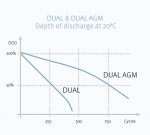
I think if you're looking at a reasonably sized bank, the Trojans would be OK. I like the cleanliness and charge acceptance of AGMs. In terms of cycle life, I can't find anything on the Exide website about the EK950 batteries, but the similar AGMs they market as "marine" batteries are rated for 750 cycles to 50% DoD. The equivalent to the EK950 would be the EP800, which is about the same price - see https://www.tayna.co.uk/Exide-EP800-DUAL-AGM-Leisure-Marine-Battery-P9746.html

Screen Shot 2017-03-12 at 18.19.05.png
 
Last edited:
....a posting by a gentleman that uses the online handle of Maine Sail. This is Rod Collins of Compass Marine in Maine....
MaineSail also contributes to this forum and I have had PMs with him on several issues. I agree that he is probably the most useful and knowledgeable poster on any Forum on the net.

Your Link to sailboat owners site is the best discussion on AGMs anywhere, and I would recommend anyone buying AGMs to read all of it. I agree with every word - and it supports my claims that your posts were wrong:;

https://forums.sailboatowners.com/index.php?threads/agm-batteries-making-the-choice.124973/

There are some very important points he makes about AGMs:

FACT: All lead acid batteries sulfate regardless of AGM, GEL or Flooded.
FACT: All batteries require proper charging
FACT: PSOC use will shorten the life of all lead acid batteries not just AGM
Better Charge Efficiency - The ability to store more energy in a shorter time frame due to less over-charge being required.

The only point that MaineSail doesn't address directly is my point that: "you don't NEED a large charger or alternator to take advantage."

But his most important point was that:

*AGM batteries should always be installed as a SYSTEM*

This means you should have, at a minimum, a charger that meets the manufacturers criteria - for Lifeline that is a minimum of 0.2C, for Odyssey 0.4C. 5% should be added for boat loads. If you installed Lifeline's recommended charger of 130A then there would be a great advantage over FLA batteries.

MaineSails sums it up with:

Higher acceptance - This is a HUGE benefit IF you can take advantage of it.

So if you were to double or triple your charger there would be a HUGE benefit to AGMs, but this "HUGE" advantage is not possible on most cruising boats. I have a 280A DC generator and 2 x 100A alternators and my Lifelines are 12 years old as a full time liveabroad, with only 140Watts of solar and a 400w Wind Genny. I must be doing something right!

Link on Charge Efficiency:

http://www.otherpower.com/images/scimages/7427/Lead_Acid_Battery_Efficiency.pdf

See this link above which explain Charge efficiency, especially important with Solar Panels. It also explains how non-linear this is, so whilst an FLA battery may be 95% efficient at low SOC it rapidly decreases as SOC increases. All battery manufacturers quote an average value that you should put into you Battery Monitor. The default is 85%. Lifeline claims charge efficiency of 98% for a new battery, but all these values become less as the battery ages.


MaineSail also contributes to this forum and I have had PMs with him on several issues. I agree that he is probably the most useful and knowledgeable poster on any Forum on the net.

Your Link to sailboat owners site is the best discussion on AGMs anywhere, and I would recommend anyone buying AGMs to read all of it. I agree with every word - and it supports my claims that your posts were wrong:;

https://forums.sailboatowners.com/index.php?threads/agm-batteries-making-the-choice.124973/

There are some very important points he makes about AGMs:

FACT: All lead acid batteries sulfate regardless of AGM, GEL or Flooded.
FACT: All batteries require proper charging
FACT: PSOC use will shorten the life of all lead acid batteries not just AGM
Better Charge Efficiency - The ability to store more energy in a shorter time frame due to less over-charge being required.

The only point that MaineSail doesn't address directly is my point that: "you don't NEED a large charger or alternator to take advantage."

But his most important point was that:

*AGM batteries should always be installed as a SYSTEM*

This means you should have, at a minimum, a charger that meets the manufacturers criteria - for Lifeline that is a minimum of 0.2C, for Odyssey 0.4C. 5% should be added for boat loads. If you installed Lifeline's recommended charger of 130A then there would be a great advantage over FLA batteries.

MaineSails sums it up with:

Higher acceptance - This is a HUGE benefit IF you can take advantage of it.

So if you were to double or triple your charger there would be a HUGE benefit to AGMs, but this "HUGE" advantage is not possible on most cruising boats. I have a 280A DC generator and 2 x 100A alternators and my Lifelines are 12 years old as a full time liveabroad, with only 140Watts of solar and a 400w Wind Genny. I must be doing something right!

Link on Charge Efficiency:

http://www.otherpower.com/images/scimages/7427/Lead_Acid_Battery_Efficiency.pdf

See this link above which explain Charge efficiency, especially important with Solar Panels. It also explains how non-linear this is, so whilst an FLA battery may be 95% efficient at low SOC it rapidly decreases as SOC increases. All battery manufacturers quote an average value that you should put into you Battery Monitor. The default is 85%. Lifeline claims charge efficiency of 98% for a new battery, but all these values become less as the battery ages.


I guess we are reading different articles because I see information that supports every claim I have made.

here are some tips that came out of our test that can help you prolong the life of your AGM battery.

Charge to full as often as possible, this point cannot be over emphasized.

NOTE: From Maine Sails web site "I have long known that a higher charge rate, with AGM batteries, does not necessarily translate to *significantly faster charge times from 50% SOC to 100% SOC." In his test with lab equipment it took 5:45 hours to fully charge an AGM from 50% to 100% SOC at 0.2C.
Size your most powerful charge source, usually an alternator or inverter-charger, for a minimum of 20 percent of bank capacity. Odyssey TPPL AGM’s prefer 40 percent of amp-hour capacity as minimum charge current.

Nearly every boater I've met with AGM's has bought them for their ability to take a fast charge then fed them with a diminutive alternator & charging system that took no advantage of the high acceptance rates

Don't forget minimum charge current:
Lifeline does stipulate that these batteries ideally need to be charged at a minimum of 0.2C or 20% of rated Ah capacity or you will shorten the cycle life.

AGM's tend to do best between 20% & 40% of Ah capacity in charge current. The real optimal range for fast charging is somewhere between .25C and .35C.. Bulk charging however only lasts until they hit absorption voltage and start accepting considerably less current once they become voltage limited.. The higher the charge current the sooner you hit voltage limiting and are limited by the CAR or charge acceptance rate. At .4C a Lifeline battery will exit bulk at about 20 minutes and at .2C in about an hour and fifteen minutes.... Simple stuff...

Sadly I have yet to see many boat owners truly take advantage of the actual acceptance rates on AGM banks. With typical bank sizes of 400 - 800Ah's, you'd need a HUGE alternator, or two, or a huge charger to do so. Small sailboat AUX engines just can't do this very well with serious alternator upgrades.


Here is a summary of Rod's comparison of FLA vs AGM on one boat.

Flooded vs. AGM - Same Vessel:

14 years ago I replaced four T105's on a local sailboat that had lasted 7 years with a 90 amp dumb regulated alternator (14.6V factory set point). This boat resided on a mooring with no solar or wind. The AGM bank that replaced it cost over $1400.00 and was dead going into the spring of what was to be their fifth season.

At the same time we upgraded the batteries, a full gourmet charging system with 150 amp alternator, dual pulleys, MC-612 Balmar regulator, temp sensing etc. etc. on and on was installed. He even bought a maintenance charger that was recommended by Lifeline tech support for the off season. Off season the batteries were stored in his 55 degree basement and cycled on and off the charger to keep them at 100% SOC.

The only thing he lacked was solar because he did not like the look of it. This small piece of the cycle life puzzle is what failed him. Despite the expensive charging system he rarely, if ever, got back to 100% SOC and was in effect PSOC cycling his battery bank continually. His max absorption voltage was also lower to match the battery bank at 14.4V.

Total cumulative motor run time over the four previous seasons was just over 400 hours. The bank had never been discharged below 60% SOC during these four seasons as monitored by his well calibrated Ah counter. They were simply grave-yard dead well before they should have been and EVERYTHING was done better than he'd done with his simple and inexpensive wet cell bank yet he still got two less years of use.


Note this boat owner got two years less use on a more expensive AGM bank even after investing a lot of money in an upgraded charging system.
I will repeat what I have said before. AGM batteries can offer significant benefits but at a cost, both in dollars and required charging routing. YES FLA BATTERIES ALSO BENEFIT FROM PROPER CHARGING AND WILL SUFFER FROM POOR CHARGING. However, they will tolerate abuse better and if they die an early death you have spent 30-50% on the same capacity FLA bank vs AGM.

Here's a couple more comments from Maine Sail and his website

"In order to achieve the maximum cycle life from sealed lead acid batteries, (AGM) not only should the DOD be kept as low as possible, but the charge current limit should be as high as possible."

The study then goes on to suggest that a balance needs to be met between equipment and optimal cycle life. Today Dave (an engineer for Odyssey) suggests a minimum charge current of .2C for Lifeline AGM's.

From one of Rod's articles in Practical Sailor.

AGMs are, in one sense, a Catch 22. You paid more for an AGM battery for its fast charge acceptance rate, and shorter engine or generator run times, but if you continue this partial state of charge operation, AGM batteries begin to behave more like flooded batteries in terms of their charge acceptance rates. And while a flooded battery’s capacity can often be partially restored through equalization, the effects of partial state of charge are often permanent in AGMs
 
Top