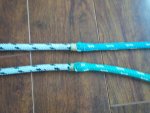
repairing damaged rope cover

Foolish Muse

Well-Known Member
Joined
27 Dec 2012
Messages
375
Visit site
I've got poly double braid sheets. The cover is badly damaged about 1 foot from the end. I don't want to toss 60' of line for just the damaged cover on the last foot. Is there a way to repair or replace the damaged cover?
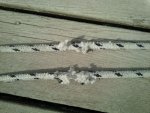
Rope Cover.jpg
 
The rest of the line doesn't look wonderful. You should get new lines and re-use the old sheet for something less critical, washing line perhaps.
 
I've got poly double braid sheets. The cover is badly damaged about 1 foot from the end. I don't want to toss 60' of line for just the damaged cover on the last foot. Is there a way to repair or replace the damaged cover?
View attachment 59963

Cut off the damaged 1 foot ends. Splice on new lengths at each end


Last edited:
Cut them short by 12" and remake the ends.
end for end them
These are actually the two ends of a single continuous sheet. It would be too short if I cut off the ends.
You should get new lines
Seems a waste of 56' of line when just a small bit of the cover is damaged. I'd like to find a better way.
Splice on new 1 foot lengths at each end
This line has been tightened beyond extreme many times, so I think it would be impossible to splice in a new line as shown in the video with brand new, never tightened line. And the core is still good, so why waste it.

I'm really looking for a way to splice on just a cover.
Any ideas?
 
If it is for a genoa you could cut it in half and attach to clew with bowlines. This will either work well or be a right pain catching on shrouds.
Alternatively whip over the damaged area, which adds no strength but will help prevent further distress. May give you a few more years.
 
Cut off the damaged 1 foot ends. Splice on new lengths at each end

On reflection far more sensible to buy new sheet,

Cut damaged ends off old one and downgrade to a 58ft mooring warp
 
Last edited:
Looks to me like the rope is in need of replacement, however, if you must salvage it........

Pull the cover towards the bitter end as much as you can and put a few stitches in, a couple of inches before the damage to stop it slipping back.

Cut through the damaged bit and pull it back over the end, don't cut it off yet.

Slide some replacement cover over and overlap the cut by about three inches, stitch this to the existing cover and whip over the join.

Pull the new cover tight and put a few stitches through it and the core.

Snip the old cover off and neatly stitch and whip the end.

Seems like a lot of work to me.

I'd rather bin some of the existing rope. Cut the damaged foot off of one end and re-whip it.

Cut the damaged foot off of the other end and using an end to end braid splice join on several feet of new line. This will get rid of all of the damage, move the "knot" at the clew to a different place and give some extra rope so if/when it happens again you can simply trim the ends.

What is causing the damage so close to the ends of the line ?
 
If you are really intent on salvaging what's left of the sheet:
Cut off the damaged bits and whip the new ends.
Double the line and tie an Alpine Butterfly at the bight.
Fit a pennant to go between the butterfly and the clew.
 
These are actually the two ends of a single continuous sheet. It would be too short if I cut off the ends.

Seems a waste of 56' of line when just a small bit of the cover is damaged. I'd like to find a better way.

This line has been tightened beyond extreme many times, so I think it would be impossible to splice in a new line as shown in the video with brand new, never tightened line. And the core is still good, so why waste it.

I'm really looking for a way to splice on just a cover.
Any ideas?
Cut off the damaged bits and splice in a short length of thinner dyneema ?
 
All done. In the end I did not want to cut or splice the core, because that is the strong part of the line. So I just cut off the damaged cover and stitched the end of the old cover to the core. Then I took another cover from an old sheet and milked it over the existing cover by an inch and stitched it into place. If it holds for another year I'll be happy. Looks funky too! I can tell people I've got super high tech sheet ends.
Rope Cover New.jpg
 
All done. In the end I did not want to cut or splice the core, because that is the strong part of the line. So I just cut off the damaged cover and stitched the end of the old cover to the core. Then I took another cover from an old sheet and milked it over the existing cover by an inch and stitched it into place. If it holds for another year I'll be happy. Looks funky too! I can tell people I've got super high tech sheet ends.
View attachment 59971
:encouragement:
 
All done. In the end I did not want to cut or splice the core, because that is the strong part of the line. So I just cut off the damaged cover and stitched the end of the old cover to the core. Then I took another cover from an old sheet and milked it over the existing cover by an inch and stitched it into place. If it holds for another year I'll be happy. Looks funky too! I can tell people I've got super high tech sheet ends.

Wish i'd have thought of that :)
 
I thought that double braid lines shared their strength fairly equally inner to outer. Given the stitching, which is now shortest and hence taking the load? Agreed, dyneema cored ropes are mainly core strength.
In practice I think that most sheet sizes are bought by size for handling and self tailing winch jaw size, rather than the working load capability
 
Top