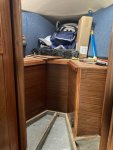
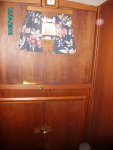
How do you achieve a finish which is not varnish but is similar to the sort of ‘satin’ finish achieved by the original builder
The boat is a1996 Victoria 34
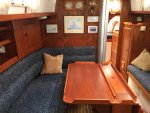
Is there an owners association you can ask what was originally used. I suspect they used a lacquer, not a varnish. Westerly and a number of other British builders used Morrells. As I am currently relacquering my interior, I am using Morrells 450 high build up acid catalyst low odour lacquer with 20% sheen. Your finish looks to be 0% sheen. This photo is after the first coat and looks a lot better now it has been finished.
I think you will find that is a satin varnish. The challenge is not so much matching the finish, but stripping the old and removing the staining. Two products that others have used successfully for satin finishes are Ronseal Satin (water based) - matches well with older Bavaria and Jeanneau and Epifanes rubbed finish. You may have to experiment in less obvious places. Refinishing solid trim is relatively easy but whole bulkheads are a challenge, particularly once you have stripped the old and possibly restained to remove the water damage.
Thank you both for the information. I will look into those products. After your words of caution I will definitely find an an out of sight small area to ‘practice‘ on.
One of my bulkhead finishes was ruined (1974 boat). At the end of the day a new veneer was applied over the old. The veneer was actually 1.5mm ply from Robbins and applied over the old veneer after surface preparation. The grain is similar to that in your pictures.
I like the idea of a veneer - I had a small area around the companionway fixed that way on a previous boat. I didn’t know that a big area was an option so thank you for that.
For a as good as new finish veneer is the answer. Veneers can be purchased in very large sheets and are relatively easy to bond. Obviously getting a good match of veneers is important. However once done, it is probably easier than trying to match and restore the existing, depending of course on how good a finish and how blemish free you are seeking.
ps I would say you have a beautiful interior and the veneer doesn’t look too bad, so a restore may well work out fine, especially if you aren’t looking to remove every blemish, but it is difficult to tell from photos. You might even be able to cut in a new veneered panel on very thin ply as an alternative.
If you are going to try the wood stain method then use a water based one like Liberon. Water stains are more controllable for the density of colour compared to spirit based ones and have softer edges to the colour if heavily applied.
If you veneer direct to the bulkhead I would think about a pre glued backed veneer which is ironed on. It looks like the original was three matched sheets, and this would be much easier than handling a large sheet. Inevtiably very accurately cut a template first. You should be able to achieve a very good result.
The finished veneer will require a light sand and then finishing.