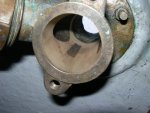
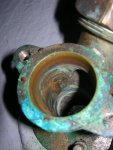
Removing blakes seacocks for servicing.

steve yates

Well-Known Member
Joined
16 Oct 2014
Messages
4,106
Location
Benfleet, Essex/Keswick, Cumbria
Visit site
Having removed the nuts, the seacock doesnt budge. Im assuming its bonded to that circular plinth somehow? How would you get it off for bringing home to clean up and regrind the cones? Or would you leave it and do it in situ?
This one is a cockpit drain and i want to replace all the hoses. The angle is quite awkward for getting it off if the seacock stsys in situ, any tips?
Ive removed 3 of the 4 cones so far, from the cockpit drains and the toilet seacocks with a mixture of heat and penetrating oil then a drift snd hammer, but the 4th is being especially stubborn. Any bright ideas? Can I wack it ? :)

Thanks.
 
Get yourself a hairdryer (says he with very little hair). They are amazing for getting hoses off and on. If the seacock body looks safe and sound, I definitely wouldn't disturb it. Easy enough to lap the valve in situ.
 
Wack it from outside with a sawn off broom handle and a lump hammer.
Agree but, first spot of penetrating oil, let it soak in then gently at first apply the broom handle and hammer

oops, that is what you have been doing..... bar the entry from outside


can't see how you can lap it without taking the cone out... (and leaving the body insitu)
 
Last edited:
Mine were badly seized years ago ..... present of Solent Seawater !!

I removed the two nuts and the holding plate .... leaving the square top and cone in place - seized ! Liberal doses of Releasall ... do they still sell that ? Its a petroleum based release oil that has absolutely no lub property at all .... but frees up bolts / nuts etc.
Forget all that spray rubbish ... even diesel is better !!
Let it soak in ... then I just kept tapping the square top with a mallet .... and a number of taps around the body taking care not to be too vigorous !! Finally it started to give and eventually slid out ...

The trick was patience and frequent light shocks to break the seal ....
 
Another question. Does the cone need to be lapped in its own seacock?
I have a spare at home i bought and it would be very easy to use that and lap the cones in it one at a time.
Depends if lapping is just to clean up the cone or if is to marry it to the inside of the seacock?
 
You don't need to remove the seacock body/skin fitting from the hull, and you don't need to take the cones home, because you need the bodies to lap the cones in.

As some others have said, just moderately whack the cone from outside the hull using a mallet or hammer on a 'drift' comprising a bit of broom handle or other bit of wood narrow enough to pass through the external opening of the skin fitting.. The combination of the vibration and the grunt (technical term) of the whack will almost certainly free it.

Before you whack it, consider replacing the cone securing ring with the clamping bolts done up just loosely. This will avoid the cone making a dive for the depths of the bilges or some other inaccessible place as it comes free as result of the aforementioned whack.

Blakes recommend using medium grinding paste for lapping in the cones, but fine and coarse paste is more readily (e.g. Halfords, etc.) and cheaply available. I splashed out on some medium paste by mail order, but others have reported on here using the 'wrong' grades without apparent ill effect.
 
Another question. Does the cone need to be lapped in its own seacock?
I have a spare at home i bought and it would be very easy to use that and lap the cones in it one at a time.
Depends if lapping is just to clean up the cone or if is to marry it to the inside of the seacock?

No, do each cone in it's own seacock body. You are grinding both cone and body, so that they mate as closely as possible.

Quite likely with age there will have developed some irregular wear/erosion that means it is not exactly regularly conical. That doesn't matter much, so long as the body and cone match one another.

You might get away with doing them separately, by why would you?
 
Another question. Does the cone need to be lapped in its own seacock?
I have a spare at home i bought and it would be very easy to use that and lap the cones in it one at a time.
Depends if lapping is just to clean up the cone or if is to marry it to the inside of the seacock?

I have swapped cones and it was ok after grinding in. Not saying I recommend it or that it will work every time but I have done it. I guess you may have a problem if you have a very old, bronze and a newer type, don't know though.
 
On my current boat , the Blakes seacocks were all glassed in. All the cones were seized. One was a real bugger despite all the above ideas.

As mentioned, it's very hard not to increase the hammer blow force from outside to free the cone. It may be possible for someone inside the boat to offset the hammer blows . Something like a jacket to shield the inboard volunteer from hopefully not being pierced by the flying cone. Edit. Meant to say rolled up jacket.
 
Last edited:
Something like a jacket to shield the inboard volunteer from hopefully not being pierced by the flying cone.

See post #9, paragraph 3 for something unlike a jacket that will avoid such an unfortunate outcome!

If a couple of moderate thwacks don't release it, try repeated tapping between thwacks, rather than ever more violent thwacks - it's amazing what vibration can do. (Sometimes!)
 
Last edited:
See post #9, paragraph 3 for something unlike a jacket that will avoid such an unfortunate outcome!

If a couple of moderate thwacks don't release it, try repeated tapping between thwacks, rather than ever more violent thwacks - it's amazing what vibration can do. (Sometimes!)
Rather than escalating to a sledge hammer, a pneumatic hammer might be better as it delivers a succession of relatively light blows.
 
Rather than escalating to a sledge hammer, a pneumatic hammer might be better as it delivers a succession of relatively light blows.

A pneumatic hammer would indeed be better than a sledge hammer (which I wouldn't recommend at all), but a forearm can also do the job, and not only save the cost of buying or hiring a pneumatic hammer, but also a trip to the gym. ?
 
Why cause further problems, hitting the valve from inside or outside is never a good idea to risk cracking the hull

We are not talking (at least I wasn't) about hammering out the body/skin fitting, but hammering out (well, actually inwards) the seized cone from the skin fitting, while the latter remains affixed to the hull.

In my view, if the hull and/or skin fitting can't take a moderate thump from a hammer, then its best to find that out while the boat's ashore!
 
We are not talking (at least I wasn't) about hammering out the body/skin fitting, but hammering out (well, actually inwards) the seized cone from the skin fitting, while the latter remains affixed to the hull.

In my view, if the hull and/or skin fitting can't take a moderate thump from a hammer, then its best to find that out while the boat's ashore!


In my mind its not risk of breaking the item ... but of cracking or breaking the seal of the unit to hull. Usually the offending item has been in place for many years ... sealant used when originally fitted dried out or deteriorated. Growth has accumulated keeping it watertight .......... Joe Blogs comes along and gives it a whack .....

Where is that water coming from that's slowly collecting in the bilge ??????
 
Top