Rejuvenating wood

Joined
1 Aug 2011
Messages
2,010
Location
Maybe in a boat next to you?
Visit site
I am starting to look at my internal woodwork & am thinking how to 'do it up'.

It all seems to be teak faced type ply that over the years has either received a light coat of some sort of varnish or "wood stain."On top of that has been applied a liberal coating of nicotine & general mould.I would like to restore it to it's original condition & either give it a coat of oil or maybe Johnson's wax type furniture polish.
In places I have given it a scrub with sugar soap & this has produced good results but I suspect it won't overcome the more intact varnish/woodstain,any suggestions?
 
If you really want to do the job properly then use a chemical paint stripper to remove all the old finish. A range of scrapers will help carefully remove the old finish without damaging the veneers on panels. Light sand and maybe some use of oxalic acid to bring the colour of the wood back to an even finsih. Then refinish with a satin finish polyurethane. Very little material cost but hours of work and well worth it when you finish.
 
If you really want to do the job properly then use a chemical paint stripper to remove all the old finish. A range of scrapers will help carefully remove the old finish without damaging the veneers on panels. Light sand and maybe some use of oxalic acid to bring the colour of the wood back to an even finsih. Then refinish with a satin finish polyurethane. Very little material cost but hours of work and well worth it when you finish.

I read in a similar thread about people using a 50/50 bleach mixture,does that produce the same result as oxalic acid or is it not comparable & if it is not comparable where do you buy that oxalic acid,ebay?
 
I'd agree but caution as the scrapers are not intended to scrape the wood, just the "varnish". If possible, don't use a scraper, use a medium scrubbing brush instead. This is likely to be messier as it will flick muck about, but you'll need to rinse down the panels anyway to get all the stripper off. Try to look at this rinsing water as an opportunity rather than a nuisance as it will collect in the bilge and clean that out too! Much the same applies to the use of oxalic acid or any other teak cleaner and brightener. It must be thoroughly rinsed off efore you can refinish.

The choice of a new finish is a very personal one. Unless the finish is flawless, a gloss varnish will emphasise any imperfections. I prefer a matt or semi-matt finish - e.g. Le Tonkinois offer a matting agent that can be added to the top coat. My own boat has all the internal woodwork finished with many coats of Deks Olje 1, which gives a slight sheen. Advantages of oil, easy to apply, doesn't chip and can be given a fresh coat anytime: disadvantages, doesn't weather too well (not so important in the cabin) and if not thoroughly dry can hold dirt.

Rob.
 
If you really want to do the job properly then use a chemical paint stripper to remove all the old finish. A range of scrapers will help carefully remove the old finish without damaging the veneers on panels. Light sand and maybe some use of oxalic acid to bring the colour of the wood back to an even finsih. Then refinish with a satin finish polyurethane. Very little material cost but hours of work and well worth it when you finish.

+1

Of the many boats we have sold the best refinishing job I have seen done on an old tired interior was done by the owners with Nitromors, followed by VERY careful scraping back to bare veneer with a cabinet scraper. The solid wood trim was also stripped, but some sanding done as well - no sanding on veneer though as too easy to go through. I saw this boat "before and after" and the transformation was superb. This boat was then refinished with oil, which looked very good but I disliked the "feel" - I personally prefer a satiny varnish.

I have done small parts of various yachts myself, and got good results, but never needed to do a total refurb. Recently discovered Epifanes rubbed effect varnish, which is really nice to use, though I have also previously got a really nice finish with a mix of Ronseal oil-based satin and gloss varnishes - about 50/50 gives a nice result.
 
Last edited:
I read in a similar thread about people using a 50/50 bleach mixture,does that produce the same result as oxalic acid or is it not comparable & if it is not comparable where do you buy that oxalic acid,ebay?

Wessex Chemicals sell oxalic acid. No doubt there are other suppliers. Comes in crystal form so you can dilute to suit severity of staining. As already suggested wash thoroughly after use and before sanding as dust is very unpleasant.

Important thing is to remove all the old finish. I am using a Polyfilla stripper at the moment which seems effective at shifting old finishes. Once you get back to bare wood you will see if you need to use any restorer.

The rubbed finish jwilson suggests is good as the last coat on top of normal varnish for real depth but I have always had good results from Ronseal satin finish polyurethane.
 
The wide range of Liberon products (http://www.woodcareexpert.co.uk/interior-woodcare/) also includes a wax and polish remover and a stripper. The right grade (!) of steel wool is usually recommended with many wood cleaning products. I have done a fair amount of furniture restoration, as an amateur, and would underscore Vara's point about starting with a more benign product such as a wax remover/cleaner before going to stripper - unless it's obviously beyond that point.

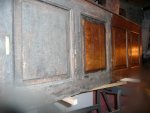
This shows the restoration of an old chest, which I hope illustrates that a wood cleaner/steel wool combination can be effective with heavy soiling whilst retaining patina. Be warned that it was a lot of work, however! (And I did have to replace the damaged inlays.)

P1000999.jpg
 
OK boyo's some good sound advice there.I have found sugar soap applied with some scotchbright type stuff (similar to a brillo pad) a friend gave me from his last employment did a pretty good job of cleaning up the basic wood & I reckon it could also work well with the more dedicated paint removers mentioned here & I will give that a go when the time arrives.I like the polyfilla striper suggestion that should be pretty cheap & readily available I imagine & the local Wilko's also do that colyron range of products + their own brand so I shall take a look at that & all the other advice has been valuable.
If I decide to varnish I reckon that's covered.Thanks all :)
 
The wide range of Liberon products (http://www.woodcareexpert.co.uk/interior-woodcare/) also includes a wax and polish remover and a stripper. The right grade (!) of steel wool is usually recommended with many wood cleaning products. I have done a fair amount of furniture restoration, as an amateur, and would underscore Vara's point about starting with a more benign product such as a wax remover/cleaner before going to stripper - unless it's obviously beyond that point.

This shows the restoration of an old chest, which I hope illustrates that a wood cleaner/steel wool combination can be effective with heavy soiling whilst retaining patina. Be warned that it was a lot of work, however! (And I did have to replace the damaged inlays.)

View attachment 45160

Just a question.That chest looks very grey,is that finished? I'd be very tempted to give it a go with sand paper or did you subsequently improve upon that?
It looks like it has still got a coat of old undercoat on it or something.
 
Last edited:
Just a question.That chest looks very grey,is that finished? I'd be very tempted to give it a go with sand paper or did you subsequently improve upon that? It looks like it has still got a coat of old undercoat on it or something.

Er ... that's the uncleaned part! It's a picture taken part way through cleaning - perhaps if you click on it to enlarge you may be able to see some difference between the nearest section (uncleaned), the next section (central panel cleaned) and the furthest two sections (completely cleaned). But it's interesting, in the context of the advice Vara and I were giving to start gently, that your reaction to the uncleaned portion was to reach for the sandpaper.

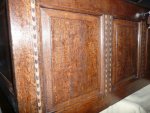
Here's a photograph of the grey panel in the last one after cleaning, with new inlay but before final fettling and polishing (which toned down the light colour of the inlay). It hasn't the smooth perfection we like to see in our boat interiors, but then it's a very old piece (much of the rear frame is made from an older item, roughly carved with ‘finger’ decorations - not an uncommon practice in the making of 'country' chests.)

P1010112.jpg


Anyway, don't be too quick to pick your own pocket :) for sandpaper - and good luck!
 
Er ... that's the uncleaned part! It's a picture taken part way through cleaning - perhaps if you click on it to enlarge you may be able to see some difference between the nearest section (uncleaned), the next section (central panel cleaned) and the furthest two sections (completely cleaned). But it's interesting, in the context of the advice Vara and I were giving to start gently, that your reaction to the uncleaned portion was to reach for the sandpaper.

Here's a photograph of the grey panel in the last one after cleaning, with new inlay but before final fettling and polishing (which toned down the light colour of the inlay). It hasn't the smooth perfection we like to see in our boat interiors, but then it's a very old piece (much of the rear frame is made from an older item, roughly carved with ‘finger’ decorations - not an uncommon practice in the making of 'country' chests.)

View attachment 45182


Anyway, don't be too quick to pick your own pocket :) for sandpaper - and good luck!

OH I see.I thought that bit that looked grey to me was the bit you were claiming was cleaned (In the previous picture) & the far panel was varnished or something..Now your present picture is a great improvement & I can't see any need to use sandpaper on that one.:o
 
Last edited:
Er ... that's the uncleaned part! It's a picture taken part way through cleaning - perhaps if you click on it to enlarge you may be able to see some difference between the nearest section (uncleaned), the next section (central panel cleaned) and the furthest two sections (completely cleaned). But it's interesting, in the context of the advice Vara and I were giving to start gently, that your reaction to the uncleaned portion was to reach for the sandpaper.

Here's a photograph of the grey panel in the last one after cleaning, with new inlay but before final fettling and polishing (which toned down the light colour of the inlay). It hasn't the smooth perfection we like to see in our boat interiors, but then it's a very old piece (much of the rear frame is made from an older item, roughly carved with ‘finger’ decorations - not an uncommon practice in the making of 'country' chests.)

View attachment 45182


Anyway, don't be too quick to pick your own pocket :) for sandpaper - and good luck!

the inlay's an improvement.
 
A lot of good advice- personally would always use chemical stripper on veneer - if using cabinet scrapers (which can give great results) learn how to raise the edge on the scraper to give a clean cut and be gentle.
for waxing I would make my own wax - commercially sold waxes are made to be easy to apply but are therefore very soft. It’s easy to make a mix from Cornuba wax, bees wax and solvent- I use paraffin but there are lots of choices and plenty of advice online. Best applied with 0000 wire wool but a new stiff shoe polish brush works very well.
the end result is much longer lasting- for instance finished a new walnut coat rack I made this way and 4 years on after much use still hasn’t needed to be redone
 
I would cast my vote for traditional oil-based spar varnish for most things on a boat, because it doesn’t crack like polyurethane when woodwork expands and contracts with the variations in temperature and moisture that are inevitable, even below deck.
I have not tried it myself, but I hear that an electric heat gun and a stiff brush are good for removing old finishes.
 
Top