Reinstalling under deck buoyancy?

MystyBlue2

Well-Known Member
Joined
27 Aug 2020
Messages
819
Visit site
Hi folks as a few of you may have seen on another thread that my boat has a few safety issues..The biggest concern is the lack of positive buoyancy i had to remove as the old foam was soggy and the deck was rotten. Because of this i opted out of doing that again. However it has been brought to light that it can be a MAJOR safety concern so im willing to rectify with i little guidance.

Now ive heard some horror stories about the CLOSED CELL 2 PART POUR FOAM as if not calculated correctly can cause catastrophic damage but is probably the best option as for getting into every crack and crevice to ensure maximum buoyancy is achieved. I'm not too keen on drilling several holes in deck as "vents" as its a whole new deck yes! Maybe this should have been done BEFORE the deck was laid but my reason for removal put me off making the same mistake again....

So if i where to use this method what would be the best tactics to achieve best results without damage and drilling 100 holes in my new deck?

Second option is PLASTIC BOTTLES.
Again this probably should have been done before deck was laid as i only have 2x 3" inspection hatches to put them down under the floor (one at stern and one at bow both central) so they will only lie in single file from stern to bow and rattle unbelievably and because of this i would only get a total positive buoyancy equal to that of a 20L drum tied to the side. So the bottles cant be "compressed and squeezed together tighter to reduce rattle and increase buoyancy.

Third option - PING PONG BALLS, But if a boat fire was to arrise it would cause a catastrophic chain reaction of small explosions as the gas inside is flammable and the molten plastic would make matters worse. But because they are small enough they could near enough fill up as much dead space as possible as appose to single file bottles and give me good positive buoyancy.

Fourth option is KIDS PLAY PIT BALLS. Slightly larger than ping pong balls but without the flammable gas inside. Can be easily dropped down the inspection hatches to fill the void as much as i can to give a higher buoyancy than bottles but not as much as the expanding foam. But also no need for 100 small holes all over my new deck.

Is there anything anybody would like to add or tips and advice on the above methods and which one would be most effective as POSITIVE BUOYANCY.

any other methods would be taken onboard aswell.

Sorry for the blab folks hope this makes sense, looking forward to your thoughts ?
 
Sorry to be a gainsayer, but I'm not convinced of any of your suggested solutions. Have you got a photo pf the boat?

Making watertight compartments or adding buoyancy bags would be my preferred option and the chosen method for dinghies for many years.

The buoyancy has to be in the right place. ie Evenly distributed for and aft as well as at the right height. If you ended up swamped, you don't want to end up with a boat afloat but with just the bow sticking out of the water or the whole boat upside down. Built in bouyancy isn't quite as straightforward as some people think.

(The reason I don't like bottles or balls is that for the volume they take up, you don't gain as much buoyancy as you hope to. In other words, for a 1m cube you only gain perhaps 70% or 80% of that volume as effective buoyancy in the event of swamping.)
 
Use the closed cell foam but do a little at a time to avoid issues. You'd only damage if it expands and puts pressure on something and that would only happen if you fill it in one go :)
 
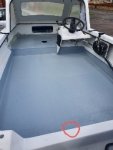
This is a pic of the deck...it has now been finished and inspection hatches installed. See pic
 

Attachments

  • 20210203_112431.jpg
    20210203_112431.jpg
    16.9 KB · Views: 50
So theoretically could i use the foam...tip the bow down and stern up and pour from stern hatch and allow it to slowly run forward.

Once it has filled up the aft half of the boat tip the bow up on jockey wheel and pour from bow down until it flows out of bow hatch creating a join of foam in the middle?
 
What would i do about the 2 side sponsons? The only acess to them under deck voids are 2 drain bungs on the transom, so if i poured into there, it could cause damage as it has nowhere to escape from apart from the bungs?

This seems to be alot harder than originally expected. :unsure:
 
Sorry to be a gainsayer, but I'm not convinced of any of your suggested solutions. Have you got a photo pf the boat?

Making watertight compartments or adding buoyancy bags would be my preferred option and the chosen method for dinghies for many years.

The buoyancy has to be in the right place. ie Evenly distributed for and aft as well as at the right height. If you ended up swamped, you don't want to end up with a boat afloat but with just the bow sticking out of the water or the whole boat upside down. Built in bouyancy isn't quite as straightforward as some people think.

(The reason I don't like bottles or balls is that for the volume they take up, you don't gain as much buoyancy as you hope to. In other words, for a 1m cube you only gain perhaps 70% or 80% of that volume as effective buoyancy in the event of swamping.)
I've had a think of your idea on buoyancy bags...would INFLATABLE RIB KEEL ROLLERS work?

I could stuff it down the hatch and down the centre keel and leave the valve sitting just under the inspection hatch at the stern cap so can be inflated and also adjusted to deflation/over expansion due to outside temperatures?
 
On my mobo I have used our local milk bottles that are mainly square in section and made from HDPE. I filled then with PU foam and fixed the top on.

I have 8 " plastic hatches in my bow section. That so can remove the bottle and inspect then every so often.

The sides of my boat are filled with sealed PVC tube all along each side up to gunned level.

The major issue is buoyancy at the stern where the engine weight is.

The other issue you will have to calculate if you have enough buoyance to keep the boat afloat

The floor of my boat is sealed except for a drain plug at the bottom of the transom so I can check for leaks after recovery back on to my trailer
 
On my mobo I have used our local milk bottles that are mainly square in section and made from HDPE. I filled then with PU foam and fixed the top on.

I have 8 " plastic hatches in my bow section. That so can remove the bottle and inspect then every so often.

The sides of my boat are filled with sealed PVC tube all along each side up to gunned level.

The major issue is buoyancy at the stern where the engine weight is.

The other issue you will have to calculate if you have enough buoyance to keep the boat afloat

The floor of my boat is sealed except for a drain plug at the bottom of the transom so I can check for leaks after recovery back on to my trailer
Which the size and shape of the void is going to be extremely hard to begin with. And to top it off my maths is not good at all.

One false slip up and i have a massive chance of potentially ripping apart my boat or not putting in enough and its all been for nothing.

As my maths is completely rubbish it is going to be guess work at best...it boils down to a gamble now then.
 
I think the foam is mostly just a future menace.
If you have a structurally sound deck with a sealed dry compartment below it, you are sorted.
In retrospect, I'd have made it 3 compartments, but 1 is OK.
If you want to add buoyancy in case of getting holed, bottles or bags of bits of polystyrene .
Or air bags of some sort.

Some people squirt the foam into a stout poly bag under the deck, this hopefully slows the foam absorbing water.
 
Only other option i have is to make several holes in the deck above the seperate Chambers about 200mm apart the full length bow to stern, once filled up cut the overspill out and fill in the holes with plastic padding and flowcoat over the top.
 
Which the size and shape of the void is going to be extremely hard to begin with. And to top it off my maths is not good at all.

One false slip up and i have a massive chance of potentially ripping apart my boat or not putting in enough and its all been for nothing.

As my maths is completely rubbish it is going to be guess work at best...it boils down to a gamble now then.


When filling a closed space with foam can can explode the void quite easy (don't ask me how I know) This is why I went for bottles

I made a jetty for my boat from discarded floats from the marina my sail boat is in. They were discarded as the were filled with closed cell foam but took up water from rail. I cut an 8" hatch opening n the side and cutout all the foam (one hell of a job) and filled with bottles. Fitted the hatch and pressure tested to ensure no leaks, job done.
 
I think the foam is mostly just a future menace.
If you have a structurally sound deck with a sealed dry compartment below it, you are sorted.
In retrospect, I'd have made it 3 compartments, but 1 is OK.
If you want to add buoyancy in case of getting holed, bottles or bags of bits of polystyrene .
Or air bags of some sort.

Some people squirt the foam into a stout poly bag under the deck, this hopefully slows the foam absorbing water.
The compartments are seperate as the deck is sitting ontop of the chines as support so if you cut the transom off and look through ul see a M shape (chines) and deck sitting ontop seperating each chamber.

Its not a sealed air compartment as i have installed inspection hatches so if i did get a leak from D ring, chip in keel etc i could see how bad it was and start bilging it out. But because of that ive opened myself up to the possibility of filling underdeck with water and sinking.
 
When filling a closed space with foam can can explode the void quite easy (don't ask me how I know) This is why I went for bottles

I made a jetty for my boat from discarded floats from the marina my sail boat is in. They were discarded as the were filled with closed cell foam but took up water from rail. I cut an 8" hatch opening n the side and cutout all the foam (one hell of a job) and filled with bottles. Fitted the hatch and pressure tested to ensure no leaks, job done.
Blooming heck! This is a horrible job isn't it!
 
Major rescue launched after boat sinks in the Menai Strait

This post is going to appear very negative.

There were many people taking to the water in repaired older craft last summer in our area.
Lockdown projects were launched and some may still be floating.

This one was never found.

It was a similar small cathedral hulled boat. Unfortunately they managed to foul their anchor line in their prop and were effectively towed backwards at 5 knots. No one was able to reach the line with a sharp knife on a pole without flooding the boat.

These boats had minimal positive buoyancy even when brand new.
Fill it up with fuel, fishing gear, anchor chain warp, a few mates and your freeboard at the stern will be negligible.. (forget a permanently mounted auxiliary)

Before you venture 6 mile off into the deep try reversing at 5 knots into the waves in a force three whilst you can still swim ashore. I have read your other post and I think this is compensation for your main concern which is the suitability or fitness for purpose of your old craft.
I praise you for your endeavours but I think you really know the problem!

I make no apologies but I think I am only posting what some are too reticent to say.

Steve
 
Major rescue launched after boat sinks in the Menai Strait

This post is going to appear very negative.

There were many people taking to the water in repaired older craft last summer in our area.
Lockdown projects were launched and some may still be floating.

This one was never found.

It was a similar small cathedral hulled boat. Unfortunately they managed to foul their anchor line in their prop and were effectively towed backwards at 5 knots. No one was able to reach the line with a sharp knife on a pole without flooding the boat.

These boats had minimal positive buoyancy even when brand new.
Fill it up with fuel, fishing gear, anchor chain warp, a few mates and your freeboard at the stern will be negligible.. (forget a permanently mounted auxiliary)

Before you venture 6 mile off into the deep try reversing at 5 knots into the waves in a force three whilst you can still swim ashore. I have read your other post and I think this is compensation for your main concern which is the suitability or fitness for purpose of your old craft.
I praise you for your endeavours but I think you really know the problem!

I make no apologies but I think I am only posting what some are too reticent to say.

Steve
Thats why im trying to be as safe as i can before i go out, any boat can sink at any time from sinking on a mooring to 100miles from land. Im trying to make the boat as safe and buoyant as i can so i can use it.

Its not a big ornament i can put on my fire place.

These style of boats have been widely used for decades and where the GO TO boats in the 80/90's as they are super stable and safe craft.

Every boat has its down sides but i do consider it to be alot safer than a kayak say...and we've all seen that solitary kayaker dissappear into the horizon with only a lowrance and a handheld, no support and limited gear. I have no intention of going as far out as that. 6miles is away from land but still coastal.

These are very capable boats there is a film made by phil williams
...

Very capable small boats for definite. I just need to perfect some minor issues to make myself a little safer and cover my back end.

Obviously if my time is up then thats up to the gods to decide.

As long as i cover every aspect of safety then if i ever need to make a call for help my conscience is totally clear. Any boat can get into trouble at any time regardless of size and shape.

We breathe air not water so being on the water in general is a huge hazard.

Im in no hurry to be a statistic so im trying to be as safe as i can.
 
How many boats actually have any form of buoyancy built in ? I would say hardly any !
Therfore is it worth all the hassle ?
What if i bought 2 new inspection hatches with new seals. Fit them with plenty polyurethane adhesive.

In theory when the caps are on it would be one big sealed air chamber yes?

And periodically open then to inspect for leaks...

When the caps are on i have that sealed chamber of buoyancy yes?

Or am i totally wrong in this respect?

If im correct then i could get away with that "big air pocket" as POSITIVE buoyancy...
 
Top