Reinforcement

zoidberg

Well-Known Member
Joined
12 Nov 2016
Messages
6,933
Visit site
I'm knee-deep in preparing reinforcement for the hull in way of a pair of 'sockets' for yacht legs.... which have substantial 16mm bolt-pairs through the hull.
Following guidance on Vyv Cox's website ( installing-yacht-legs ) I plan to fasten a piece of backing material inside the hull, each side. Unlike VC, I don't have foam to hoik out, so the material will be bonded to the insides of the hull with thickened epoxy.

The question for me is 'What material to use?'

I have 25mm ply, and 25mm oak, 40mm and 20mm teak. No Tufnol. Epoxy will be applied liberally over, under and around.... Does it matter? Would a surveyor suck his teeth?
 
It depends upon thickness of GRP for the hull, although needs to be of a reasonable area/size to spread the load. Any of the wooden pads would do, but ply possibly easier to bond with thickened epoxy, having roughened the surface it is bonding to. Think about adding steps for access.
 
Neither oak nor teak are ideal for epoxy gluing, as the acids and oils can interfere with bonding. I would be concerned also about introducing hard spots around the pad that may cause stress cracks in the GRP. Personally, I would favour the 25mm ply, is it is proper marine stuff. I would chamfer the edges so as to avoid hard stress lines. Finally, I wonder if a more flexible adhesive, Sikaflex or the like, might be kinder on the GRP as it would provide some cushioning.
 
For myself....
Ply is more stable.
Grind and key the hull grp
Round off all the edges if you like on the ply block then pug it down on a polyester pug mix, nicely filleted radii, once it has set up in place laminate over it to the hull with grp and cloth , feathering outwards with the layers , jobsa good un.

I wouldn’t bother with epoxy, myself ..but each to their own

One can so easily overthink these things
 
Agree with ply for backing piece. I would say use ' no more nails' or similar to stick it to the hull as high performance not needed (the fixings will hold it in place). As it's not under water, marine ply not really necessary but I'd paint or varnish it.
 
I agree with using plywood and Sikaflex, keying surfaces, and rounding off corners; in addition, I am curious: is the inside of the hull as flat as the piece of plywood? 25mm plywood is very stiff to bend, and you won't be able to clamp it very well (unless you already have holes-at what stage will you drill them? )
So will you shape the plywood, to give a close mating surface to the hull?

Will you be putting bolts through the holes regularly, in a hurry, one-handed, from an awkward position?
Possibly have a bit of a countersink type chamfer to make it easier to put the bolts in.
Maybe consider lining the holes with a bit of tube, to avoid wear?
 
Thanks, guys. Ply it is. I'll be 'fairing' it using planer and belt sander - 'cos I have them handy - and using epoxy bog, as I have the makings.
Certainly I'll round the corners and chamfer the edges. The 'mountings' bolts fit through the hull grp, just, and I'll relieve those 'oles a little so I can soak the exposed layup with some eopxy.... may as well!The bolts 'n nuts will hold the pieces of ply in place while the epoxy bog goes off...... insh'allah!

The 'mountings' themselves will have some CT1 applied to their mating faces, and a little of that will be applied to the slightly-chamfered outer edges of the hull 'oles.

The faces of the ply pieces will have some epoxy 'flowcoated', which should prevent any moisture takeup. If that's not good enough, I'll eat my hat!
 
I used Iroko 300mmx300mmx25mm and clagged it on with Toolstations PU40 which is similar to Sika.
Works a treat but to be honest unless you get the grounding spectacularly wrong they get very little load.
I can sway my 7.5 ton boat from side to side when it’s on the legs
 
Zoidberg, are you fabricating the legs as well? I'm looking for ideas for my long keel Evasion 32 which already has the sockets from new.
I'm thinking of allu scaff, joined in the middle to allow onboard stowage but having only seen pics of dried out boats, wary!
 
Zoidberg, are you fabricating the legs as well? I'm looking for ideas for my long keel Evasion 32 which already has the sockets from new.
I'm thinking of allu scaff, joined in the middle to allow onboard stowage but having only seen pics of dried out boats, wary!

Nope. I thought long/hard about that. Couldn't quite convince myself that alu scaff poles had the 'mojo' - and didn't want to find out the hard way. I was mulling over using some sections of small boat mast ( much larger diameter tubing ) when a set of genuine ( used ) Yacht Legs turned up in Sales/Wants somewhere. ( see Viv Cox's site - link at #1 ).
They've needed a little fettling to fit, but I'll have no worries with those.
 
Pre-cast fiberglass, bonded in place. It becomes a part of the boat that will last as long as the boat. I don't understand adding wooden pads in critical places. I've seen too many through hull backing plate rot, resulting in loose valves and considerable risk.
+1. Not only rot, it crushes relatively easily too. I use scrap ply to stand engines and gearboxes on because projecting lumps make their own holes.
 
+1. Not only rot, it crushes relatively easily too. I use scrap ply to stand engines and gearboxes on because projecting lumps make their own holes.
You definitely have a good point about crushing. Any place plywood is commonly used on yachts, there is probably some kind of plastic which is better. Gluing them might be a bit specialised.
I have plastic pads on my oak engine beds, the material is rock hard and nothing can rot or hurt it, the stuff needs machine tools to work it. The trouble is I can't even remember the name of it. The engine suppliers suggested using it.
For Zoidberg to use a familiar material within his obviously great DIY skills makes sense, and plywood will be fine.
 
Nope. I thought long/hard about that. Couldn't quite convince myself that alu scaff poles had the 'mojo' - and didn't want to find out the hard way. I was mulling over using some sections of small boat mast ( much larger diameter tubing ) when a set of genuine ( used ) Yacht Legs turned up in Sales/Wants somewhere. ( see Viv Cox's site - link at #1 ).
They've needed a little fettling to fit, but I'll have no worries with those.
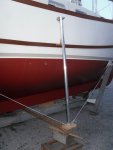
2 3/4" heavy wall pipe (1/4") worked for us on a 8.5ton boat. They are 7' long. I also made the brackets out of solid aluminium stock. Aluminium can be easily worked with common woodworking tools.
The following year I divided them in half and sleeved them for easy storage and added steps up one side.

SAM_0484 (2).JPGSAM_0484 small.JPGjagris 856 (2) small.JPG
 
Always interesting to consider the various views on offer.

If you prefer to avoid encapsulating wood altogether then perhaps a length of box metal section could be acquired ?
After all it is the two faces that do the work but the void would still need to be fillled with incompressible inert material .

On balance, 25mm of solid grp thickness would not take too long to build up on the bench and then bond in place on polyester pug mix and then laminate it to the hull with generous filets and tapering layers of cloth and resin.

So, I take back my earlier suggestion and go more heartedly with Thinwater no8s suggestion ?
 
G-10 (material) - Wikipedia
Ply is just inviting problems down the line as the epoxy coating will inevitably fracture due to repeatedly bolting / unbolting the legs
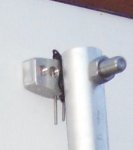
I'm not sure you understand how those legs work. There is no bolting and un-bolting involved. Once the fitting is mounted, the pin on the leg is inserted and held in place by the prongs of the u-bolt as seen in my pic.

Once installed, the ply backing will never be touched or disturbed again unless you are t-boned by a freighter.

I'm not sure why entire boats and interiors may be built in ply, but it is not permissible to use a ply backing plate sealed with epoxy. The Gougen brothers must be a ripe pair of fools. Maybe the OP should use titanium bolts as well?

I haven't looked at my ply pads in 11 years, should I panic now or save it for when I try out my legs again?
 
Top