Regulator Rectifier

Need more information. The name "Regulator Rectifier" might be confusing. Is that the name on the box? Or is it what you think it is? My guess is that it is a regulator for an alternator and as such the rectifier is usally in the body of the alternator. A photo perhaps and description of how it is used. good luck olewill
 
Hi Vic,
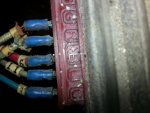
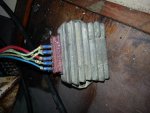
You are quite right. I did ask about this generator before. I have serviced the engine, replaced old wiring, renewed anti vibration rubbers and painted all. The problem I now have is that the regulator/rectifier, which is a 6 pin Italian model, I believe, has only used 5 of the 6 spade connections. The letters on the spades are G,G,R,+B,L and C. The first G is empty. I cannot find where these spades are supposed to go. I think +B is to go to the battery (+). The rest have me baffled. I have tried to get help from Stamegna - genset manufacturer - unsuccessfully. The engine does not have an alternator, just a tensioning pulley for the fan belt so I think that the rectifier/regulator is to charge the battery although I am concerned that it might fry it.
Can you help?
Thank you,
Liamo
 
My best guess:

Is it a rectifier/regulator associated with a charging coil to provide a ( small) current for recharging the engine start battery. Similar to the charging circuit found on many electric start outboards.

The two wires with the braided yellow insulation come from the coil. They deliver AC to the rectifier.
The red wire is the positive DC output to the battery, The case will be the negative connection.

The blue wire is probably the battery voltage sensing connection

The grey wire may provide an output signal for a tachometer

If so you might be able to also charge another small battery via a VSR or similar.
 
Thank you Vic for your answer.

I am not sure if the rectifier is associated with a charging coil. How can I tell?

The two braided wires come from the generator and the case is negatively connected to the engine block.

How can I test the blue and grey wire for a battery voltage testing connection and tachometer ( which I do not have )?

I do not know about VSRs but will look it up. That would be a great idea for the main engine start batteries.

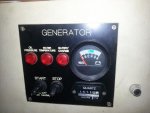
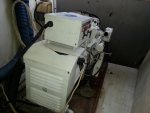
I have attached some more photographs.

Thank you again for your expert advice.

Best regards,

Liamo20141208_122120.jpg20141207_183235.jpg20141209_162537.jpg20141217_170419.jpg
 
Thank you Vic for your answer.

I stress it's not a great deal more than a guess, especially the function of the blue and grey wires. In fact now knowing that there is no tach ( I'd have been surprised if there was really) and seeing the picture of the control panel, I'll now suggest that one two may be connected to the "Battery charging" indicator light. The other could be a sensing wire though. ??or a feed to the hour counter ??

One may be a negative of course if I am wrong about the case being negative

You really need a wiring diagram to sort this out but at least the colour coding and numbering will make tracing the wiring easy.
 
Oh boy I get cranky about the English language. When I was younbg an alternator was a device which produced alternating current. A generator produces direct current also called a dynamo. Then along came alternators for cars producing DC with internal didoes from AC. Now my friends on this forum call a a machine to produce 240VAC a generator. Oh well I will try to keep up with language changes.
Anyway the 240VAC generator must have a regulator for its AC output. This consists of a small rectifier that takes a sample of the 240VAC output and copares this to a standard and then produces a correct field current to produce the required output voltage. (regardless of load). Filed coil being the rotating coil fed by brushes on slip rings. Although some designs have a brushless arangement. Here another alternator is mounted on the shaft with rotating pick up coils and rectifiers directly connected by wire to the main field coil. (all rotating) The magnetic field for this little alternator is provided by coils around the outside of the body, the current of which is controlled by the regulator
Now Vic has been describing and talking about a rectifier /regulator for charging the battery of the engine. A completely different thing I presume. (might be in the same box.)
The engine may have a pick up coil under a flywheel a bit like an outboard motor but more likely not because there is lots of power floating around in the 240VAC output to take some for battery charging.
So this these notes may avert some confusion or just add to it good luck olewill
 
Oh boy............
Now Vic has been describing and talking about a rectifier /regulator for charging the battery of the engine. A completely different thing I presume.

The reason for this is because I found the following descriptions of (current model) Stagmegna gensets

pal4-en.gif

12 v DC (24v optional) starter motor, lead acid battery, changing alternator for sets up to 100 KVA; 24v for larger sets as standard.

and

pal6-en.gif

AC brushless, 4 pole, class H insulation, automatic voltage regulation +/- 0.5, screen protected, self excited, drip proof IP21 - IP 23, sealed-for-life ball bearing, impregnated winding, fan ventilated, totating rectifiers (diodes), standard voltages.

This describes a separate 12 ( or 24) volt alternator for charging the starter battery.
It seems possible that it could be something very similar to the charging coil in outboards.
The rectifier regulator looks very similar indeed to some of the ones used in outboards. It is only OMC ones that I know much about but older ones have the sensing and tach output connections I described. The tach output is I believe about 8 volts and could be used to power the charging indicator lamp. ( newer/ replacement ones do not have the sensing connection as the sensing is now done internally)

The unused G connection might even be because the same unit could be used with the three wire AC output lighting/charging coil like, IIRC, your Johnnyrude
 
Thank you William for your information. When I next go to the boat I will dig deeper into it. The generator was bought from an Australian in Turkey some years ago and then I put it into my boat but I didn't know how it should charge the battery. I saw this little box with these wires coming out and one terminal had +B on it. So I thought that this must go to the battery. But I don't know where the grey and blue wires go. The little box case was connected to the engine with a grounding wire.
Still baffled but grateful for all the help'
Best regards and Happy Christmas,
Liamo
 
This dynamo has 3 phase (AC) and it has fixed magnets. The regulator rectifies the ac and by only using a portion of the sine wave it produces 14,4 volts (same principale as a dimmer). It works like a bycicle dynamo, but with three phases. It needs no power to energize. Trouble with this spanish regulator it can not feed large batteries, because the cooling of the thyristors is bad. This regulator is made for a 400 watts dynamo. Best is to replace the dynamo with a normal car dynamo. Its also cheaper and will last. Most likely your engine is made by RUGGERIN. If you use two batteries in parallel, it will kill the regulator.
 
I can not find the pdf and do it now from memory .3 wires are coming from the generator (3 phases no ground). One is B+ (heavy connection) , one ac output for the tachometer, one goes to the lamp . My advice use a car or a tractor alternator. This engine was made for a cement mixer and the regulator will not last on a boat.....
 
The pic inside the control box reminded me of a car wash booth I was asked to look at. I quietly closed the enclosure and made my excuses...

Does the AC side work? If so why not miss out the 12v charging and top up the starter battery with a mains charger?
 
Top