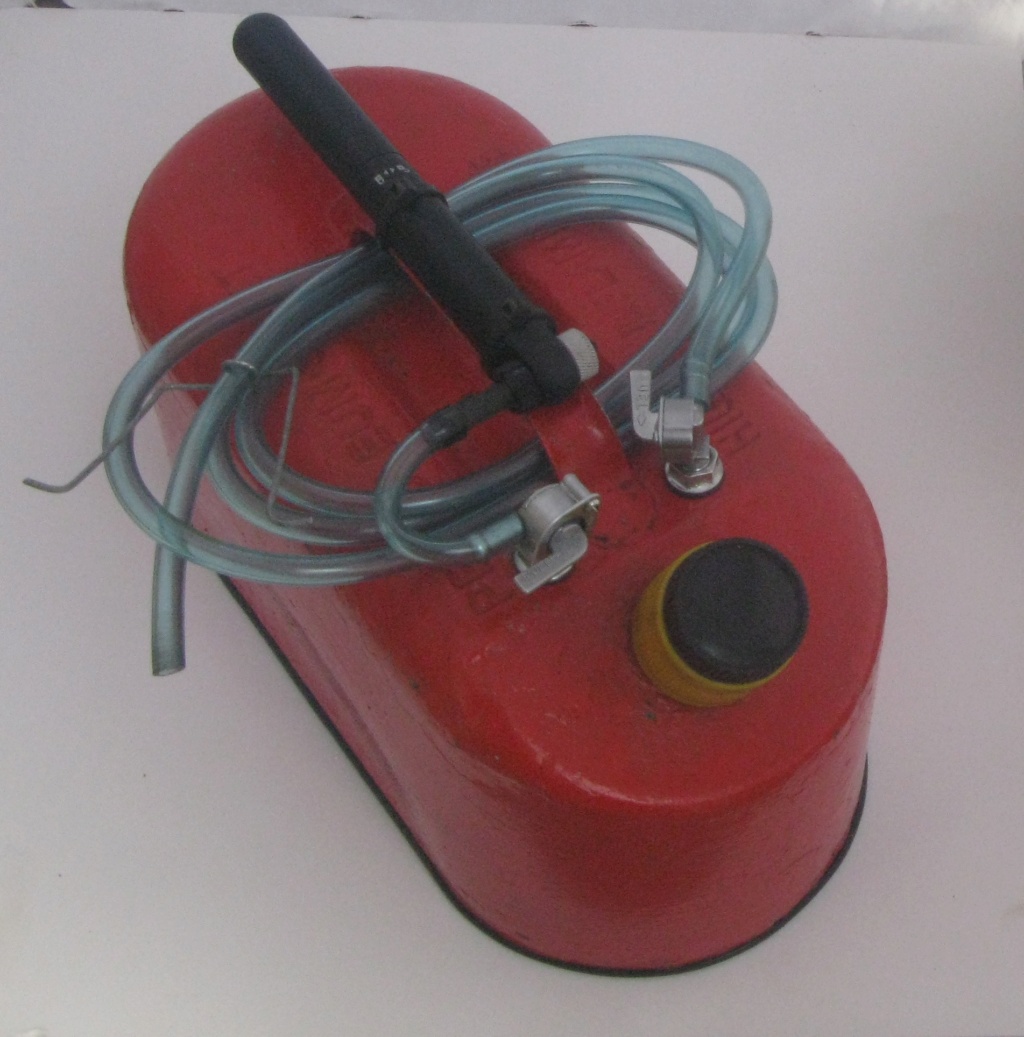
Refilling outboard petrol tank

Has anyone tried using a bulb as a pump in this way? How long to pump a litre through? If nobody knows I'll try it at the weekend and report back.
Having had the misfortune to have been obliged to drive a boat with a 9hp o.b. which had an inoperative fuel pump for a few miles, I can tell you it was no fun having to use the bulb to pump up fuel whenever the engine began to falter, which was about every two minutes
 
It took me a while to deduce that this outboard is not powering a tender but your actual boat. What you need is a remote fuel tank. Examine the engine and see if there is a socket for one

He says his outboard doesn't have a fuel pump, so it won't run from a remote tank unless he builds some kind of DIY lashup with either an inline pump or a pressurised tank.

Pete
 
These came up recently. I bought one and can confirm they are excellent.
FuelFriend®-PLUS - Jerrycan 1.0 liter + spout lockable: Amazon.co.uk: Car & Motorbike
I bought this as well and its perfect. The stiff spout fits perfectly in the tank filler and you can just dump the lot in when the fuel has run out without worrying about spilling. No hoses to worry about and no spills in the boat. The bottle neck is big enough to fill from a bigger can or even petrol pump. Very solid construction made in germany.
 
It took me a while to deduce that this outboard is not powering a tender but your actual boat. What you need is a remote fuel tank. Examine the engine and see if there is a socket for one, or post the make and model number on the forum so that knowledgeable members can give info in this regard.
If the outboard has no remote fuel fitting, bring it to someone who can fit one, amd buy a 5litre remote tank, plus either a fuel line complete, or the tubing, priming bulb, jubilee clips and end fittings and make it up yourself.
It will cost you some money but will contribute considerably to your sailing pleasure, and quite possibly, your safety.

Like prv said, he did say the outboard does not have a fuel pump. So unless he can rig up a gravity feed it's going to be a no-go for a remote tank.
Sounds like time to buy a S/H motor with a remote tank.
 
Has anyone tried using a bulb as a pump in this way? How long to pump a litre through? If nobody knows I'll try it at the weekend and report back.

I bought a bulb pump from Amazon last week with a view to using to empty the in-built tank of my 4hp Yamaha before I put it in the boot of my car. It works well but I am going to add a stiff plastic tube to the end so that I can get to the last remnants of fuel. I guess I pumped a 1/3rd of a litre in less than a minute.
 
I have small outboard with no fuel pump. Is there a way I can fill up underway without funnel etc. I have 5 litres fuel cans the tank only 1ltr but lasts long 4 strokes
Thank you.
Should have stuck with your previous motor from 4 years ago..

Hi. My petrol remote tank sheds fuel through the cap when heeling alot. has anyone made a different type to stop this?
thank you.
 
Yes, there are outboards with both an internal tank and external hook-up (I have a Honda 4 hp 4st with this system).

But just get a can with good regulation or use a shaker siphon. I've refilled afloat (but not running) many times. My last dinghy had a tiny tank. I would usually refill before it stalled.
 
This is my solution. It was posted on this Forum on 21st March 2021 in a thread started by Slawosz on 26th September 2018.


"My boat is very small, to me a standard external tank is too big and the tubing a nuisance. On the other hand of course pouring fuel from a heavy tank on extended arms in a lively boat in a short chop is all but pleasing.
I made this pressurized tank.


pic_5-10.jpg


It remains on the floorboards. For refilling, the hose end is fitted into the OB tank input, the wire spring holds it in, you pump the air in and open the fuel tap (right hand in the picture). Refilling keeps on all alone, just watch for overflow.
The other tap shuts the air input and vents the tank after refilling.
Due to the season and Covid moving limitations I did not yet test the tank on board but it is the updated copy of one I made as a young boy with a military 20 litre jerrycan and a motorscooter tire pump which worked very well.

Next job would be a valve that stops the flow before overflowing but I think I'll never tackle this for sake of "keep it simple".

The tank is mild steel 5 litre salvaged floating on the lake many years ago. The size is good for my motoring."

Sandro
 
Last edited:
Has anyone tried using a bulb as a pump in this way? How long to pump a litre through? If nobody knows I'll try it at the weekend and report back.

Yes - me. I never refuel when the engine is running, but for longer trips where refuelling is necessary, a fuel line with priming bulb is so quick and easy compared to precariously balancing over the end of a bobbing dinghy, wondering when the fuel will inevitably overflow...

I plug the line ends using a wooden toggle, then store it with the spare tank - super simples and no wasted fuel. I reckon it has saved me the cost of the bulb/line in fuel :ROFLMAO:
 
I bought a bulb pump from Amazon last week with a view to using to empty the in-built tank of my 4hp Yamaha before I put it in the boot of my car. It works well but I am going to add a stiff plastic tube to the end so that I can get to the last remnants of fuel. I guess I pumped a 1/3rd of a litre in less than a minute.

Many thanks, that sounds like a totally viable solution for me, certainly well worth a try. (I have external tank + bulb for my other OB, so the kit's already in place.)
 
This is my solution. It was posted on this Forum on 21st March 2021 in a thread started by Slawosz on 26th September 2018.


"My boat is very small, to me a standard external tank is too big and the tubing a nuisance. On the other hand of course pouring fuel from a heavy tank on extended arms in a lively boat in a short chop is all but pleasing.
I made this pressurized tank.


pic_5-10.jpg


It remains on the floorboards. For refilling, the hose end is fitted into the OB tank input, the wire spring holds it in, you pump the air in and open the fuel tap (right hand in the picture). Refilling keeps on all alone, just watch for overflow.
The other tap shuts the air input and vents the tank after refilling.
Due to the season and Covid moving limitations I did not yet test the tank on board but it is the updated copy of one I made as a young boy with a military 20 litre jerrycan and a motorscooter tire pump which worked very well.

Next job would be a valve that stops the flow before overflowing but I think I'll never tackle this for sake of "keep it simple".

The tank is mild steel 5 litre salvaged floating on the lake many years ago. The size is good for my motoring."

Sandro

That's real PBO ! . Plus tank found floating in a lake even better.

I wonder if this non overflow spout could work with it.

No Spill Spout for Combi Can
 
Yes - me. I never refuel when the engine is running, but for longer trips where refuelling is necessary, a fuel line with priming bulb is so quick and easy compared to precariously balancing over the end of a bobbing dinghy, wondering when the fuel will inevitably overflow...


Many thanks, very useful, looks like refuelling is going to be effortless. Appreciate you taking the trouble to post.
 
Transferring flammable liquids by pressurizing with air is considered extremely dangerous in every country and is strictly forbidden.

The reason gasoline is relativly safe in a tanks is that there is not enough air in the tank to explode. The atopsphere is dominated by fuel vapor and is a flooded mixture. When you pump air into the tank you may create a mixture in the flammable range that could explode. Yes, I understand that there should be no source of ignition, but the pumping of air itself can creat static, and somewhere withing the hose system there WILL exist an explosive mixture. This practice ever be aproved nor can it be defended. If flammable or combustible liquids can only be transfer using pressure, nitrogen is used.

Google "transfer flammable liquid with air pressure."

OSHA
"Transferring liquids by means of air pressure in a container or portable tank is prohibited. This may result in overpressure which could exceed what the container or tank could withstand. In addition, a flammable atmosphere could be created within the container or tank that is more sensitive to ignition due to the pressure. "

Pressure generated by the tank sitting in the sun is totally different. You have not added air to the vapors.
 
Many thanks, that sounds like a totally viable solution for me, certainly well worth a try. (I have external tank + bulb for my other OB, so the kit's already in place.)

My post was solely aimed at your question re the flow rate that a bulb pump might achieve. Take great care as I think there are real issues relating to both the vapour and to the residual fuel in the hoses.
 
Last edited:
My post was solely aimed at your question re the flow rate that a bulb pump might achieve. Take great care as I think there are real issues relating to both the vapour and to the residual fuel in the hoses.

Thanks I'll certainly be careful. Residual fuel *shouldn't* be a problem because it's no different to unplugging from the other outboard, but I'll watch for it.

I'll try it and see what I think.
 
Should have stuck with your previous motor from 4 years ago..
Ha . Still got it. 2hp shonda so versatile .can go in well lift out of well and put plug in for max sailing. Go on inflatable easy. I could afford body building lessons for big outboard but not the steroids.?
 
thinwater,
I thought to the danger of pressurizing a fuel tank, not so much for explosion as, more likely, for causing unnoticed leaks. Thus I always pump the tank only for refilling the outboard and vent it immediately after. I modified the air tap on this purpose to avoid opening the cap.
It did not came to my mind of the static spark danger. Static charge could be generated by the friction of the pump piston but in this area there is only air, no vapours. To be sure that no vapours come back fom the tank to the pump one could do one or two pump strokes before opening the air tap.
Anyway a mixture of air and vapours is always present in a partially full tank. Indeed problems often arise from condensation water in the tank, arriving to the carburator etc. and this water comes from the air.
Well, matter for thought.

A bulb pump would do the job but would keep a crew busy during all the filling time - rather long due to the low flow rate - and a tap would be needed at the outboard end of the tubing to avoid spilling at the end of the action and the tubing itself would always remain full of fuel.

Long Keeler,
I am afraid that the No spill Spout is only fit for its Combi Can. It should be interesting knowing its working principle but, as with all gear sold on line, very little information is given.

I would add that I also spotted from far away a small car wheel washed up on a beach on the lake. On inspection the tyre turned out to be my trailer's size. Salvaged as spare.
 
Top