
Reefing the main sail almost downwind solo

Those of you with a line up to the reefing spectacles - do you have one end made off on the gooseneck up to the cringle, then back down again to a winch (i.e 2:1) or do just have a line made off on a cringle then straight down?
We have our line just single to a winch otherwise you end up with too much string. We take a single line to a winch at the mast as we reef at the mast anyway
 
Those of you with a line up to the reefing spectacles - do you have one end made off on the gooseneck up to the cringle, then back down again to a winch (i.e 2:1) or do just have a line made off on a cringle then straight down?

often it's enough just to have something to pull on - without leading it to a winch..,just tie it off somewhere convenient.

i've never used 2:1 for this.

on bigger boats it can be really difficult even to get a good grasp of the sailcloth to pull down - sometimes it's far off the deck, so you are standing on one of those steps that fold out from the mast, you probably have one arm around the mast to hold on, and that leaves only one hand to pull down.
 
So how do you actually hoist, handle the additional sail?
I use a hank on high cut Yankee on an inner forestay.
Lay it out along the side deck, sheet it loose via an aft quarter turning block to the windward cockpit winch. Pole onto the Genoa, change course to put the Genoa slightly to windward, hoist the Yankee, pole it out, set course and adjust sheets.

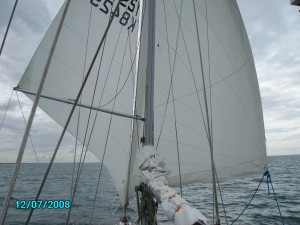
PICT0597-300x225.jpg
 
Getting the wind in front of the beam and letting the sail luff makes it easy, but there are sometimes reasons not to. When downwind, I pull the main towards the centre enough to get the sail off the spreaders then pull it down with the reefing lines. I have full battens and cars, which helps obviously.
 
often it's enough just to have something to pull on

I should have mentioned: if you have a bolt rope, you can probably get a hand on the sail cloth and pull, so a line to pull the sail down probably won't be needed. And if you have a bolt rope, the boat is probably not that big, so the loads won't be that great.

If you have cars, on a big boat it can be difficult to reach up above the stack to pull

with full battens, if the sail isn't fully luffing, the compression loading can make it hard to pull the sail down.

i see more and more big boats without a fixed reefing line to the reef points on the luff - just a strop on the mast that goes to a webbing loop on the sail

in this situation, the pull down line really helps
 
I should have mentioned: if you have a bolt rope, you can probably get a hand on the sail cloth and pull, so a line to pull the sail down probably won't be needed. And if you have a bolt rope, the boat is probably not that big, so the loads won't be that great.

If you have cars, on a big boat it can be difficult to reach up above the stack to pull

with full battens, if the sail isn't fully luffing, the compression loading can make it hard to pull the sail down.

i see more and more big boats without a fixed reefing line to the reef points on the luff - just a strop on the mast that goes to a webbing loop on the sail

in this situation, the pull down line really helps
Yep, the compression loads on our fully battened main are high when you are over powered and need to put a reef in. Hence the system we have developed by trial and error. It works. The sail is not hard to grab as you can grab the cars but in 30kts the sail won't move until you stick the haul down line on a winch. It's all preferred to spinning the boat into the wind in 2.5/3m seas in the dark. The increase in apparent wind and motion going into steep seas is just not worth it for us
 
On my little boat FB main with bolt rope (no slugs) I can not reef down wind. Not been a problem in my kind of sailing but as soon as I turn on up wind leg Reefing is easy. I use 2 line reefing ie a line at the tack down and forward so no horn and line goes back to cockpit. I reef in stages. ie loosen halyard about half way of what is ultimately needed. Take up tack line then take up clew line (both on winches at cockpit) Then lower the halyard and take up tack line and tension it. Then take up clew line and tension. And way we go. All while hard on the wind as far as possible under jib power. ol'will
 
I see the difficulty of shifting the main when its pressed against the shrouds having almost run ashore at Felixstowe with a crab pot line aound the prop holding my stern to the relatively light wind until I dropped the anchor in 2 metres of water.
Phew.
 
I find autohelm and motor into wind the easiest when single handed. Also raise the topping lift to take the weight off the sail and then adjust after reefing, this also prevents boom dropping onto sprayhoods.
Whilst I appreciate that motoring into the wind might make life easy in some senses, the statement also raises the hairs on the back of my neck a little. Firstly, what will you do if you ever have engine failure? Secondly, I’ve sailed lots of boats in situations where it’s either impractical or impossible given the seastate and strength of wind and lack of engine power to ‘motor into the wind with the autohelm’. What’s your plan B and do you practice it? In a sailing boat my feeling is one ought to be able to do most anything without recourse to the engine. All IMHO of course.

I recall an account (in the last year or so) where a big offshore boat routinely’motored into the wind to reef. A catalogue of disasters and at least one crew died IIRC.
 
By experimenting with sail trim and tying the rudder in one or other position you can usually make the boat plod slowly along somewhere around a close reach with the main spilling wind but not flapping uncontrollably, and the foresail pulling a little. For me, that's a good singlehanded reefing position. Obviously for a longer stop it's preferable to heave to properly so the sails aren't flapping themselves to pieces, but that's usually better done after reefing.
 
By experimenting with sail trim and tying the rudder in one or other position you can usually make the boat plod slowly along somewhere around a close reach with the main spilling wind but not flapping uncontrollably, and the foresail pulling a little. For me, that's a good singlehanded reefing position. Obviously for a longer stop it's preferable to heave to properly so the sails aren't flapping themselves to pieces, but that's usually better done after reefing.
How do you do that in 30kts of wind or more? Seas are likely to be correspondingly big. Heaving to works best when the sails are appropriate for the wind speed. First you have to reef
 
Personally I cannot see how going slowly into the wind under engine can be more dangerous going down wind with a sail in a part furled state , possibly jammed & the boat going much faster as a result of a full sail.. Because whatever one says , going down wind means that the sail with have wind in it & it will always have, beit with a loose leech, or not.The rest of the sail will either have to be part sheeted in or aginst the shrouds.
A boat going upwind can always bear away. Remember that when picking up an MOB one does not tend to do it blasting down wind. More in a controlled up wind situation.
So I would like to see more details about the death before I would regard motoring into a sea as being one that causes death to an unfortunate crew member.
 
Personally I cannot see how going slowly into the wind under engine can be more dangerous
It depends: in shore, motoring into the wind or close to the wind may be fine.

but offshore, with bigger seas, the motion of the boat can get terrible; worse than actually sailing upwind. Working at the mast gets tricky...

having the ability to reef without turning into the wind is nice.

In the end, everyone figures out what works for them...
 
One of the major advantages of junk rig, especially for short handed sailing, is that reefing and unreefing are quick easy jobs for one person on any point of sail. I've always fancied it myself for that reason.
Indeed.
I get the impression that responders to this thread are dealing with two quite different scenarios:
A) light weather sailing inshore, probably as part of a daysail, tucking in a reef as the wind increases from F4 to F5
B) heavy weather offshore sailing, probably as part of an extended passage, with considerable seas and wind in the F8 region
My impression is that the OP is more interested in the lighter wind scenario, but it's useful for the discussion to cover the heavy weather perspective as well.

Junks vary (as do Bermudians!) but on mine, reefing on a dead run is easy, and all done from the cockpit:
  1. Let go the main halyard. In light airs, that will be enough - the main will drop under the weight of the battens. All that's needed now is tidying up.
  2. If the main doesn't want to drop (because it's being pinned against the mast by strong winds), I give a yank on the downhauls. That has always done it for me, but no experience yet in F8.
  3. Tidying up -
    1. I will pull on the downhauls, to tighten the shape, and to pull the sail back against the mast (they are combined downhauls/batten parrels on my boat)
    2. Pull on the Yard Hauling Parrel - this tightens the yard against the mast, peaking it up slightly
    3. Adjust the sheet - it will need pulling in.
Because reefing is easy, and finely adjustable, then a junk rigged boat is less likely to be sailing severely overpowered to start with.
 
Personally I cannot see how going slowly into the wind under engine can be more dangerous going down wind with a sail in a part furled state , possibly jammed & the boat going much faster as a result of a full sail.. Because whatever one says , going down wind means that the sail with have wind in it & it will always have, beit with a loose leech, or not.The rest of the sail will either have to be part sheeted in or aginst the shrouds.
A boat going upwind can always bear away. Remember that when picking up an MOB one does not tend to do it blasting down wind. More in a controlled up wind situation.
So I would like to see more details about the death before I would regard motoring into a sea as being one that causes death to an unfortunate crew member.
Motoring into the wind isn’t necessarily more dangerous in itself but in the example quoted, it was the goto solution and in big seas offshore it got them into serious trouble. I was really making the point that a sailing boat ought to be able to be sailed, hand reefed and steered WITHOUT an engine.

“We need to put a reef in”
“ OK Start the engine”

Shouldn’t be normal practice. It’s all wrong.

If I had a YM candidate who wanted to put the engine on to reef, they’d be told pretty quickly that the engine wasn’t available to them.
 
Last edited:
I think it very much depends on the sail we have heard virtually all of them, bolt rope luff with and without battens, fully battened with cars with and without intermediate cars.
On my last boat with a fully battened main with harken cars and intermediate cars single line reefing I could pull in a reef on virtually any point of sail but pulling the main sheet in tight and centring it would ensure that there was no drama.
 
Should one be reefing the typical cruising yacht in F8 whether inshore or off?
I am ignoring junk rigs; as "non typical", in european ownership
Yes! You might weather a squall with too much sail but a steadily rising wind demands action. What action depends on course relative to wind and sea state etc. I think any cruising boat taking on passages of 8 hours plus needs to be able to deal with weather surprises, even if its just rolling away more sail.
 
The question about when you put the reef in depends on the boat so asking whether you should be reefing in force x is an open question. I would have 3rd reefed before but If I had a 4th it might be the time to stick it in. I would be stowing what was left at that point and have in the past as the wind increased through 35kts apparent on a run. At that stage the forces on the sail are similar to putting the first reef in at 15kts.
So long as I pull the boom in to less that 45° it's relatively easy. The difficult bit is hanging on at the mast but I always fasten my harness around the mast when the conditions are sketchy.
 
Top