Reefing Eyes

Thedreamoneday

Well-Known Member
Joined
23 Jul 2013
Messages
358
Location
North West
Visit site
My little Westerly (22 Nomad) doesn't have any reefing eyes on the main sail which I feel more comfortable having, I've just spoken to a local sail repairer who has said he'll put a set in for £50 which I think is reasonable.

He's asked me to mark out where I want them, is there a set place, the bottom quarter or third??

I have no idea.

Any suggestions much appreciated.

Thanks
 
I don't know the definative answer but the sailmaker should know what the standard persentage of sail area is reduced for each reef.
You don't say how many sets you want to put in, if it is only one, maybe that is why he ask you, as with only one set you might want it deeper than if you had two or three.
 
We had some put into Avocet's main and I think the first set reduced the mainsail area to about 80% of full sail area. The second set reduced it to (I think ) about 65% of full sail area and the third, to about half.
 
My first impulse would be to say that the sailmaker should know better that you, where the reefing cringles should be placed, but isn't there an owners' association for this make of boat? They would surely advise you.

Good shout, I'll pop a post on there.

I don't know the definative answer but the sailmaker should know what the standard persentage of sail area is reduced for each reef.
You don't say how many sets you want to put in, if it is only one, maybe that is why he ask you, as with only one set you might want it deeper than if you had two or three.

I did only mention one but giving it a bit more thought, 2 would be better again and would give him more of an idea of where they should go.

Thanks
 
I must admit, I'm confused (nothing new there!). Most Westerlies were originally sold with a through the mast boom rolling system, so the main simply rolled onto the boom when reefing. To convert an existing sail to slab reefing, you need reinforcement patches and cringles put in, with the option of adding eyes and reefing lines to tidy up the bunt of the sail once reefed. It's probably just a case of misunderstanding your nomenclature - the reef cringles are the things to take the strain and the eyes must never be put under tension or they will stretch or tear the sail.

When I had a new main made, I left it to the sailmaker to put two sets of reefs in the design - it's not particularly critical with a masthead rig as the choice of foresail size is more significant than the amount of main left standing - it's most important function is to create a slot for the jib! We decided to dispense with the third reef on the grounds that it's a pain to tie in, being too deep to carry permanently rigged lines, and for a coastal sailor I should be tucked up in a berth before I need it.

A few pictures of Nomads under sail should provide accurate enough detail to make the decision.

Rob.
 
It's probably just a case of misunderstanding your nomenclature - the reef cringles are the things to take the strain and the eyes must never be put under tension or they will stretch or tear the sail.

Fairly sure the OP is talking about tack and clew crinkles. Hopefully the sailmaker will add a few reef points (your "eyes") as well.

Pete
 
I would also feel inclined to allow the sail maker to decide where the reef points should go, (infact that is just what I did do when I had reef points fitted to mine )

If you do try to decide for your self remember there is a square relationship between the effective luff length and the sail area.
 
I must admit, I'm confused (nothing new there!). Most Westerlies were originally sold with a through the mast boom rolling system, so the main simply rolled onto the boom when reefing.

Rob.

How does this work, I can't recall seeing anything like this, but then again I haven't been looking.
 
Roller reefing (round the boom) is very common on older boats and particularly small ones. They are fitted with a mechanism (eg worm gear and winder) to rotate the boom and wind the sail around it. In theory its quite a good system as you can reduce the sail area by any amount you want. In practice, its not so handy as you lose the ability to put a kicker on the boom unless you use a 'claw' and is slow to use. Slab reefing is much more handy and quicker to put a reef in. I converted my Leisure 17 to this method and put 2 reef points in. First reduced sail by 25% and second by 50% I think. You also need some way of reducing the head sail or you'll keep bearing away. The L17 had hank on headsails so I had to put up a smaller one when reefed. I never bother with reefing eyes or a tidy bunt!
 
Roller reefing (round the boom) is very common on older boats and particularly small ones. They are fitted with a mechanism (eg worm gear and winder) to rotate the boom and wind the sail around it. In theory its quite a good system as you can reduce the sail area by any amount you want. In practice, its not so handy as you lose the ability to put a kicker on the boom unless you use a 'claw' and is slow to use. Slab reefing is much more handy and quicker to put a reef in. I converted my Leisure 17 to this method and put 2 reef points in. First reduced sail by 25% and second by 50% I think. You also need some way of reducing the head sail or you'll keep bearing away. The L17 had hank on headsails so I had to put up a smaller one when reefed. I never bother with reefing eyes or a tidy bunt!

Actually you can get over the kicker problem a bit by rolling a length of webbing in the sail as you roll it. After some practice you can get it ok if you spiral it in line with the pulling force
Then hook the block & tackle on to that
You cannot get full purchase but good enough for running down wind if the sail is not too big
Such as on a Stella
 
I used a length of seat belt webbing on Avocet. It's surprising how long a length you need though! Biggest problem was that I couldn't tension the foot of the sail, so it was very baggy when reefed.
 
When I decided to put reefs in my dinghy mainsail last year, I only had enough kit to make one row. I chose to make it a very deep one, in anticipation of often being overpowered.

The Nomad's mainsail looks considerably bigger than the foresail, so I'd be inclined to make the reef pretty deep if you're limited to just the one.
 
For a cruiser (as opposed to dinghy) you really need 2 reefs or, better, 3. Slab reefing is the way to go. The intermediate reefing points are just there to keep things tidy, and are not essential, it's the ones in the luff and leech which do the work. If you are really limited to just one reef, make it a big one (maybe just below a batten so the batten is not in danger of being bent). You can't really rule out being hit by an unexpected force 6 or thereabouts, and need to be able to cope. Incidentally if the reef is a tad deeper at the leech than at the luff, you are less likely to be hit on the head.

Roller reefing around the boom is (if what we did to Enterprise dinghy aeons ago is any guide) not an ideal system, the problems with the kicking strap have been mentioned and the use of a reefing strop is only partly effective (and puts a lot of strain on the gooseneck) as well as being tedious to use. Sail shape is horrible due to the difficulty of getting enough tension in the foot. Our Enterprise sails finished up as flat as a board due to being reefed this way.
 
I think much depends on the OP's sailing style regarding reef point(s). If he wants to race then multiple reef points can give precisely the right amount of sail for any given conditions. Certainly one reef point with lines in is a good way to set off on any voyage. If OP just does day sails then he can hopefully predict the weather and so not get caught in really bad weather inadvertently. In which case a shallower reef might suit well. If he wants real safety back up then a deeper reef is indicated.
On my little 21ft TS I have 2 reefs in the sail. However I only really use one reef reeved up at all times and set up for 2 line reefing. This is used for racing. The second reef is only and seldom used if it is a bit blowy with newbees on board. (training) and is put in before departure. Often with just short ropes to the first reef which is pulled in as well.
Having a large main fractional rig the boat goes well with one or 2 reefs. But to keep up with the big kids I need all the sail I can mange. Many will poopoo racing but it does demand that you be able to sail to windward effectively under a variety of conditions. Certainly when it is a bit rough sailing to windward is far better than motoring. IMHO
So for the OP I might suggest a single reef at about 25 % of luff height should be OK. Bare in mind that the sail is not only reduced in area but the level of centre of pressure on the sail is reduced also. I would encourage 2 line reefing back to the cockpit. I found 2 more winches were not that expensive for the reefing lines. Makes reefing quick and safe.
good luck olewill
 
Most Westerlies were originally sold with a through the mast boom rolling system, so the main simply rolled onto the boom when reefing.
Rob.

How does this work, I can't recall seeing anything like this, but then again I haven't been looking.

Many , probably not most, were fitted with though mast roller reefing.
I'd think the Nomad might predate it but it was certainly fitted on models like the Centaur and the Berwick during the 1970s. I think probably later designs eg Griffon, Konsort and Fulmar probably had slab reefing.

Through mast was a system whereby the boom was rotated to roll the sail round it by a handle fitted on the front face of the mast.

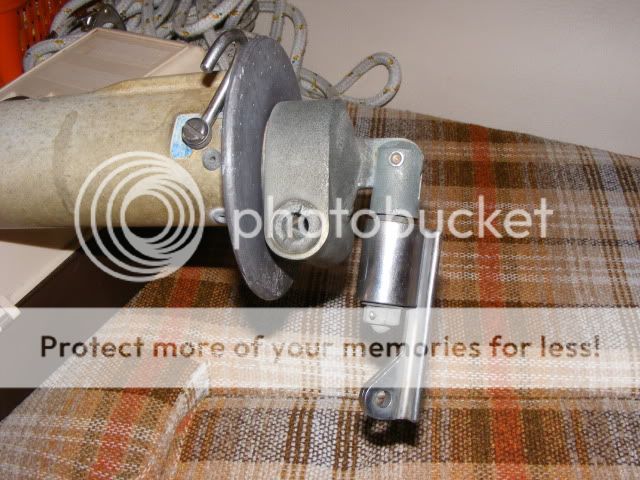
Another system , which may have been fitted to earlier boats is that described in #10 and shown in the photo below. A cranked handle fits in a square socket in the hole you can see to operate it via a worm gear

DSCF0423.jpg
The improvised hook is a later addition for slab reefing
 
Last edited:
Roller reefing (round the boom) is very common on older boats and particularly small ones. They are fitted with a mechanism (eg worm gear and winder) to rotate the boom and wind the sail around it. In theory its quite a good system as you can reduce the sail area by any amount you want. In practice, its not so handy as you lose the ability to put a kicker on the boom unless you use a 'claw' and is slow to use. Slab reefing is much more handy and quicker to put a reef in. I converted my Leisure 17 to this method and put 2 reef points in. First reduced sail by 25% and second by 50% I think. You also need some way of reducing the head sail or you'll keep bearing away. The L17 had hank on headsails so I had to put up a smaller one when reefed. I never bother with reefing eyes or a tidy bunt!

At the risk of appearing patronising (not my intention) an excellent description.

On my 1st 22' boat I had 2 internal leach lines, (through the boom), 2 leach reefing eyes and one flattening reef. The luff reefs were pulled down by a lanyard from boom to a clamcleat on the mast.

Assuming the OP has a roller-reefing boom, his required modifications are likely to be far greater, involving fitting leach line cheek blocks to the mast and (possibly) rams horns to the gooseneck than merely modifying his sail with some reefing cringles.
From what I can make out they had no provision for reefing the modest main of 108ft2, in any case I doubt the OP would need more than a single reef and with a quoted foresail area of just over 80ft2, I doubt he'd need a smaller foresail, despite the design being a masthead rig. The boat was a bilge keeler designed by Denys Rayner.
Rather than ask the questions here, he might do well to contact the Westerly owners website www.westerly-owners.co.uk and ask there. The information would be more authoritative and factual from there.
In two years of production they made 267 so it was quite popular and many must still be in use.
 
Last edited:

Though not a Westerly aficianado, the Nomad definitely post-dated the gunter rig of the early baby Westerlys. I note VicS has a photo of a roller-reefing gooseneck which someone has had the good sense to convert to jiffy reefing.
Fortunately boom roller reefing only had its vogue in the 60s. The boom used to droop lower and lower and the main set more and more baggily, adding the risk of braining to the certainty of knock-down. On many a cross-Channel race, I've watched our tacking angle growing wider and wider till it reached 140 degrees, on one's ear.
Nowadays I can put +/- 60, on whichever tack I'm on and see my track go through 90 degrees, in reasonably still water, when I don't have to power up it gets even better.
 
I must admit, I'm confused (nothing new there!). Most Westerlies were originally sold with a through the mast boom rolling system, so the main simply rolled onto the boom when reefing. To convert an existing sail to slab reefing, you need reinforcement patches and cringles put in, with the option of adding eyes and reefing lines to tidy up the bunt of the sail once reefed. It's probably just a case of misunderstanding your nomenclature - the reef cringles are the things to take the strain and the eyes must never be put under tension or they will stretch or tear the sail.

When I had a new main made, I left it to the sailmaker to put two sets of reefs in the design - it's not particularly critical with a masthead rig as the choice of foresail size is more significant than the amount of main left standing - it's most important function is to create a slot for the jib! We decided to dispense with the third reef on the grounds that it's a pain to tie in, being too deep to carry permanently rigged lines, and for a coastal sailor I should be tucked up in a berth before I need it.

A few pictures of Nomads under sail should provide accurate enough detail to make the decision.

Rob.

Google them - none appear to have the complication of a reef in the main.
Whilst the Nomad was produced at the height of the roller-boom craze, I think you'll find they fitted the roller reffing to the larger boats only.
In fact she's described as a masthead rig, but of very conservative sail area, about 70% of my first 22'.

http://sailboatdata.com/viewrecord.asp?class_ID=4031
 
Top