
Reef Pennants

davidej

Well-Known Member
Joined
17 Nov 2004
Messages
6,740
Location
West Mersea. north Essex
Visit site
We have a Bene 361 with a fully battened mainsail. We only cruise, not race.

The single line reefing pennants have their outer ends secured to the boom almost exactly vertically below the cringles on the sail. This was how it was rigged when we bought it and it has been the same ever since.

This means that when the pennant is pulled in tight to reef, the cringle is pulled firmly down to the boom but there is no real pull outwards. IMHO our reefed sail then has much too much fullness in the foot and should be flatter.

In general, are these securing points further outwards and, if so, roughly how much? Our flexibility is limited by the positions of the saddles fixed to the bottom of the boom, but these could be drilled out and re-fixed further outboard.

All opinions welcomed!
 
We have a Bene 361 with a fully battened mainsail. We only cruise, not race.

The single line reefing pennants have their outer ends secured to the boom almost exactly vertically below the cringles on the sail. This was how it was rigged when we bought it and it has been the same ever since.

This means that when the pennant is pulled in tight to reef, the cringle is pulled firmly down to the boom but there is no real pull outwards. IMHO our reefed sail then has much too much fullness in the foot and should be flatter.

In general, are these securing points further outwards and, if so, roughly how much? Our flexibility is limited by the positions of the saddles fixed to the bottom of the boom, but these could be drilled out and re-fixed further outboard.

All opinions welcomed!
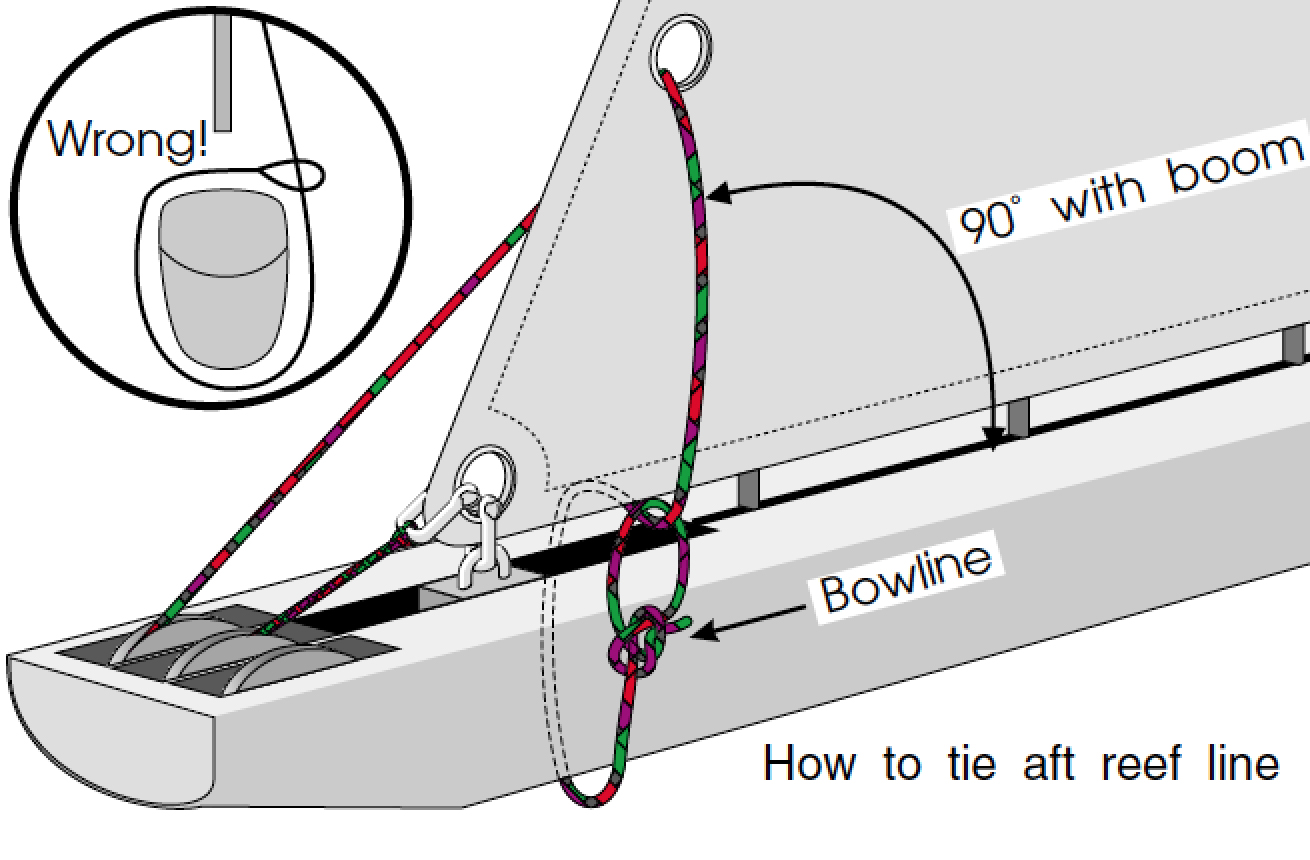
Don't use the saddles, just tie a running bowline around the boom. Then the reefing pennant will find the correct spot. Although sometimes you have to give it a little tug backwards.

E.g.

TyingReefOuthaulDiagram.jpg
 
The vertical bit of the pennant pulls the sail down, the bit running back to the sheave tensions the foot.
If the foot is still full, look at the reef tack, maybe that needs sorting to pull forwards?
There are many ways for single line reefing to work badly, often it's friction somewhere which means the tension actually getting to the sail is sadly diminished.
 
I reckon a starting point is about 10 degrees aft of where the cringle will be for a fully stretched mainsail foot. I wonder if when at the top end of the wind speed range for that reef, the foot of a Dacron sail sail stretches. So you need a little more pull aft to get the foot flat again.
 
Don't use the saddles, just tie a running bowline around the boom. Then the reefing pennant will find the correct spot. Although sometimes you have to give it a little tug backwards.

E.g.

TyingReefOuthaulDiagram.jpg

Why is it wrong for the bowline to be led under the sail on top of the boom rather than under the boom?
 
Why is it wrong for the bowline to be led under the sail on top of the boom rather than under the boom?
Dunno, neither can I work out why our method of tying a bowline that just slides on the boom is wrong, becuase it works fine and self adjusts. The 'correct' way is easier to tie when you have to move the first pennant to the third reef in a breeze.
 
The reef 'saddles' will have been set up for the reefs of the factory sail, it sounds like a new sail has been made at some time (I infer as it is fully battened) so this may have different reef positions. On my Beneteau 331 which now has three reefs so there is quite a bit of difference from the original two reef sail, I tie the reefs around the boom as suggested.
 
We have a Bene 361 with a fully battened mainsail. We only cruise, not race.

The single line reefing pennants have their outer ends secured to the boom almost exactly vertically below the cringles on the sail. This was how it was rigged when we bought it and it has been the same ever since.

This means that when the pennant is pulled in tight to reef, the cringle is pulled firmly down to the boom but there is no real pull outwards. IMHO our reefed sail then has much too much fullness in the foot and should be flatter.

In general, are these securing points further outwards and, if so, roughly how much? Our flexibility is limited by the positions of the saddles fixed to the bottom of the boom, but these could be drilled out and re-fixed further outboard.

All opinions welcomed!
May I ask, is your mainsail loosefooted or does it have a bolt rope slid into a groove in the boom’s topside?
Mike
 
Why is it wrong for the bowline to be led under the sail on top of the boom rather than under the boom?
Not really sure. Can't say it's ever a part of the process I've ever paid much attention to. I've definitely tied it both ways and have never noticed one to be better.

Guess the "correct" way might result in a better lead....?
 
Some bolt rope-footed sails I've used have longitudinal slits (50mm ish) for reef lines but I can't remember the sewing/re-inforcing detail. Probably doesn't need much, there's very little load across them.
 
Some bolt rope-footed sails I've used have longitudinal slits (50mm ish) for reef lines but I can't remember the sewing/re-inforcing detail. Probably doesn't need much, there's very little load across them.
Yes, I had a 'shelf foot' sail like that some years back. The 'shelf' was quite light material.
 
The sail is a replacement and is loose footed .

It may be that the saddles worked better with the original sail - i can't remember. I will try securing it so it can slide along the boom but there seems to be a divergence of opinion as to how.

The point about lack of tension due to friction is a good one. I try to only lower the halliard enough to keep the turning block on the luff a few inches above the boom. If it gets right down then the pennant all fouls up.
 
single line reefing is prone to problems from friction.

what typically happens is that the tack tightens before the new clew is sufficiently tight, and no further tightening of the reef line is possible.

it is definitely possible that the reef line is too far forward on the boom - the bowline loops tend to drift forward when not used for a while

so.., if you think the problem is just that the line is too far forward,, find a way to keep it further aft.

if you think the problem is friction, you have a few options: strip the cover off the line forward of the clutch. you may need new line if you don't have a high-tech dyneema core strippable line. the narrower diameter and slippery nature of dyneema will greatly reduce friction. Another thing you can do is to use low friction rings on the sail reef points, rather than the common steel cringles - those are very frictiony. The final change is to go with single-line reefing. I think on a 37ft boat using stripped dynema and low friction rings will reduce friction enough that single line reefing will work fine in most circumstances.
 
...

The point about lack of tension due to friction is a good one. I try to only lower the halliard enough to keep the turning block on the luff a few inches above the boom. If it gets right down then the pennant all fouls up.
That may be allowing the reefed tack to move aft?
It may also mean the reef line at the clew is pulling more down than aft?
 
The point about lack of tension due to friction is a good one. I try to only lower the halliard enough to keep the turning block on the luff a few inches above the boom. If it gets right down then the pennant all fouls up.

Davidej, do you have blocks on the reef clews? I didn't on my 331 but had a sailmaker add webbing to take them. Has made a big improvement.
 
Davidej, do you have blocks on the reef clews?

if you have blocks.., single line should probably work okay on a 37ft boat.

assuming the blocks are not seized... you might try a smaller diameter line.

if it's an old line.., maybe one that came with the boat.., it is probably a fat, low tech polyester double braid.., and is probably quite stiff from ageing and years of salt accumulation in the cover.
,
as i mentioned above, a newer line with dyneema core can be down-sized, and will run better through the blocks. you might not need to strip it if you have blocks.

of course, it needs to work in your clutch, so you can't down-size to aggressively. There are ways to add a little bulk - just at the right spot - so the line will hold in the clutch if it's just a bit on the small side.
 
Top