reducing the noise on the aft deck at D speeds, any cheap solutions?

  • Thread starter Thread starter vas
  • Start date Start date
..........

Modifying the ending of the channel as Alf says, Alf I did loose you at the end there, any pics or can you elaborate a bit more how the exhaust gasses and water is exiting?
That would well be and add-on to the baffling of the channels themselves following removal........

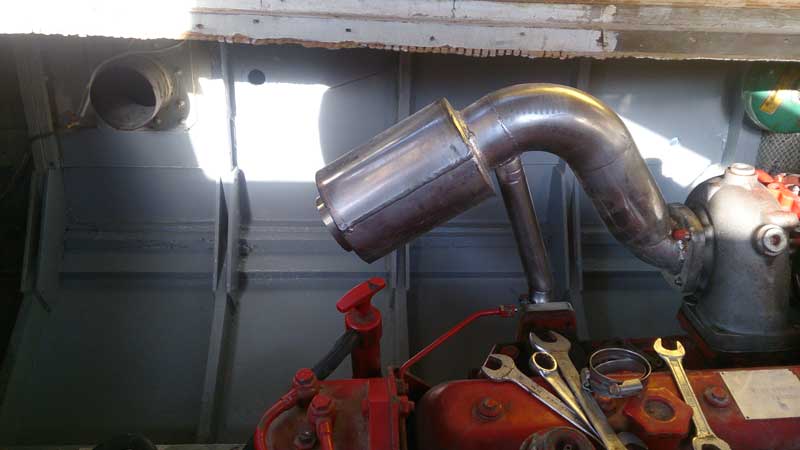
No modification of the channels, just the through hull piece .... Exhaust etc, still goes into the "channels" more or less in same location, but at a very different angle.... and if you extend that to a flange on the outside, you could fit a short piece of exhaust hose and also fit a tubular muffler inside the "channel"... negating the issue of considering installing anything in the engine room (keeping access to outside of engines the same)
 
Last edited:
Exhaust etc, still goes into the "channels" ... just at a very different angle.... and if you extend that to a flange on the outside, you could fit a short piece of exhaust hose and thus also fit a tubular muffler inside the "channel"... negating the issue of considering installing anything in the engine room (keeping access to outside of engines the same)

so to get that right, instead of having a 127mm dia tube approx 100mm long with a vertical flange to it bolted to the hull side meaning the pipe is vertical to the hull and all exhaust gasses and water "hits" the outside of the channel at almost right angle, you modify that to say 45deg and fit an extra 45deg elbow outside and mount another piece of 127dia tube within the channel?

That's interesting and way too easy to accomplish (other than having to spend a couple of hundred euro to buy more 127mm exhaust hose!)

cheers

V.
 
Ah, and along these lines, how would it feel if I blocked the rear outlet of the channels and cut holes at the bottom just infront to let the water and gasses exit downwards but not quite underwater?
Resting even full of fuel and water it's still 30-50mm above w/l, underway it's usually just underwater, wonder if that would affect backpressure.
I can easily add a backpressure gauge on my exhaust temp and water flow sensor setup.

cheers

V.
 
so to get that right, instead of having a 127mm dia tube approx 100mm long with a vertical flange to it bolted to the hull side meaning the pipe is vertical to the hull and all exhaust gasses and water "hits" the outside of the channel at almost right angle, you modify that to say 45deg and fit an extra 45deg elbow outside and mount another piece of 127dia tube within the channel?

That's interesting and way too easy to accomplish (other than having to spend a couple of hundred euro to buy more 127mm exhaust hose!)

cheers

V.

10 points.... I'm a simple person..., so simple solutions which does not change structure etc., is usually the way I prefer to go.. :)
 
Ah, and along these lines, how would it feel if I blocked the rear outlet of the channels and cut holes at the bottom just infront to let the water and gasses exit downwards but not quite underwater?
Resting even full of fuel and water it's still 30-50mm above w/l, underway it's usually just underwater, wonder if that would affect backpressure.
I can easily add a backpressure gauge on my exhaust temp and water flow sensor setup.

cheers

V.

I'd still be worried about water pressure being forced up the cut openings when underway at speed .... would you not consider a simple exhaust flap ?? (I will install this during the winter somehow) ... would be closed (or near) at idle ... and underway it would open up enough to let gases and water flow, whilst deflecting noise downwards.... Combined with an inside channel muffler, that should also be easy to achieve....
 
dear all,

thank you for the plurality of the arguments/ideas as well as the interesting points raised.
A few general comments and some more questions / individual requests, wont try to reply to every post as it will take too much time and there'll be some repetition.

OK, first, craft is 70s designed, originally with DD fitted, just like Alf's Navigator.
For sure NO silencer ever fitted, doubt the concept existing back then, just straight throughs, with the twist of half gas/water path inside the e/r and the other half outside. When re-engined 20yrs ago they did a fair job overall with stock risers that within 500h ruined the port turbo. Not impressed with their job tbh...
Finally the option of rerouting the exhaust via the lazarette is a no go, as there are two 250lt water tanks on the bulkhead sides leaving no space for such mods.

The noise inside the saloon, (yes, engines are just under the saloon) is different, dumpened by insulation and carpet, and will eventually install some rubber underlay, but that's NOT my worry. If in the middle of the summer going someplace someone is in the saloon is probably taking a nap, engine noise is probably helping him/her to it...

Concern is the bass bumping noise from the transom exits even at 7kn, ok it's better at 4kn but unlikely to go anywhere at that speed!

I can understand that noise reduction is proportional to money thrown at it as a problem to an extend. I also imagine that design and shaping silencers according to the rules following the speaker enclosure designs avoiding standing waves et al, can help (and is not easy and can help shape and fit a custom box within the available space...).
From the ones that have followed the MiToS rebuilt, you are aware by now that a bit of diy is not something I'm worried about, on the contrary I'd clearly say I'd be looking forward to now that other serious jobs are more or less over...
What I'm currently missing is clear understanding of the principles and some starting points.
Also not sure I would like to go to diy underwater exhausts just like that, unless someone can help and support the design process.

As far as of the shelf bits of kit that would work there are three types:
dustbin size (not exaggerating for my 5inch pipes!) risers that I could with a bit of careful arrangements fit in there but make the access to the outside of the engines a slight nightmare. Cost at around 1.2K euro both sides. http://www.asap-supplies.com/eu/bra...k-vernalift-grp-wet-exhaust-waterlock-1500116

inline silencers, shortest I found is approx 800mm long which is pushing it A LOT on the port engine where the turbo is on the port side and there's a tightish curve and straight out. Stbrd side is doable. Cheaper probably 700euro both sides, and probably will need some serious mod to introduce a 45deg elbow at least for the port inlet. http://www.asap-supplies.com/eu/bra.../centek-vernatone-minimax-grp-muffler-1050500

inline SS mufflers some fancy SS circular U-shaped sections full of I guess 8-10mm holes in the perimeter that claim to reduce noise without hampering performance. I guess soundwise they wont be anything special but are even cheaper at approx 500euro a pair. Just an idea: http://www.ebay.co.uk/itm/221790836272?_trksid=p2055119.m1438.l2649&ssPageName=STRK:MEBIDX:IT

All these are simple e/r mods leaving the long side grp exits untouched. Unfortunatelly none of these would work on the outside channels, except maybe for the last one but wouldn't be able to get it all the way to the front where the exhaust exits the hull.

Summing it all up it looks like I'd be tempted to look more carefully and proceed along the following routes (with your help of course!):

Going the JFM route with diy dustbin watertraps/mufflers, John I'd appreciate some of your nicely detailed and dimensioned sketches ;)

Introducing baffles and noise reduction design features on the side "channels" As I already said, they are U shaped (approx 220X160mm in section) bolted to a double skin plywood hull side with half a zillion countersunks, will be a happy evenings work to remove. Would happily close them to a full section after introducing baffles if that's going to help. Cannot imaging being difficult, cannot imagine introducing massive amounts of backpressure considering the massive volume involved.

Modifying the ending of the channel as Alf says, Alf I did loose you at the end there, any pics or can you elaborate a bit more how the exhaust gasses and water is exiting?
That would well be and add-on to the baffling of the channels themselves following removal.

Finally consider underwater exits within the e/r (with great care!)

Or any combo of the above!

So, as always looking forward to your suggestions/sketches/ideas!

cheers

V.

The best and cheapest way of getting rid of exhaust noise is to convert the outlets under water with sc goose necks on the exits. One of the reasons for me to trade in the Phantom 38 for the Ferretti was to get properly designed underwater exhaust. The Phantom was reasonable silent at displacement speeds but at planning speed the exhaust noise was too much on long runs, even on the flybridge for me. The Phantom had large Halyard dust bins but at planning speeds they were blown empy and the system worked like straight pipes. The Ferretti has an arrangement like JMF described above with small by pass outlets above the water, still giving a nice muted rumble when standing on the dock behind the boat :-). On board at any speed there is virtually no exhaust noise. Also the genset exhaust is exiting under water and in a light breeze you cannot hear it running on the aft deck. On th Fairline the genset exhaust was merged to the port main exhaust which made it quite noisy. I was considering converting the Fairline to have underwater exits but the Halyard bins would have had to be removed to reduce the back pressure.

So watertraps might reduce your low speed noise issues however at higher speeds you still have the noise and back pressure might become an issue. Underwater exhausts need to be carefully designed also to avoid too much back pressure. It can be done quite easy however.
 
Last edited:
It's blinding obvious to me , x pollinating with the motor industry ,wressling with track days and 103 Db -jobs worth killjoys .
Use a suitable material to line the pods -thereby turning them into silencers .No need for baffles .
Here's a link -of the type of stuff -but there are others
http://www.saveguard.com/exhaust/exhaust insulation products.pdf
Just an example there s plenty of the others -just a case of enquiring
 
It's blinding obvious to me , x pollinating with the motor industry ,wressling with track days and 103 Db -jobs worth killjoys .
Use a suitable material to line the pods -thereby turning them into silencers .No need for baffles .
Here's a link -of the type of stuff -but there are others
http://www.saveguard.com/exhaust/exhaust insulation products.pdf
Just an example there s plenty of the others -just a case of enquiring
 
The Phantom had large Halyard dust bins but at planning speeds they were blown empy and the system worked like straight pipes.
Sounds like a problem (Design? Size? Can't tell for sure) of THOSE dustbins, rather than of the system in general.
The quietest boats I've ever heard had dustbins, rather than straight (albeit possibly u/w) exhausts.
 
It's blinding obvious to me , x pollinating with the motor industry ,wressling with track days and 103 Db -jobs worth killjoys .
Use a suitable material to line the pods -thereby turning them into silencers .No need for baffles .
Here's a link -of the type of stuff -but there are others
http://www.saveguard.com/exhaust/exhaust insulation products.pdf
Just an example there s plenty of the others -just a case of enquiring

Porto,

looks like excellent material thanks for the pointer, but I struggle to see how I could use it. Only use I could think of, is wrap it around the 127mm exhaust hose that Alf recommends I stuff within the side channels. However, doing so, it will be:
A. a tight squeeze and I doubt it's going to be very efficient under the circumstances
B. susceptible to seawater contamination. From the literature, it doesn't seem to be an option, so whole thing should be carefully sealed in order to perform.

Let's see how the whole set of ideas develop and I'll keep it in mind as a channel wrap.
I'm also worried that it's not only dB we are talking about it's also low frequencies as Montemar points on post #19 and they are more difficult to tame unless you play with baffles. At least that's my understanding from the time I was into speaker enclosure designs a couple of decades ago (OK, make them 3...)

The best and cheapest way of getting rid of exhaust noise is to convert the outlets under water with sc goose necks on the exits. One of the reasons for me to trade in the Phantom 38 for the Ferretti was to get properly designed underwater exhaust. The Phantom was reasonable silent at displacement speeds but at planning speed the exhaust noise was too much on long runs, even on the flybridge for me. The Phantom had large Halyard dust bins but at planning speeds they were blown empy and the system worked like straight pipes. The Ferretti has an arrangement like JMF described above with small by pass outlets above the water, still giving a nice muted rumble when standing on the dock behind the boat :-). On board at any speed there is virtually no exhaust noise. Also the genset exhaust is exiting under water and in a light breeze you cannot hear it running on the aft deck. On th Fairline the genset exhaust was merged to the port main exhaust which made it quite noisy. I was considering converting the Fairline to have underwater exits but the Halyard bins would have had to be removed to reduce the back pressure.

So watertraps might reduce your low speed noise issues however at higher speeds you still have the noise and back pressure might become an issue. Underwater exhausts need to be carefully designed also to avoid too much back pressure. It can be done quite easy however.

tbh I'm more concerned on D speed noise suppression, so the bins sound like a plan. Problem is I've no idea how they look inside, saw a cutout with a horizontal baffle and a tube going bottom to top in the middle, but engineeringwise (and with my limited knowledge on the topic) I wasn't really convinced.
Let's see what sketch JFM comes up with ;)

cheers

V.
 
It's blinding obvious to me , x pollinating with the motor industry ,wressling with track days and 103 Db -jobs worth killjoys .
Use a suitable material to line the pods -thereby turning them into silencers .No need for baffles .
Here's a link -of the type of stuff -but there are others
http://www.saveguard.com/exhaust/exhaust insulation products.pdf
Just an example there s plenty of the others -just a case of enquiring

The sound reduction curves look OK apart from the low frequencies where the OP has the problem. There is not enough absorbent to kill the LF energy. Low frequencies = long wavelengths = difficult to absorb.
 
It's blinding obvious to me , x pollinating with the motor industry ,wressling with track days and 103 Db -jobs worth killjoys .
Use a suitable material to line the pods -thereby turning them into silencers .No need for baffles .
Here's a link -of the type of stuff -but there are others
http://www.saveguard.com/exhaust/exhaust insulation products.pdf
Just an example there s plenty of the others -just a case of enquiring

Sorry to say: Squeezing a few A weighted dB from a high speed gasoline engine exhaust simply by re-packing absorptive elements cannot be likened to squeezing a few more low frequency dB from a low speed Diesel engine exhaust. By comparison, other "hit & hope" options suggested here have merit beyond comprehension!
 
Porto,

looks like excellent material thanks for the pointer, but I struggle to see how I could use it. Only use I could think of, is wrap it around the 127mm exhaust hose that Alf recommends I stuff within the side channels. However, doing so, it will be:
A. a tight squeeze and I doubt it's going to be very efficient under the circumstances
B. susceptible to seawater contamination. From the literature, it doesn't seem to be an option, so whole thing should be carefully sealed in order to perform.

Let's see how the whole set of ideas develop and I'll keep it in mind as a channel wrap.
I'm also worried that it's not only dB we are talking about it's also low frequencies as Montemar points on post #19 and they are more difficult to tame unless you play with baffles. At least that's my understanding from the time I was into speaker enclosure designs a couple of decades ago (OK, make them 3...)


tbh I'm more concerned on D speed noise suppression, so the bins sound like a plan. Problem is I've no idea how they look inside, saw a cutout with a horizontal baffle and a tube going bottom to top in the middle, but engineeringwise (and with my limited knowledge on the topic) I wasn't really convinced.
Let's see what sketch JFM comes up with ;)

cheers

V.

A friend of mine installed large Vetus "dust bins" to reduce noise at harbour speeds on his Princess 55, which had straigh pipes with side exits at the waterline originally. This made a day and night difference. If you have large enough space inside the er or below the aft deck this is the way to go. They have to be large enough to avoid excess back pressure. Vetus has some dimensioning guidance on their website where you can get an idea of the volume needed.
 
Coastal Rides have had in the past some pretty large dustbin type silencers in their bankrupt stock bin.They also turn up on ebay every now and then,
 
With a similar Boat and engine size as detailed above a massive difference with Vetus water trap dustbins, I assume the in line water traps would do the same thing.

If you can fit in in do it.
 
thanks for all the posts and ideas.

There's a substantial number of cases where dustbins reduced a lot the noise, so that's going to be my first take.
Being sketching and trying to figure out how I can install such a large thing in there without making a mess of e/r access.
Still suffering from my back and there's noway I can start squeezing down there at -2~-6C to measure, so just working from photos atm-I know once I actually measure it i'll have to redimension the lot, but at least that's a starting point...

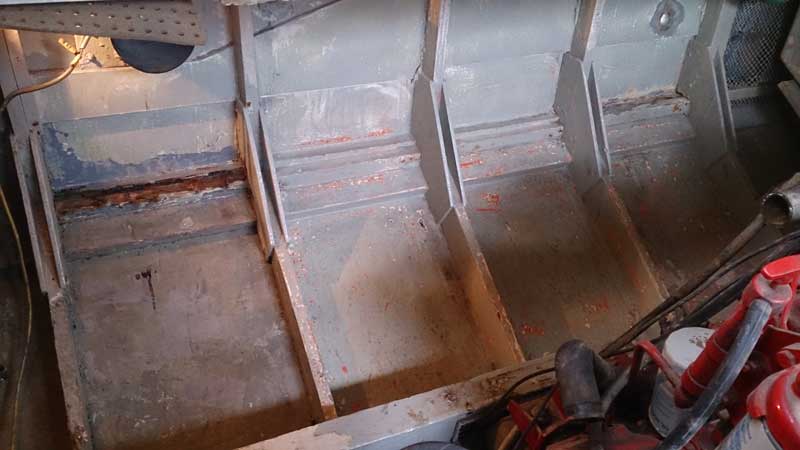
Now, frames are approx 400mm apart as shown in the following pics:

muffler_space_1.jpg


muffler_space_2.jpg


Seems that I can built a custom box 500X420 in plan resting on the outside engine bearer plus on a thin strip on the outside towards the chine and approx 600mm in height. That will make it approx 120lt which is according to the Vetus catalogue the largest they produce for 5inch exhaust hoses systems. This way I can get the intake at the bottom with an upward facing elbow with a hopefully fairly straight path for the 127mm rubber flexhose from the riser and a straight side out matching the spot of the outlet. Theory is always simple...
From what I've read and understood I'd have to opt for a dual stage barrel with a baffle in the middle and 120-140mm dia pipe joining the lower to the upper department as demonstrated in this cutout:

VET_Waterlock_Cover.gif


Main issue is construction method, I'd be very happy modelling it in ply, breaking/smoothing all angles, using some sort of release agent, and building it by wrapping it up with matt and epoxy in a way I can remove the model from inside the box at the end (making it a five sided thing, with an open top that is) so that I can do the other side afterwards. Then build a lid and epoxy (or glass it) on to seal the thing after fitting and epoxying/glassing the baffle and connecting tube that is.

Reality is that if I give it to my SS fabricator I'll have it done in a day (at a much higher cost of course...) so I'm thinking about it. Extra problem with the GRP homemade approach is that I have to find a way of modeling 125mm outside dia tube sections for the in and out, AND make it smooth so that I can slip the rubber hose on them.

The idea is to built one, install it, measure what/how well it performs compared to the other engine and THEN built the other, starting from the port side where I have easier access.
Now, a rather extreme idea I had if i go SS, is to make an (exterior?) jacket where I can route my potable water to heat it. My main issue with accessing the outside of the engines is that it's the only place to fit a hot water cylinder, so was thinking of hitting two birds with one stone and have a combo thing for both jobs in port side. Sbrd would be easier and smaller without the extra water jacket.

ideas?

cheers

V.
 
With respect to stainless steel , it corrodes.

yep,

did some more reading after posting, sulfur on the exhaust gases together with the salt is not good at all. In theory 316 may survive but not 304. Having said that, it's not a area you want a failure when underway!
Had a few ideas how to model a slightly tapered box so that I can easily remove the mold without destroying it, so once I can bend my back and fit down there I'll see how I could do it in GRP.
The water heating idea goes out of the window though unless I built a much larger box and get the potable water cylinder INSIDE it somehow and seal it, gets a bit too complicated tbh.

cheers

V
 
Top