
reducing the noise on the aft deck at D speeds, any cheap solutions?

  • Thread starter Thread starter vas
  • Start date Start date

vas

Well-Known Member
Joined
21 Jun 2011
Messages
8,200
Location
Volos-Athens
Visit site
good evening all,

a few of the occupants of the couple of weeks and couple of hundred nm excursions over July and August, complained about the level of noise when MiToS is moving at about 7-8knots.
Essentially, it's difficult to have a relaxed conversation at the aft deck with all the booming and general exhaust noise. Personally I don't really mind, but tbh if you're about a 3-4h pootling it gets on your nerves. Yes, I know the solution is to open the taps and go upstairs at the f/b, but not always desirable.

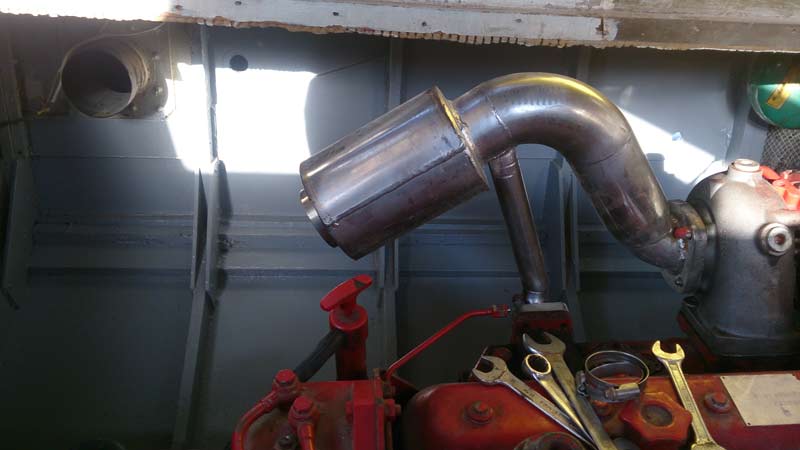
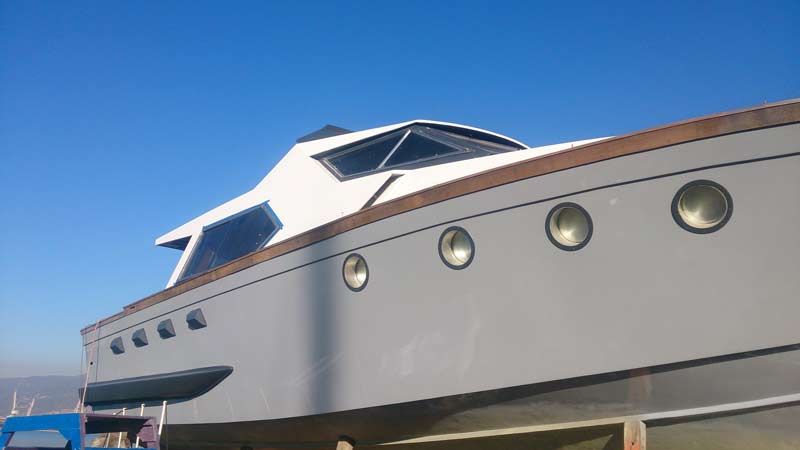
MiToS setup is 2X330hp straight six IVECOs turbodiesel, SS risers, 128mm flex hose (approx 1.5m-2m each) going to a fitting on the side of the hull and through which water and fumes travel along the side grp "channel" ending up at the transom above w/l 2.5m later.

next pic shows port engine riser vs hull side exit. Spend an hour searching through a few K pics couldn't find one with the hose attached, doh!
portengine_refit_6.jpg


next pic shows the route of the gases/water outside the hull to the transom (I really like this pic!):
topcoat_46.jpg


So effectively there is no silencer anywhere to be seen in the path, nor any flap at the transom end.
Exit with normal load is just above water level.


So Q, is there a CHEAP(ish) way of reducing this bass bumping noise I get on the aft deck at D speeds?
Please don't suggest I invest 1.2K at least in order to install proper HALYARD silencers, wouldn't easily stretch to Vetus either and tbh not so sure how much of the noise they actually reduce.
If something can be done outside the hull within this grp section I'd consider removing it and doing somesort of mod and refitting it, hell the portside one needs resecuring as it somehow worked loose at the aft...

All (cheap and/or diy) ideas welcomed!

cheers

V.
 
How much engine room insulation is there? Any gaps? Putting up more insulation is probably the cheapest and the quickest DIY fix you can do
 
What about in-line silencers fitted into the outside ducts. You'd have to open the ducts and install pipe-work to allow the silencers to be fitted and then close up the ducts with removable panels. Can't remember the name of the silencers but they make a remarkable difference for a couple of hundred squids.
Quiet-Life from A.S.A.P.
 
Last edited:
How much engine room insulation is there? Any gaps? Putting up more insulation is probably the cheapest and the quickest DIY fix you can do

There's insulation at the saloon floor (not excessive maybe 50mm rockwool), there's no insulation on the hull sides, there's insulation again a bit of rockwool on the bulkhead to the lazarette, and there's the whole lazarette under the aft deck with no noisy things in it, and a decent door to the e/r that is kept closed underway.
I'm pretty sure the noise actually comes from the exhaust tip not the engine themselves.

What about in-line silencers fitted into the outside ducts. You'd have to open the ducts and install pipe-work to allow the silencers to be fitted and then close up the ducts with removable panels. Can't remember the name of the silencers but they make a remarkable difference for a couple of hundred squids.

That's what I'd like to hear! You mean you start introducing S-shaped loops and back and forth movement of the gases in order to dampen the noise? Any link or sketch of how that would work would be much appreciated, it will be probably an evening's work to remove the two ducts (and a good chance to repair the aft endings of them from chippings...)
Could it be a matter of fitting a few baffles in there, making sure you don't increase backpressure as I could easily built grp baffles and organise them in decent intervals.

cheers

V.
 
Get a sound meter, or a smartphone app, and check everywhere for sound, engine and exhaust
 
The problem is that the hard surfaces of the duct boxes is creating an echo chamber that exacerbates the sound. I'm now thinking that just running the exhaust in rubber hose would make a big difference. Baffles might help but there is still the problem of the hard surfaces.
 
good evening all,

a few of the occupants of the couple of weeks and couple of hundred nm excursions over July and August, complained about the level of noise when MiToS is moving at about 7-8knots.
Essentially, it's difficult to have a relaxed conversation at the aft deck with all the booming and general exhaust noise. Personally I don't really mind, but tbh if you're about a 3-4h pootling it gets on your nerves. Yes, I know the solution is to open the taps and go upstairs at the f/b, but not always desirable.

MiToS setup is 2X330hp straight six IVECOs turbodiesel, SS risers, 128mm flex hose (approx 1.5m-2m each) going to a fitting on the side of the hull and through which water and fumes travel along the side grp "channel" ending up at the transom above w/l 2.5m later.

next pic shows port engine riser vs hull side exit. Spend an hour searching through a few K pics couldn't find one with the hose attached, doh!
portengine_refit_6.jpg


next pic shows the route of the gases/water outside the hull to the transom (I really like this pic!):
topcoat_46.jpg


So effectively there is no silencer anywhere to be seen in the path, nor any flap at the transom end.
Exit with normal load is just above water level.


So Q, is there a CHEAP(ish) way of reducing this bass bumping noise I get on the aft deck at D speeds?
Please don't suggest I invest 1.2K at least in order to install proper HALYARD silencers, wouldn't easily stretch to Vetus either and tbh not so sure how much of the noise they actually reduce.
If something can be done outside the hull within this grp section I'd consider removing it and doing somesort of mod and refitting it, hell the portside one needs resecuring as it somehow worked loose at the aft...

All (cheap and/or diy) ideas welcomed!

cheers

V.

Low cost & noise mitigation are rare companions! Some points to ponder: has the root cause / source been reliably identified? One identified, first action is to mitigate at source. Is the machinery fit OEM? Was exhaust attenuation standard but got removed sometime, in the past, or offered as an option? The point is to match pressure loss imposed by attenuators with the ability of the engine to sustain it; some power loss is likely after installing attenuation. If the source is secondary, such as vibrating panels, then thin free, or better still constrained, layer damping applied to the host will be effective. If its an engine room resonance (high level, narrow machinery speed range) then ponder replacement mounts or just operate outside that speed! Hope this helps.
 
I had a Fairline 36 Sedan with 2 x 370hp Volvo Penta, water injection bends then straight through rubber exhaust hose to side of boat, noise at displacement speed or full chat was very high.

I had the boat for 5 years and after some feedback from the family about the Bark or howl of the exhaust (along the lines of why dont other boats make the dreadful noise our boat makes) I looked at it and I fitted Vetus dustbin mufflers of the type below.
http://www.vetus.com/exhaust-system...ype-nlp-90-mm-hose-connections-10-litres.html

The noise reduction was massive, I was astounded. Also very pleased.

I assume the engines in your boat are under the saloon? Engine room insulation and mounting of floor on rubber seals is another matter.

Depending on the space you have I would have thought it is do-able possibly re routing the exit from the after compartment under the cockpit?
 
Last edited:
Ideally as mentioned € and noise reduction are proportional .
You request low € spend and indicate that removing the pods outside the hull is kinda easily do -able .
Eliminating high end € spend 1st
1-thought the hull underwater + boxes
2-additional vetus or what ever boxes between riser and side exist

Then as you infer that just leaves leaves modding the side pods .

I would suggest lining them with a sound absorbing (water proof ) material .
The noise /boom is a pressure difference -idea is to reduce that -so as the gasses move through the pods some of the sound energy is absorbed into the soft deading lining .Not bouncing off and arguably being amplified by the hard surfaces .

I would not go down the baffle route -back P issues and really at full chat or even D speed chat ,diesels are massive gas pumps with compression ratios of 16-20 to 1 or what ever compared to petrols @1/2 that -with can "cope " with baffles and back pressure .
Hence -conclusion
Cheap fix sound deaden via lining the GRP /wooden ? - side pods .

There is some super H temp fibre -cum matting we use to line Ferrari ( mid engine ) exhaust back boxes -removing the OEM solid and heavey insulation , so i know there're stuff out there suitable .We do it to reduce weight 32Kg to 9 kg
Well that's my 0.02 p,s worth
 
Last edited:
On a much smaller scale.
For years put up with the throaty racket from pair of non turbo charged 6 litre Perkins diesels.
For a while the sound was "interesting" but after several long distance trips (8-10 hours) the noise coming from the exhaust began to become very wearing.
First action was adding insulation to every interior surface likely to reflect sound,considering the amount of money and effort involved the results were marginal.
Virtually all boats of certain era appear to have no exhaust silencing at all.
After consulting an expert or two on this forum,regards back pressure,decided to buy a couple of water lock type silencers with no great expectations of success in reducing noise.
The installation process was simple,mould in couple of bases to secure water lock box, cut exhaust hose and remove sufficent to insert silencer in line .Total job 2 days both engines .
The noise reduction was no less than dramatic,best way of describing difference was that you could actually now hear the wash being made at stern of boat from the flybridge.
You can now however hear all the noises previously masked by exhaust noise. :)
 
Last edited:
Vas,
I know that exhaust configuration pretty well :) ... and as you know we're running on original loud DD's, but fit this through large water traps (dustbins), which makes it a very soft exhaust note indeed... Not what you want to do at this stage by the sound of things...

When the water traps was installed onboard, the original outlets (straight out like yours) were blocked off and replaced with outlets on a quite steep angle backwards and with a lip through the hull and into the "channel". This apparently stopped the engine exhaust booming directly into the wall of the "channel" (leading the exhaust sound more or less directly backwards into the channel opening) and made the boat quieter even without the water traps (not that you ever can call two-stroke DD's on open pipes quiet:) ) ... so that is probably the first modification I'd consider doing irrespective of what you consider putting in there ... like a muffler ...

With respect to the "channel" working loose, please remember that these also will, under speed, be under a fair bit of pressure from the water and probably give your boat's stern some lift as well, so please ensure that your fixing of the "channels" are solid..
 
...

That's what I'd like to hear! You mean you start introducing S-shaped loops and back and forth movement of the gases in order to dampen the noise? Any link or sketch of how that would work would be much appreciated, it will be probably an evening's work to remove the two ducts (and a good chance to repair the aft endings of them from chippings...)
Could it be a matter of fitting a few baffles in there, making sure you don't increase backpressure as I could easily built grp baffles and organise them in decent intervals.

cheers

V.

was also my initial idea, but
you need some noise absorbing material in there, and I don't see a solution that can resist the temp, AND is water resistant (?)
 
I reckon you could make your own "halyard style" dustbin silencers. You could mould them using a €5 plastic bin as a mould. Then fit them with underwater outlets and downgrade the side exhausts and chine pods to mere bypasses. Obviously quite a project but literally €100 of matting and resin. Want a sketch?

Anything else is faffing around at the edges. Insulation sure wont help
 
have you tried running on one engine at D speeds. You won't get the twin engine resonances and the exhaust and engine sounds will be a higher frequency so less tiring. Also more water running through the running engine's exhaust system so that should help too ???? - cheapest solution.
 
Last edited:
Sound insulation is not going to do much as the frequencies are low so very thick layers of insulation are needed. You do not have the space for this and the material will need to be able to resist high temperatures. Low frequencies are hard to absorb. Chambers, like the one in your pic, let low frequencies through but do trap higher frequencies. If they contain baffles they may be doing some good.
Some device including baffles like a car silencer may work and it sounds as if water traps will work.
As was mentioned earlier what was originally fitted? This may be a good guide.
The glassfibre mouldings on the side of the boat may be introducing an organ pipe resonance which is amplifying the sound. If these can be removed it may be informative.
Eliminating a lot of low frequency, high energy noise is not easy and a dedicated device will be needed. I am looking at this purely from an acoustical point of view.
 
dear all,

thank you for the plurality of the arguments/ideas as well as the interesting points raised.
A few general comments and some more questions / individual requests, wont try to reply to every post as it will take too much time and there'll be some repetition.

OK, first, craft is 70s designed, originally with DD fitted, just like Alf's Navigator.
For sure NO silencer ever fitted, doubt the concept existing back then, just straight throughs, with the twist of half gas/water path inside the e/r and the other half outside. When re-engined 20yrs ago they did a fair job overall with stock risers that within 500h ruined the port turbo. Not impressed with their job tbh...
Finally the option of rerouting the exhaust via the lazarette is a no go, as there are two 250lt water tanks on the bulkhead sides leaving no space for such mods.

The noise inside the saloon, (yes, engines are just under the saloon) is different, dumpened by insulation and carpet, and will eventually install some rubber underlay, but that's NOT my worry. If in the middle of the summer going someplace someone is in the saloon is probably taking a nap, engine noise is probably helping him/her to it...

Concern is the bass bumping noise from the transom exits even at 7kn, ok it's better at 4kn but unlikely to go anywhere at that speed!

I can understand that noise reduction is proportional to money thrown at it as a problem to an extend. I also imagine that design and shaping silencers according to the rules following the speaker enclosure designs avoiding standing waves et al, can help (and is not easy and can help shape and fit a custom box within the available space...).
From the ones that have followed the MiToS rebuilt, you are aware by now that a bit of diy is not something I'm worried about, on the contrary I'd clearly say I'd be looking forward to now that other serious jobs are more or less over...
What I'm currently missing is clear understanding of the principles and some starting points.
Also not sure I would like to go to diy underwater exhausts just like that, unless someone can help and support the design process.

As far as of the shelf bits of kit that would work there are three types:
dustbin size (not exaggerating for my 5inch pipes!) risers that I could with a bit of careful arrangements fit in there but make the access to the outside of the engines a slight nightmare. Cost at around 1.2K euro both sides. http://www.asap-supplies.com/eu/bra...k-vernalift-grp-wet-exhaust-waterlock-1500116

inline silencers, shortest I found is approx 800mm long which is pushing it A LOT on the port engine where the turbo is on the port side and there's a tightish curve and straight out. Stbrd side is doable. Cheaper probably 700euro both sides, and probably will need some serious mod to introduce a 45deg elbow at least for the port inlet. http://www.asap-supplies.com/eu/bra.../centek-vernatone-minimax-grp-muffler-1050500

inline SS mufflers some fancy SS circular U-shaped sections full of I guess 8-10mm holes in the perimeter that claim to reduce noise without hampering performance. I guess soundwise they wont be anything special but are even cheaper at approx 500euro a pair. Just an idea: http://www.ebay.co.uk/itm/221790836272?_trksid=p2055119.m1438.l2649&ssPageName=STRK:MEBIDX:IT

All these are simple e/r mods leaving the long side grp exits untouched. Unfortunatelly none of these would work on the outside channels, except maybe for the last one but wouldn't be able to get it all the way to the front where the exhaust exits the hull.

Summing it all up it looks like I'd be tempted to look more carefully and proceed along the following routes (with your help of course!):

Going the JFM route with diy dustbin watertraps/mufflers, John I'd appreciate some of your nicely detailed and dimensioned sketches ;)

Introducing baffles and noise reduction design features on the side "channels" As I already said, they are U shaped (approx 220X160mm in section) bolted to a double skin plywood hull side with half a zillion countersunks, will be a happy evenings work to remove. Would happily close them to a full section after introducing baffles if that's going to help. Cannot imaging being difficult, cannot imagine introducing massive amounts of backpressure considering the massive volume involved.

Modifying the ending of the channel as Alf says, Alf I did loose you at the end there, any pics or can you elaborate a bit more how the exhaust gasses and water is exiting?
That would well be and add-on to the baffling of the channels themselves following removal.

Finally consider underwater exits within the e/r (with great care!)

Or any combo of the above!

So, as always looking forward to your suggestions/sketches/ideas!

cheers

V.
 
Last edited:
Top