Recommended UK rudder bearing manufacturer, material & contact

demonboy

Well-Known Member
Joined
11 Oct 2004
Messages
2,237
Location
Indonesia
www.youtube.com
Hi,

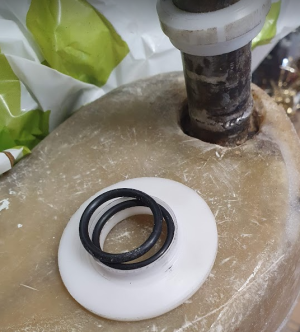
Having now removed my rudder I am looking to bore out the worn casting to a wider diameter and fit a bearing over the rudder pintle. @vyv_cox pointed me to his article in which he had to do something almost identical (see his photos of the finished bearing).

I'd like to replicate this idea so I need to work out how much to bore that hole out by. I had a few preliminary questions:

1. Vyv made his from Acetal. Is this the recommended material, and how much life can I expect out of it in terms of years (to be fitted to a full-time liveaboard boat)?
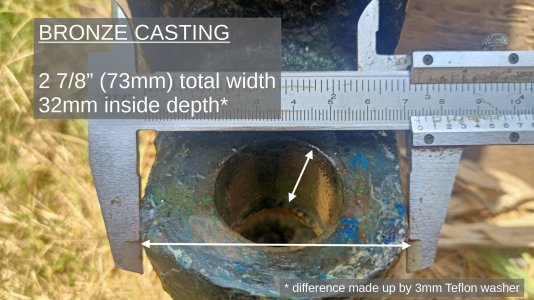
2. Is there a recommended thickness? I'll include a thrust collar like Vyv's since it will replace the current Teflon washer. The washer spans the width of the casting but it is only 3mm thick. I suspect the body of the bearing should be thicker.
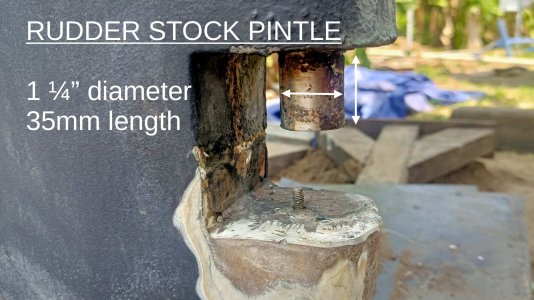
pintle.jpg

casting.jpg

(In the second image you can just make out the original width of the hole at the bottom of the casting.)

Vyv used BBH Precision Engineers but while I am in Indonesia I wanted to contact a manufacturer first by email. From my cursory research, BBH has neither a website nor an email, only a phone number, so...

3. Any recommended manufacturers of bearings based in the UK who can both supply the material and manufacture the bearing according to my spec?

TIA
 
BBH is a tiny organisation, only two(?) men in a tiny shed in Bangor. I feel certain you can find a local company to do the job for you.
Acetal is available in bar stock on-line but any decent machine shop should have it. The application is not demanding and I think the properties of Vesconite are probably not required. Acetal is widely used for this and similar jobs.
 
When I did mine I added 2 rubber o rings and a lot of silicon grease inside. I think I made them from Delrin, and I also replaced the rudder bearings with delrin.
 

Attachments

  • rudder.png
    rudder.png
    647.7 KB · Views: 8
1. Get them made locally from PET, Delrin, Acetal, or Vesconite - pricing in that order, there are other more expensive materials available as well - Vesconite have a strange pricing policy where its cheaper to get them to make a bushing and ship from South Africa than it is to buy the raw material from them, and it is many times more expensive than the alternatives

2. Thickness varies by make and model, we make bearings that are 1mm thick and others that are 10+mm thick - thickness is not relevant to life, fit, finish, and design are more relevant - that skeg would be best having the bore remachined to be straight and round as well

3. We make rudder bearings and thrust washers in a variety of materials, mainly custom work

Acetal and Delrin are slightly different materials, it used to be that DuPonts brand name was the only difference but Acetals are multi-polymer and Delrins are single polymer and and better quality, and higher price
 
Last edited:
1. Get them made locally from PET, Delrin, Acetal, or Vesconite - pricing in that order, there are other more expensive materials available as well

2. Thickness varies by make and model, we make bearings that are 1mm thick and others that are 10+mm thick - thickness is not relevant to life, fit, finish, and design are more relevant - that skeg would be best having the bore remachined to be straight and round as well

3. We make rudder bearings and thrust washers in a variety of materials, mainly custom work

Acetal and Delrin are slightly different materials, it used to be that DuPonts brand name was the only difference but Acetals are single polymer and Delrins are multi-polymer and better quality, and higher price
When i did mine I made a few custom washers for spacers, to make sure there was no vertical movement in my rudder. I was paranoid when someone told me that rudders can jump out of the skeg if they're not a good fit.
 
When i did mine I made a few custom washers for spacers, to make sure there was no vertical movement in my rudder. I was paranoid when someone told me that rudders can jump out of the skeg if they're not a good fit.
I make spacer washer sets for the Westerly W33's as they have a spacer for the rudder that wears away, sometimes completely
 
Acetal is likely to swell slightly when the boat is back in the water, which means you should be careful with the tolerances. Vesconite is considered to be the best material for the application, but quite expensive. I made mine last year from UHMWPE, which was readily available and really cheap. I think it pays to be extra careful in measuring shaft diameter to be sure you don't end up with bearings that are too tight or too loose. I think I went for a 0.15mm tolerance on mine. The rudder stock was nominally 38mm but I actually measured it to be 37.95mm.
 
Acetal is likely to swell slightly when the boat is back in the water, which means you should be careful with the tolerances. Vesconite is considered to be the best material for the application, but quite expensive. I made mine last year from UHMWPE, which was readily available and really cheap. I think it pays to be extra careful in measuring shaft diameter to be sure you don't end up with bearings that are too tight or too loose. I think I went for a 0.15mm tolerance on mine. The rudder stock was nominally 38mm but I actually measured it to be 37.95mm.
I find UHMWPE very hard to machine to a strict tolerance,
 
Why do it by mail? There are lots of machine shops in India. If you’re worried about the quality of the material they might use, you could always order in the stock and just take in in to be bored/milled etc.
Hi John. I'm in Indonesia, not India, and I'm returning to the UK next week, so I can pick this up.
 
I find UHMWPE very hard to machine to a strict tolerance,
I was worried about this as I heard that it's quite difficult to machine, but my machinist did not seem to have any difficulties. In all honesty, I have some lingering doubts as to whether I was really given UHWMPE or HDPE at the shop, but I'm quite happy with the results so far so won't be digging more into this. It's only been one season, so time will tell! For now at least, the rudder has no discernible play and is easy to turn.
 
Acetal is likely to swell slightly when the boat is back in the water, which means you should be careful with the tolerances. Vesconite is considered to be the best material for the application, but quite expensive. I made mine last year from UHMWPE, which was readily available and really cheap. I think it pays to be extra careful in measuring shaft diameter to be sure you don't end up with bearings that are too tight or too loose. I think I went for a 0.15mm tolerance on mine. The rudder stock was nominally 38mm but I actually measured it to be 37.95mm.
Acetal in water has minimal swell, 0 - 0.2%. Whereas nylon can be as much as 10%, dependent on grade.
 
Vesconite is a lovely material, but very expensive and way overkill for rudder bushes
Several Hanse owners have used it to good effect with no further maintenance required over the long tern. Some yachts have suffered stiff rudders & solved it with this product. I suppose that you get what you pay for.
To each his own. But I have roller bearings from Jefra. If I did not then I would turn my own ones up with no problem. I would use Vesconite to avoid further problems in the long term. One has to consider shaft wear, as well as bearing wear.

As suggested above. The Op could obtain the material he needs - which tends to be the hassle part for a small machine shop- then take it to somewhere local & get it machined.
 
Several Hanse owners have used it to good effect with no further maintenance required over the long tern. Some yachts have suffered stiff rudders & solved it with this product. I suppose that you get what you pay for.
To each his own. But I have roller bearings from Jefra. If I did not then I would turn my own ones up with no problem. I would use Vesconite to avoid further problems in the long term. One has to consider shaft wear, as well as bearing wear.

As suggested above. The Op could obtain the material he needs - which tends to be the hassle part for a small machine shop- then take it to somewhere local & get it machined.
I put a Vesconite prop shaft bearing in my motor sailer but that is a very different application from a rudder shaft. Acetal has a long history of successful use in this low speed duty.
 
Top