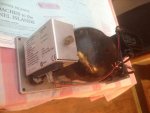
Re gassing a Waeco unit

Colin K

Well-Known Member
Joined
2 Aug 2009
Messages
411
Location
Coventry
Visit site
Hello,
I wondered if anyone had tried regassing a Waeco unit from one of the many kits available on ebay and amazon. Most come with the can hose and pressure gauge going from about a tenner to thirty odd quid. I was going ro refit it and then call an engineer who would do it and relieve me of £90.00 then I spotted the data plate on my unit and googled the type of gas.
Cheers. Col.
 

Attachments

  • IMG_3935.jpg
    IMG_3935.jpg
    92.4 KB · Views: 18
Colin

It is using R134a. A mere puff compared to the kit we make, but not available for you to buy legally as pure R134a. The cans on EBAY, or at Halfords contain a PAG oil that should not be mixed with the POE oil your fridge will hold.

The EU has decided only F Gas registered firms with F Gas qualified engineers can buy R134a. The situation with these car refill kits including oil is open to debate within our industry. If you can find a can with POE oil then that would be just fine, or straight R134a.

Any local fridge company will have easy availability of R134a as it is presently one of our commonest refrigerants, although in the next few years it will be going, with most of its available replacements being flammable.

And folk are wondering why fridge freezers burst into flames !

Follow up ...

I just had a look on EBAY and I am astounded by the misleading information and illegal sales of refrigerant gas going on. Some sellers do state the requirement to provide F Gas credentials, but at the prices being charged they are unlikely to get much if anything at all in the way of trade sales. Most of the small cans do contain PAG grade oil, which is not a good mix with the fridge's likely POE grade. One seller is offering smaller cylinders of R134a neat, but it looks like the can requires their own charge manifold which is not cheap. They say they will only sell to legitimate registered firms, but that is open to test.

R134a is not banned but its available quantity will be drastically reduced especially next year. The price is also accelerating and it has already doubled this year at trade buy in level.
 
Last edited:
Waeco units normally have Danfoss compressors, they are usually a sealed unit and don't have means to be re-gassed, if this the first time it's been done I would swallow the 90 quid and get someone to look at it. We have just been through this with a C.F. 35.

Gook luck.
 
Waeco units normally have Danfoss compressors, they are usually a sealed unit and don't have means to be re-gassed, if this the first time it's been done I would swallow the 90 quid and get someone to look at it. We have just been through this with a C.F. 35.

Gook luck.

A lot of Danfoss compressors have a service port, not sure if it's installation dependent or age dependent.
 
Superheat:
thanks for an illuminating post.

While I have your attention, may I ask a question?
When vehicle air-con systems are professionally re-gassed, considerable effort is made to remove potential contaminants (by creating a vacuum, which takes quite a while). I've heard of cases where excessive water present in boat fridge systems has been cited as the cause of performance issues. Yet whenever I've witnessed the re-gassing of a boat refrigerator, I've not been aware of any such process.

Comments?
 
Superheat:
thanks for an illuminating post.

While I have your attention, may I ask a question?
When vehicle air-con systems are professionally re-gassed, considerable effort is made to remove potential contaminants (by creating a vacuum, which takes quite a while). I've heard of cases where excessive water present in boat fridge systems has been cited as the cause of performance issues. Yet whenever I've witnessed the re-gassing of a boat refrigerator, I've not been aware of any such process.

Comments?

Even a small amount of water can cause serious problems, if it freezes in the pipework it will cause a blockage. Any form of refrigeration (including air-con) should be vac'd before a complete re-gas. If it's just a "top up" you can get away without it. But, topping up is not really the correct way to do it. If refrigerant is low the system should be evacuated and held under vacuum for a while before recharging with the specified quantity of refrigerant. There's no way of telling how much refrigerant is in a unit, other than emptying and refilling.
 
Even a small amount of water can cause serious problems, if it freezes in the pipework it will cause a blockage. Any form of refrigeration (including air-con) should be vac'd before a complete re-gas.

Thanks, Paul. That's exactly my point. Equally my impression is that it rarely happens, but I'm hoping that superheat can offer more than just an impression.

Boat-regassing is a fairly expensive business, and certainly dearer than vehicle air con specialists charge (or even Honda main dealers, as I know from recent experience). The fact that they come to you rather than the other way round obviously has some bearing on price, but is the service quantifiably inferior? As an aside, air-con shops routinely add a tracing dye to the re-gas when leaks are suspected, which seems way beyond the pay-grade of the boat re-gassers I've encountered.

This is drifting some way from Colin's original question. Worth its own thread?
 
Auto re gassing is normally carried out with an automatic unit with little user intervention other than connecting gauge lines, hitting a start button and going for a coffee and attending a simple user training session. The guy that does it is unlikely to know how or why it works. Fault finding is not normally carried out, leaks are sorted by changing hoses or fittings. This is different to an experienced refrigeration engineer you can deal with dignostics of any system, carry out out repairs not just replace parts and regard a system without knowing the system charge etc.

This leads to a higher labour rate and actually more hands on work, decanting gas, identitying leaks, repairing, vac out and recharge takes time.

Just adding a little gas does work but where has it gone, it does not just disappear for no reason and will need doing again at some time at further cost.
 
Waeco units normally have Danfoss compressors, they are usually a sealed unit and don't have means to be re-gassed, if this the first time it's been done I would swallow the 90 quid and get someone to look at it. We have just been through this with a C.F. 35.

Gook luck.

I got my Waeco CR40 fridge re-gassed no problem last year at a company that does 'shop refrigeration servicing' as the Danfoss compressor is quite often used ashore
in other fridges.
Cost £80 but that also included repairing a damaged cooling fin and took a day.

I found Waeco after sales very unhelpfull and their 's response was to send it back to Germany :mad-new:
 
For a local ref company, compressor manufacture and other items are not relevant, all are operational the same. As said try a local commercial refrigeration company, better not on a warm day as they will be busy but most will be very helpful, all work mobile so coming to you will not be an issue they might even find it an interesting task away from the norm.
 
Hello,
Thanks for all of the replies. Dont worry about the thread drift all along the same subject. I am moving the unit from my old sailing boat onto my cruiser where I have built an extra fridge on the flybridge so had to disconnect the plate from the compressor ( yes a Danfoss cold machine CU-54)
Made the box out of 50mm cellotex and lined it with 2mm pvc sheet which I have done before finding the unit only clicking in infrequently. I always access the boxes through the top to stop "cold". Loss which seems to work well. Not sure how much insulation to put on the lid can do an easy 25mm im thinking its less important as "cold". drops.......
It does have a charge nipple and enclose a pic on the unit plate it again says R134a / 35g

Thanks for all the comments, Colin
 

Attachments

  • IMG_3936.jpg
    IMG_3936.jpg
    95.1 KB · Views: 16
Did you loose the gas charge when you split the pipes? 35g of gas is really small, I use 59kg cylinders so only a squirt from of these would take seconds to charge. Ideally you want to make friend of a local ref engineer who would do this for very little cost as I do locally here, cars, boats and the local butcher. Makes a change from doing the big stuff I normally do.
 
Hello,
Yes the Waeco units come charged and you make the two pipes yourself joining the plate unit to the compressor. Unfortunatly the joint does not have a seal/valve that reseals when you break them apart afterwards (if you need to) and so yup it loses its gas.
Appreciate your and Trevors words of wisdom thanks. Think I have got my head around it. Just not clear on the gas/oil mix do the units have a bit of both?

Cheers, Colin.
 
Last edited:
Oil should stay in the system so you should not have a problem with that, you need to vac out the wpsystem before recharging and to do this any remaining gas should be recovered first. It's then normal to pressure test and purge with oxygen free nitrogen (OFN) and then vac out, this is to ensure the system is completely dry, its vac to about 2 torr, thats just above absolute vacuum, thus boils off any moisture, following this the gas charge is reintroduced by weight.

Were are you based as I may be able to help you with this as I've got all needed in my garage.
 
Sorry didn't log in yesterday so missed the follow ups.

Paul Rainbows comments are correct - water /moisture is enemy number 1 inside any fridge system and THE only way to get low level moisture out is by deep evacuation.

If you not interested in technical theory and practices of refrigeration engineering you may wish to stop reading now.

So where does the water come from after all air is dry isn't it ? - No it isn't - all air contains some moisture.

If you have air in the pipes you have moisture with it.

Air is also a compound of thousands of trace gases each with their own partial pressure. These partial pressures add to gather to form what fridgies refer to as non condensibles. These are fridge system enemy number 4.

(Enemy numbers 2 & 3 are uncontrolled liquid refrigerant and electrical supply component defects in that order, but these are for another post, another time).

So the only way to remove moisture and air is to deep evacuate the system, and I mean really deep. Imagine a room utterly filled to the brim with precisely of 762 boxes. The evacuation we need to achieve to declare the system dry and empty means we have to remove 757 of these boxes, but absolutely nothing can be allowed to replace the space they occupied. As the vacuum pumps starts to suck it can easily remove the first 600 boxes, but then as fewer and fewer are left inside the harder the remaining get to be removed, indeed even the highest quality vacuum pump will struggle to remove 760 of 762 boxes.

The physical unit I mention here is a Torr, where 760 Torr equals 760mm of Mercury at standard atmospheric pressure.

So why so low, well above 7 Torr then water as liquid will not evaporate into a gas that can be sucked out unless warmed well above 10oC. 5 Torr is needed to reasonably assume a system is dry and contaminant free. Unless you have watched a Vacuum pump suck to get to low level you haven't lived - its up there with paint drying and Kylie Minoque's singing (not her legs mind !).

Some fridge makers require < 3 Torr BTW.

I did warn this bit would get very boring, unlike Kylie's legs.
 
The kit costs about £140 total, all off eBay. You need a gauge manifold with connectors and hoses, a can of refrigerant, a tap for the can and a vacuum pump to evacuate the system thoroughly before refilling. The vacuum pump needs pump oil too.

The vacuum is important, as the oil used with R134a is hygroscopic (attracts moisture), and the only way to get the moisture out of the oil is with the vacuum pump, which causes it to boil out.

Not difficult to do at all and safe if you take some basic precautions. The Danfoss BD35F has a tap for refilling on the vacuum side with a Schrader valve. If not you'll have to fit one :-/
 
Top