Raymarine Question

MikeB.

Well-Known Member
Joined
27 Oct 2014
Messages
75
Visit site
My Merry Fisher 925 has a Raymarine C80 at the Helm at ceiling level. I would like a repeat on the Flybridge. I'm thinking of buying a C80 on eBay and piggy backing connections off of the helm and maybe off the auto pilot and the Tridata already up there - how practical is this?
Will it be OK on the fly bridge weather wise? (I always keep the winter cover on the flybridge.)
 
They are designed to be weather proof and networked so absolutely fine as long as you can source the right wires / connections. Worth bearing in mind that the C series are getting on a bit now so longevity can’t be guaranteed.
 
IIRC, (someone tell me if I'm wrong) the C series were not capable of being networked.
Even itf they are not networkable, you could probably connect them up but you would need two set of charts and I'm not sure what would happen if both engaged the pilot.
As I say, I'm not sure but it would be worth checking if they can be networked.
If it is the vintage of C series that I'm thinking, the C series wasn't networkable but the E series was.
Someone help here please.
 
I have 3 Pathfinder series displays onboard (those with vertical orientation).
One of them connected to the sounder module, another to the radome, and the third has the chart cartridge.
But I can select anything (charts/radar/echo) on each of them, even if they are only connected through Seatalk 1.

Can't remember exactly, but didn't the C series come after the Pathfinder series?
If so, it would be weird if they shouldn't provide at least the same functionalities...
 
I have 3 Pathfinder series displays onboard (those with vertical orientation).
One of them connected to the sounder module, another to the radome, and the third has the chart cartridge.
But I can select anything (charts/radar/echo) on each of them, even if they are only connected through Seatalk 1.

Can't remember exactly, but didn't the C series come after the Pathfinder series?
If so, it would be weird if they shouldn't provide at least the same functionalities...
Yes - the C did come after the Pathfinder (RL Series).
I think the idea was to provide a plotter for independent use - if you wanted a dual station, you had to pay the extra for the E Series.
 
I did wonder what the difference between the Cs and Es was, 'cause as I recall they look identical.
So, the C was essentially just a cheaper version of the E with no seatalk?
 
IIRC, (someone tell me if I'm wrong) the C series were not capable of being networked.
Even itf they are not networkable, you could probably connect them up but you would need two set of charts and I'm not sure what would happen if both engaged the pilot.
As I say, I'm not sure but it would be worth checking if they can be networked.
If it is the vintage of C series that I'm thinking, the C series wasn't networkable but the E series was.
Someone help here please.

Actually, you make a good point. We had two C series and radar could only operate on one but if memory serves a course plotted on one would show on the other and data such as course and speed was provided by Seatalk so I guess it depends what ‘networked’ is taken to mean.
 
C doesn’t network so can’t share chart or radar. They do connect the seatalk, so will network data shared in the seatalk network like speed and depth. E offers full network capabilities.
 
Now, that's weird, 'cause my older Pathfinder MFDs are only connected via Seatalk 1 and as I said they do share also radar, charts and sounder.
So, if also C series screens do have Seatalk connection, they must have deliberately restricted their capability via firmware...
Which afaik is not upgradeable anymore, hey-ho!
 
I think there is confusion in the word "Seatalk" here.
Seatalk 1 is the very old 3 wire system which is an "in house" Raymarine multi drop (bus based) version of NMEA 0183.
Seatalk 1 is not compatible with NMEA 0183 but does carry the same data.
Seatalk 1, as such, does not carry enough bandwidth to network Radar or share Chart data.
This is born up by Greg2's comment - simple course, depth and position data can be handled by Seatalk 1 and maybe some of his installation used NMEA 0183 as well.

After Seatalk 1, Raymarine produced a number of "networking versions".
IIRC, under Pathfinder, there was HS and HS2 (nothing to do with trains!!!)
These were coaxial interfaces that allowed radar and charts to display on multiple Pathfinders (RL Series) plotters.
Again, IIRC, the HS allowed 2 plotters to be connected - the HS2 allowed 4 plotters to be connected but all Pathfinder devices could share radar and chart data.

I think that after HS and HS2, Raymarine moved to a very different Seatalk 2 interface to network their E Series.
The C Series only has Seatalk 1 and I expect NMEA 0183 channels so won't network radar and chart data.

After Seatalk 2, there was/is Seatalk NG.
Seatalk NG is the funny coloured connectors and T pieces that look like pipework.
It is similar (if not identical) to NMEA 2000 which has plenty of bandwidth to allow radar and chart data to be shared amongst devices.

All very confusing and I may have some of this wrong but thats the way I see it.
My G Series uses several of these technologies so I decided to leave it all working as designed and interface the electronics that I wanted using simple one to one NMEA 0183 connections.

Well, thats how I see it anyway.
Someone will probably be along to correct me.
 
M, I'm no Raymarine expert (I had all Furuno bits on my previous boat, which I very much preferred even if older and non-networked at all), but based on what I have on the current boat I can confirm that my 3 Pathfinder displays (two RL80C and one L1260) are only connected vith the 3 wires Seatalk 1 cable, and they do share radar/chart/sounder in real time.
There is a tiny delay if you compare for instance the radar screen on the unit directly connected to the radome and any of the other two, but you must look VERY carefully to see that, and you'd never spot it unless you know what to look for. Totally irrelevant in practice.
FWIW, all units are also labelled HSB2, whatever that means. But I have no Seatalk 2 interfaces anywhere onboard.
 
M, I'm no Raymarine expert (I had all Furuno bits on my previous boat, which I very much preferred even if older and non-networked at all), but based on what I have on the current boat I can confirm that my 3 Pathfinder displays (two RL80C and one L1260) are only connected vith the 3 wires Seatalk 1 cable, and they do share radar/chart/sounder in real time.
There is a tiny delay if you compare for instance the radar screen on the unit directly connected to the radome and any of the other two, but you must look VERY carefully to see that, and you'd never spot it unless you know what to look for. Totally irrelevant in practice.
FWIW, all units are also labelled HSB2, whatever that means. But I have no Seatalk 2 interfaces anywhere onboard.
I must have got the name wrong - I said HS2 - you are correct it is HSB2.
I think if you look carefully, you will see a fat cable connects the displays.
This is the specification of data sentences that can travel across Seatalk 1
Thomas Knauf SeaTalk Technical Reference
You can see that it is all quite low demand information - a few bytes for each sentence.
Not the massive amount of data that would be required for Chart sharing or Radar displays.

That said, this is a very interesting article.
But it doesn't seem to mention the old Pathfinder HSB2.
Beginners Guide to Raymarine's Seatalk and Derivatives

As I say, it is all quite complicated and I have only investigated the bits that I need.
 
I use w C80, one in the saloon and one on the flybridge. Both plotters connected via seatalk and gps input also on seatalk. AIS input on nmea. Waypoints and routes have to be copied between units on a spare CF card. When a route is active it will be displayed on both units so handy to sit on the other helm and keep an eye on things. Both plotters need a chart so I update one every year so the other is only a year out of date and I use the the current chart on the main helm. Radar is only on the lower helm but I don't like to be on the flybridge with the radar on behind my head! NMEA has a multiplexer in the ais receiver. Don't also cross connect nmea as you only want one bi directional path between the plotters.
 
I use w C80, one in the saloon and one on the flybridge. Both plotters connected via seatalk and gps input also on seatalk. AIS input on nmea. Waypoints and routes have to be copied between units on a spare CF card. When a route is active it will be displayed on both units so handy to sit on the other helm and keep an eye on things. Both plotters need a chart so I update one every year so the other is only a year out of date and I use the the current chart on the main helm. Radar is only on the lower helm but I don't like to be on the flybridge with the radar on behind my head! NMEA has a multiplexer in the ais receiver. Don't also cross connect nmea as you only want one bi directional path between the plotters.
That all makes sense.
 
Thanks for all the reply's, the high price of used C80's on E Bay makes me consider buying new, does anyone know which dealer in the Southampton Water area is the most helpful and has a showroom to see 'stuff' working?
 
I think if you look carefully, you will see a fat cable connects the displays.
Just for the records: credit where it's due, you were correct and I was wrong.
I checked my displays in flesh, and I did find another cable that connects them all, on top of the seatalk.
Fatter, as you say, and similar to a power cable - which is what I must have confused it with the last time I looked, because I didn't remember it at all.
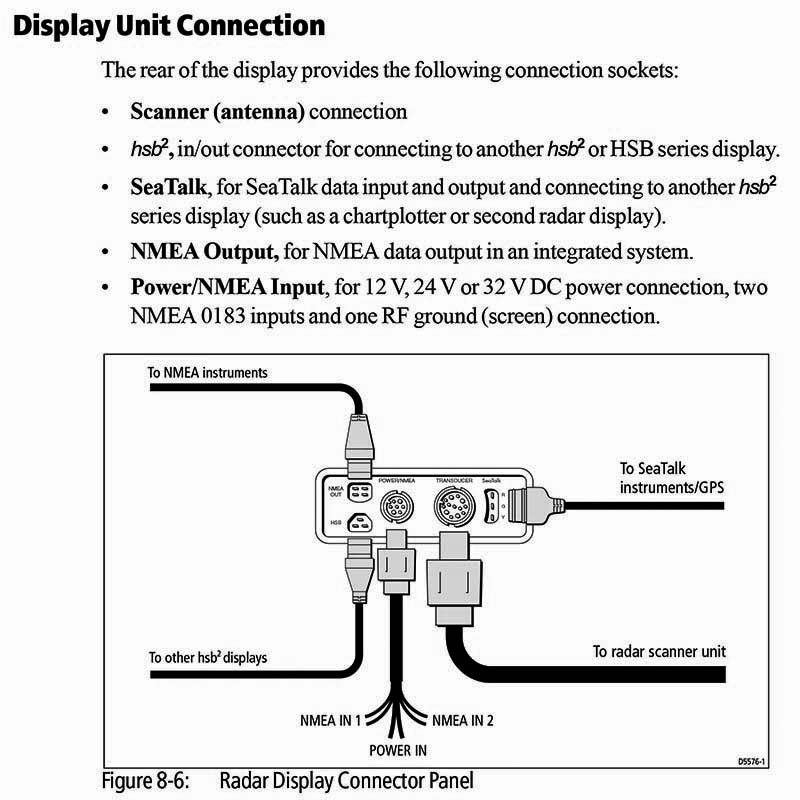
But (unsurprisingly) the manual confirms what is what, as per drawing below.
It's the cable with the triangular plug at the bottom left.
Apologies for the fake news! :)

qjbqKLk1_o.jpg
 
Just for the records: credit where it's due, you were correct and I was wrong.
I checked my displays in flesh, and I did find another cable that connects them all, on top of the seatalk.
Fatter, as you say, and similar to a power cable - which is what I must have confused it with the last time I looked, because I didn't remember it at all.
But (unsurprisingly) the manual confirms what is what, as per drawing below.
It's the cable with the triangular plug at the bottom left.
Apologies for the fake news! :)

qjbqKLk1_o.jpg
No need to apologise - I cheated.
I had a 4 station Pathfinder (1x RL80 and 3 RL70s) on my last boat - so I "kind of" knew it intimately.
 
Top