Raymarine Evolution Autopilot: ACU400, EV1, p70s - Installation Questions

  • Thread starter Thread starter Deleted member 36384
  • Start date Start date
D

Deleted member 36384

Guest
Raymarine Evolution Autopilot: ACU400, EV1, p70s - Installation Questions [Part 1]

Hello,

I have bought a Raymarine Evolution Autopilot and will have plenty of questions no doubt on the installation. The installation is currently planned as a basic stand along system (Evolution Minimum System), not integrated into anything. At some future point I will upgrade my instruments and integrate.

However, the installation instructions do show that speed can come from an STW (water) or a GNSS Receiver (ground) (Evolution Recommended System). I have ST60 instruments, would the water speed transducer be suitable? I assume if it was suitable, that I would need to put a T Piece into the transducer cable and connect to SeaTalkNG connection components. Is there a standalone GNSS Receiver that can be plugged into the iTC5. The Raymarine Raystar RS150 is expensive, so I am wondering if any old GPS antenna can be connected to SeaTalkNG.

Thanks, BlowingOldBoots
 
Last edited by a moderator:
I believe the itc5 is for analogue transducers ( not gps ) and if you have st60s which work well you’re better off with the seatalk to seatalkng converter than buying an itc5 if you don’t already have it. You can plug a raystar 150 into one of the spare ports on the converter or a cheaper n2k one via a devicenet to seaktalkng adaptor. If you already have gps on your seatalk1 bus that should be all you need. As you don’t strike me as the “go to waypoint” type, if you’re just thinking about the future, if you don’t have gps now bear in mind that if you ever want a plotter they all tend to have gps integrated these days. Apologies if I’ve misinterpreted. Currently riding out the Medicane with the help of Kythiran wine...
 
Laika I have an old Navman plotter but will not be trying to interface that (unless it is an easy plug and play). The primary objective is to fit the auto helm as standalone. I was just wondering if I could stick any old GPS receiver into SeaTalkNG and the ST60 speed transducer into the backbone (probably via some device to output a SeaTalkNG signal).

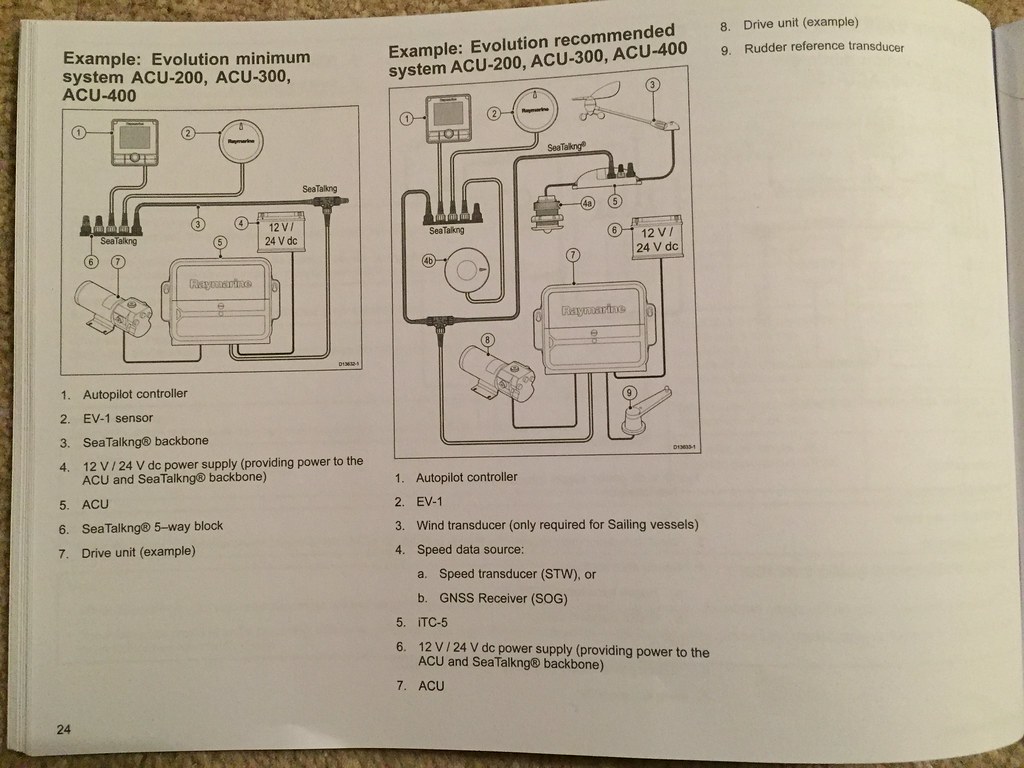
The picture on the left is what I am likely to install but with rudder feedback unit. The picture on the right I could install if it was easy to do using existing equipment. Towards the end of next year, or the following year, I am likely to replace my current plotter with a new Raymarine unit.

Untitled by Rival Sailor, on Flickr
 
Hi BOB,
If I understand your question correctly, you simply need a seatalk1-seatalkNG converter to get seatalkNG speed output from you ST60, and plug that into your 5way block (effectively into the backbone).
As for a non-Raymarine GPS, it should say whether if outputs N2K (I think most would). If it does, you would need a N2K-seatalkNG adaptor plug, then you could plug the GPS seatalkNG into your backbone (would need another cable and plug like a 5way block).
[seatalkNG and N2K are effectively the same, the adaptor plug there is just so you can connect the raymarine plug physically to the GPS plug.]
Of course, when you get a new (raymarine) plotter with seatalkNG, all this will become redundant. I believe that will have its own GPS, and be true plug and play. With the cost of cables, converters, adaptors etc, you may want to keep that money and bring forward the new plotter purchase?
I’m sorry if you already know all this.
 
There's 2 parts to the question I think: Instruments and GPS.

For the instruments...What the picture above shows you is the minimal way to hook up analogue transducers to your shiny new seatalkng network: It converts the analogue signals to seatalkng which can then be read by your p70 control head or any other seatalkng instruments. Your ST60s would then be redundant.

However, if, like me when I installed my ACU200, you have perfectly functional instruments taking the analogue transducer output, displaying it and converting it to seatalk 1 the alternate approach is to keep those and plug the seatalk 1 bus into the seatalk ng bus via the seatlak->seatalkng converter. This is what I've done with my ST50s. So your old instruments convert analogue -> seatalk 1, and the converter does the seatalk 1 -> seatalk ng conversion. You can take power for the seatalk1 bus from the converter. Crucially, your ST60s continue to work.

For the GPS...I'm not really an N2K expert but I believe any NMEA-2000 certified GNSS receiver should work. If it has a standard devicenet connection you just need to use a devicenet->seatalkng spur cable. N2K GNSS receivers tend to be a bit pricey. An alternative might be a cheaper nmea 0183 one with an nmea-0183 to nmea-2000 adapter, e.g. the actisense one with seatalkng adaptor:
http://www.cactusnav.com/actisense-ngw1-nmea-2000-gateway-with-raymarine-nmea-2000-stng-adaptor-cable-p-13589.html
However...do you really need GPS in the system, especially if you're considering later addition of a plotter which will likely have GPS integrated? Personally I almost never use GPS waypoints. Without a plotter it would be a bit of a chore anyway. When considering the statement "you don't need a gps" though I wondered whether GPS is used in the system's auto-calibration: I honestly don't know as my plotter (and hence GPS) was probably on when I did the set-up on mine.

There's some info on connecting stuff to N2K networks on the raymarine site:
http://www.raymarine.com/view/?id=400
 
Laika / Venus1 thanks for taking the time to respond and you have answered my questions. I will install as a standalone unit only and not bother to integrate. In a year or two I will buy a modern plotter and transducers and remove my instruments and then integrate.

This all new to me but I am beginning to understand how it all goes together.
 
Just to add...new instruments are hideously expensive. Those i70s multifunctions are £500 each. To replace your wind/log/depth transducers and displays with i50/i60 ones would be £1500. Personally I don't intend replacing any of my ST50s until they break: the converter works just fine. The only exception is the ST50 compass display: the off-course indicator doesn't work with the EV1 (although the heading display does). If I had a spare £500 kicking about I might consider replacing just that display with a multifunction. You probably won't have that problem: The converter isn't guaranteed to work with ST50s (in practice it mostly does) but it is with ST60s.
 
I started my N2K network exactly like that (except it's an ACU200). At first you can power it all from the ACU which is what I did.

STNG is just N2K with non-standard connectors and an extra wire for the older seatalk. If you're going all Raymarine that's good enough, so that might suit you. I had no other Raymarine kit so have mixed and matched a bit and there's a lot you can do to keep the costs down.
 
Top