Raw water Skin fitting advice please

jamie-bay

Active Member
Joined
28 Sep 2010
Messages
53
Location
Alverstoke
Visit site
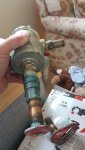
Would you change a strainer skin fitting for a straight in line fitting. I have an md2020 on a hunter hh30. On a drying mooring or anchorage the housing fills with fine weed and mud. It cannot be cleared easily. So is there any reason why i shouldnt go without the external strainer so i can rod through when it blocks. Does anyone have a hassle free inlet with just the internal strainer
 
I agree with above.. the grill just allows mud to ouse inside making it difficult for it to come back out. I,ve an open 1 1/2" deep down and when i do sit in mud for a few weeks i ve never had a blockage problem.
I wonder if your smaller diameter can make matters worse?
 
I agree with above.. the grill just allows mud to ouse inside making it difficult for it to come back out. I,ve an open 1 1/2" deep down and when i do sit in mud for a few weeks i ve never had a blockage problem.
I wonder if your smaller diameter can make matters worse?
Yes I agree its thin and really clogs ive had 8 or 9 really bad experiences where we have had to climb under the boat or use a dinghy just as the tide rises or falls to clear it........its quite near the shaft behind the gearbox so a larger seacock is not likely i am thinking of trudesigns anyway.....thanks for the advice. J
 
Guys....someone is trying to say that the inlet flow is affected without the scoop, I mean its not as if we ar cavitating at 20 knots....I get excited at 7!
 
Scoops facing forwards aren’t recommended on sailing boats because if you sail fast enough they might push water up into the exhaust, which the engine won’t push out because it’s not running. I’m not convinced this is a serious risk (would need pretty high pressure to force it past the pump) but it means the scoops are generally, or at least frequently, fitted facing aft. That being the case, suction affecting the flow would be even more of a problem than with a normal flat fitting. But as you say, at sailing boat speeds it’s a complete irrelevance.

Pete
 
Filters and strainers are intended to block, that's what they are there for. It therefore follows that they must be maintainable. So strainers outside the hull, filters inside fuel tanks, filter housings that cannot be disassembled, have no place in equipment. Take it off and put a Vetus, or similar, inside the engine room.
 
Thanks everyone, I will go ahead with my plan then. Any views on the seacocks being replaced with trudesign seacock kits? 4 to replace, mix of dzr and bronze all removed ready now.....i am quite taken with them...project cost £250 so a reasonable outlay neededComposite Seacock kits
 
Do you not have to change the composite ones every 5 years? A bronze one can be for life.
My friend has a jeanneau with lifting keel and his engine intake is always blocking when sat on the mud..
I always close my seacock before taking to the mud. I wonder if the water in the intake has some sort of effect of stopping the mud getting rammed right up in the pipe?
 
Any views on the seacocks being replaced with trudesign seacock kits? 4 to replace, mix of dzr and bronze all removed ready now
At that size, composite stuff can be a good choice. I'd rather have that or bronze, not DZR.
Ref. the scoop, you are talking of a sailboat, right?
I wouldnt' want to get rid of the scoop in any fast boat, because it helps keeping a good sea water pressure when it's more necessary, i.e. when the engine(s) spins faster.
The plain vanilla skin fitting does the opposite instead, which is the reason why you normally find it either above the w/line or, if on the hull bottom, for outlets rather than inlets (like the WC outlets, for instance).
Then again, maybe at single digit speed it doesn't make a meaningful difference, I'm not sure.
Anyhow, after the replacement, I would want to carefully check that the water flow in the strainer remains good up to WOT.
The bad news being that if it wouldn't, you should re-lift the boat and revert to the scoop... :oops:
 
I fitted a fresh water flush system running off the galley pump which enables the heat exchanger and exhaust elbow to be flushed of salt and last a lot longer. The spin-off is that if the engine isn't running the pump will blow fresh water at up to 2 bar back out of the seacock and clear any blockage. OTOH if the blockage were too solid it could blow some other part of the system such as the lid on the strainer box. Ask me how I know this.
 
Do you not have to change the composite ones every 5 years? A bronze one can be for life.
My friend has a jeanneau with lifting keel and his engine intake is always blocking when sat on the mud..
I always close my seacock before taking to the mud. I wonder if the water in the intake has some sort of effect of stopping the mud getting rammed right up in the pipe?
[/Do you not have to change the composite ones every 5 years?
No you don't. They last the life of the boat which is why the US Coast Guard approves them. I have them as standard and I've never understood all this agonising about fake bronze ones which fall to bits when the Forespar alternative is readily available.
 
I fitted a fresh water flush system running off the galley pump which enables the heat exchanger and exhaust elbow to be flushed of salt and last a lot longer. The spin-off is that if the engine isn't running the pump will blow fresh water at up to 2 bar back out of the seacock and clear any blockage. OTOH if the blockage were too solid it could blow some other part of the system such as the lid on the strainer box. Ask me how I know this.
Aha! We have a trade mark for that system, here in the asylum.
If you are prepared to spend the whole night reading about it, just search for BodgeFlow. :ROFLMAO:

Just a small warning, though: if you use the system also to backflush the seacock (which is a very logical and useful extension), you'd better fit an additional valve downstream of the fresh water inlet.
In fact, by turning the engine off with the pipe that goes to the raw water pump still open, you are back-pressurizing the raw water circuit.
Which could be a non-issue, if the raw water pump keeps a perfect seal when stopped, but if it doesn't, you are risking to create a water reversal, potentially up to the exhaust and eventually inside some cylinder, in the worst case.
 
Trudesign make a scoop/strainer that can be fitted over the through hull, secured by three screws. You could try without and only fit it if needed. I will find out soon, I have the scoop but am not going to fit it yet if at all. I like the idea of beeing able to poke a cane through to clear out any obstruction.
 
Do you not have to change the composite ones every 5 years? A bronze one can be for life.
My friend has a jeanneau with lifting keel and his engine intake is always blocking when sat on the mud..
I always close my seacock before taking to the mud. I wonder if the water in the intake has some sort of effect of stopping the mud getting rammed right up in the pipe?
I very much hope not as I have just fitted 11 trudesign skin fittings, valves and tails. The theory is they are "for life" as much as bronze ones.

The five year observation stems from EU rules which are poorly-worded and allowed certain builders to get away with installing non-dzr brass. Which was a very bad idea. The rule said that "fittings should be able to last five years" or similar effect. Brass should be replaced within five minutes IMHO; other materials should last much longer than five years.

Anyway, having done the work myself I shall be watching "with interest" upon relaunch and hoping I don't immediately have to pay a return fare....
 
Aha! We have a trade mark for that system, here in the asylum.
If you are prepared to spend the whole night reading about it, just search for BodgeFlow. :ROFLMAO:

Just a small warning, though: if you use the system also to backflush the seacock (which is a very logical and useful extension), you'd better fit an additional valve downstream of the fresh water inlet.
In fact, by turning the engine off with the pipe that goes to the raw water pump still open, you are back-pressurizing the raw water circuit.
Which could be a non-issue, if the raw water pump keeps a perfect seal when stopped, but if it doesn't, you are risking to create a water reversal, potentially up to the exhaust and eventually inside some cylinder, in the worst case.
It would indeed, which is why I have a half inch stopcock in the fresh water line preventing exactly that. The routine is that at the end of a trip the cock is opened to permit fresh water flow which is confirmed by feeling the copper pipe become warm since the galley pump can't be heard with the engine running. The seacock is then closed and the engine run for about a minute to flush it. The fresh water cock is then closed and simultaneously a pullcord operates the engine stop lever so that the fresh water isn't being pumped with the engine stopped (which as I discovered, blows the lid off the sea water strainer!) and the engine isn't running with no water through the pump.
I've never had a need to use it to unblock the seacock but it would no doubt do so as long as the blockage wasn't stubborn enough that the lid gave way first.
 
Top