
Raw water pump refurb

richardh10

Well-Known Member
Joined
7 Jul 2007
Messages
521
Location
on the move
Visit site
I recently bought a maintenance kit for the raw water pump on my volvo D2-40 and the one part I actually need is not included. According to the volvo parts catalogue it is now obsolete. On the diagram that I am (hopefully) going to attach it is part number 6 which is a spacer washer with 4 small lugs on it. My question is whether you could just put on a washer with the correct depth which includes the washer and lugs. I can't work out why the lugs (hope thats the correct name) are there.
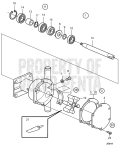
1676157843142.png
 
I recently bought a maintenance kit for the raw water pump on my volvo D2-40 and the one part I actually need is not included. According to the volvo parts catalogue it is now obsolete. On the diagram that I am (hopefully) going to attach it is part number 6 which is a spacer washer with 4 small lugs on it. My question is whether you could just put on a washer with the correct depth which includes the washer and lugs. I can't work out why the lugs (hope thats the correct name) are there.

View attachment 150973
It looks like it's a spacer that's intended to throw any leaks off the shaft, either water from one side or oil from the other.
There are probably slots in the housing where that sits on the shaft.
 
I think that is the slinger washer. It's purpose is to throw any water leaking past the lip seal (10) out through the small opening in the casing and prevent it contaminating the bearings.

Not sure why it is lugged, but if these are controlling the insertion position the the thickness could be important.

A small spacer washer the same overall thickness could be made from brass rod, but I would then mill a pair off crossing cuts on one face to recreate the small air gap.
 
#6 sits with the lugs in the spring groove of the secondary water seal so that the slinger "o" ring #9 flings water leaking from the primary seal next to the impeller out of the tell-tale hole to the outside.
 
I think the item #6 is a spacer which keeps a separation between the back to back pump water seal #10 and the engine oil seal #15 whilst at the same time straddling the slinger ( O ring #9) and allowing it to throw leakage water radially off the shaft and hence through the weep hole in the casting. I think the image is a poor representation as the 'lugs' are more rightly 'legs' and protrude from the face of the spacer disk axially rather than radially from the edge so giving the spacer depth like the four legs on say a coffee table gives the flat table surface 'depth'. The slinger would be positioned to throw water out between the legs so to speak.
 
Thanks all

ean_p I think you have hit the nail on the head, as the remaining lugs/legs do appear to be at an angle, and don't fit neatly into the spring groove of the water seal. Going to be difficult to get something like that made up unfortunately
 
Thanks all

ean_p I think you have hit the nail on the head, as the remaining lugs/legs do appear to be at an angle, and don't fit neatly into the spring groove of the water seal. Going to be difficult to get something like that made up unfortunately
Very easy for a plastic printer
 
Is the old spacer unusable?
Yes. 2 of the lugs were broken off by the last person to "fix" it.
I am using the spare pump I had so I do have a useable engine, but now I want to repair this one for a spare.

Very easy for a plastic printer
Good point and I'll do that when I get back to UK. However, at the moment I am in Fiji, and nothing is very easy here!
 
Yes. 2 of the lugs were broken off by the last person to "fix" it.
I am using the spare pump I had so I do have a useable engine, but now I want to repair this one for a spare.


Good point and I'll do that when I get back to UK. However, at the moment I am in Fiji, and nothing is very easy here!

To be fair if you have ordered and received the correct spares kit from Volvo and they say that the spacer is now obsolete then its quite feasible that you no longer need to fit it. Perhaps they have changed the spec of the seals etc so as to remove the need for the spacer. I'm not familiar with the build of the pump but would suspect that the spacer is there to stop the seals 'wandering' along the shaft and also to 'position' the outer bearing and both seals between the shaft circlip and shaft housing end plate / pump body in the correct positions. If it would make you feel better to have something there ( and again I stress that I'm not in anyway familiar with this pump assembly) then consider a piece of plastic tube/ pipe very slightly over size in terms of diameter but accurately cut as regards length to suit the thickness of the spacer. Wall thickness of the pipe would need to be two or three mm at least I should think. Remove a section of this ring to equate to just less than the length of the drain opening in the casting. Shape / taper the ends of the now split ring of plastic and using a little heat bend the ends outwards so that when the ring is 'sprung' into the shaft housing during the rebuild the bend will locate and stop and revolving of the new spacer yet keep the drain hole clear. The slight diameter oversize would apply a firm pressure to keep it located. If still worried that it may revolve, then drill several more holes through the wall of the spacer to allow it to drain in all eventualities should its position move.
 
Thanks all

ean_p I think you have hit the nail on the head, as the remaining lugs/legs do appear to be at an angle, and don't fit neatly into the spring groove of the water seal. Going to be difficult to get something like that made up unfortunately
If the seals are to seal the pump impeller housing and the engine timing case ( or how ever/ were ever the shaft is driven) then I would expect that the seals would be back to back with the 'spring grove' as you describe it facing the fluid it is intended to seal and the 'flat face facing the outside world so to speak...! But again I should stress that I'm not familiar with these pumps and a different orientation may be correct !
 
Old thread but having just rebuilt one of these pumps the plastic insert and slinger O ring do act as a spacer but the slots in the spacer also allow you to push the water seal out should you need to replace it in future, without completely dismantling the pump. I don't know if this is the intended purpose but it is useful.given the water side seal is more likely to fail (although pointless if a spacer is now deemed unnecessary)
 
Last edited:
Top