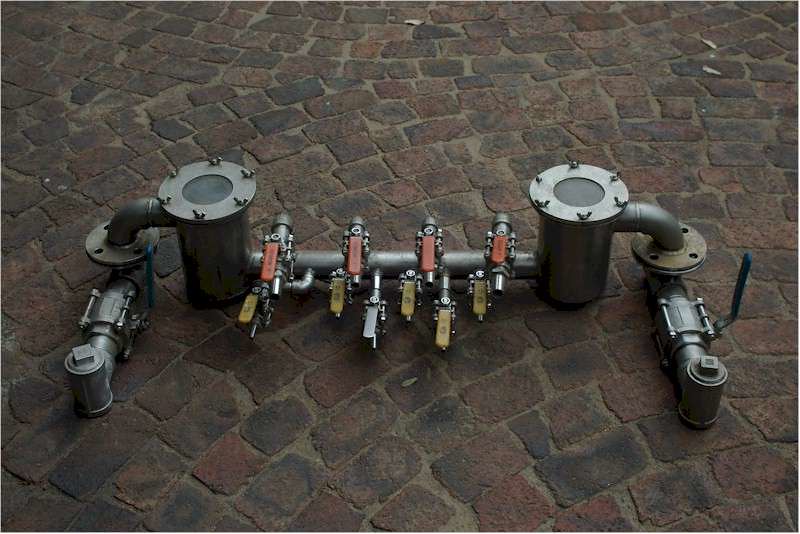
Raw water inlets

zoidberg

Well-Known Member
Joined
12 Nov 2016
Messages
6,938
Visit site
I have a Vetus 330 raw water strainer mounted above the waterline on a bulkhead, vertically about a foot above a through-hull inlet ( c/w seacock ) and connected by a flexible pipe - this all on the starboard side of the engine space. There is a similar through-hull inlet, blanked off, on the port side.

An engineer has suggested I bring this second inlet into service, coupling it to the first by a T-piece, to provide redundancy in event of partial blockage by weed, plastic bag, mussels growth.

In the experience of readers, would this provide a benefit? Or would this more likely introduce air into the supply when the boat is heeled, causing a reduction in water flow and engine overheating?
 
It's added complication, but might have a perceived benefit one day. As for introducing air when heeled, it's surely no more likely to do that than the existing inlet?
 
I have found a single inlet to be perfectly adequate. But then, I don't use braces when my trousers stay up using a belt. :D
 
Seems like a good idea, provided you have a detector/sensor which tells you loud and clear when the flow is blocked on inlet #1, so that you can switch instantly to inlet #2 (provided the valve is already open) . Waiting for a temperature sensor to tell you that engine is too hot, and then introducing cold water may not be a good idea (depends on the temp that the overheat sensor is set for, I suppose.)

And assuming that inlet #2 is not blocked by barnacles, mussels, limpets, cockles, whelks, etc. Which reminds me that I must cut a length of old wire rigging to size, to act as a prodder for my inlet system.

Would it be worth a 3 way Y Y valve so that you can choose between inlet 1 or 2, as well as a wander hose for pumping lots of unexpected bilge water ? Just to complicate matters, of course....
 
Last edited:
I have a Vetus 330 raw water strainer mounted above the waterline on a bulkhead, vertically about a foot above a through-hull inlet ( c/w seacock ) and connected by a flexible pipe - this all on the starboard side of the engine space. There is a similar through-hull inlet, blanked off, on the port side.

An engineer has suggested I bring this second inlet into service, coupling it to the first by a T-piece, to provide redundancy in event of partial blockage by weed, plastic bag, mussels growth.

In the experience of readers, would this provide a benefit? Or would this more likely introduce air into the supply when the boat is heeled, causing a reduction in water flow and engine overheating?

I have an arrangement like that but I have a seperate ball valve and strainer on each inlet. I also have a flow switch on my engine inlet from the setup.

My idea is only to use one inlet at a time and it one gets blocked I can change over to the other on the fly.

36086124865_1b0fe66605_b.jpg
 
What if the second one was to block also what do you do then? All the what ifs it could drive you mad. You could start to double up on every through hull inlet and move on to a secondary fuel filtration system. Where does it all stop usually with one inlet which works very well? Not so sure about the engine water inlet not drawing water when heeled that inlet should be on the centre of hull.
 
Your description sounds like mine. Never (touch wood) had a blockage but it is simple to clear with taking off the strainer top and poking a wire, radiator type brush handle or similar straight down to clear anything. Or get a length of tube that fits over the strainer inlet on its inside and blow down it. Both work effectively. No need for extra complexity.
 
On my new outdrive installation they recommend through the leg water and a standard skin fitting, both passing through the water trap. I think the idea here is if something gets wrapped around the leg then the water flow continues.
 
My experience has led me to checking the filter every six hours or so when on passage, and a doubled system is something that I have thought about fitting, though I don't think I have the space. It would save having to stop motoring.
 
My experience has led me to checking the filter every six hours or so when on passage, and a doubled system is something that I have thought about fitting, though I don't think I have the space. It would save having to stop motoring.

Surely you have an overheat alarm?
 
My experience has led me to checking the filter every six hours or so when on passage, and a doubled system is something that I have thought about fitting, though I don't think I have the space. It would save having to stop motoring.

I suppose it depends on the waters that you sail on, but I have a look at mine once a year after lift out.
 
Given the ambivalence above, I've removed the 'inherited plumbing fitting with a small gate valve' which was on the unused through-hull in question, and capped it off properly. For 'belt 'n braces' I've filled the orifice with CT1. That should do the trick!
 
Given the ambivalence above, I've removed the 'inherited plumbing fitting with a small gate valve' which was on the unused through-hull in question, and capped it off properly. For 'belt 'n braces' I've filled the orifice with CT1. That should do the trick!

I did exactly the same with a disused through hull, capped and filled the fitting with Sikaflex. Still sound after three years.

As with everything on the boat, I like simple.
 
What if the second one was to block also what do you do then? All the what ifs it could drive you mad. You could start to double up on every through hull inlet and move on to a secondary fuel filtration system. Where does it all stop usually with one inlet which works very well? Not so sure about the engine water inlet not drawing water when heeled that inlet should be on the centre of hull.

'Have you considered prayer....?'

I'm now searching for an alarm wot sounds/flashes when the f-f-f-fridge warms up, risking a breakdown in the coolth of the beers. That is, to me, a full-on emergency requiring decision and action in swift order. I am still surprised that 'Beer Condition Recovery' techniques are not taught/examined on RYA Courses.....
 
Top