Ratio between wind speed and force

You seem to mixing up energy and energy flux, clearly different things.

I am not mixing them up. You'll note that I wrote "kinetic energy flux", and in a fluid the energy transported is - all other things equal - proportional to the cube of the velocity. It's momentum flux which produces force, and the reason momentum flux is proportional to velocity2 is nothing to do with kinetic energy.
 
If cold air is 7% more dense than warm air does one square the differences in density. Simply because of the development of the thread, I think not - but thought I'd ask the gurus.

Jonathan
 
I am not mixing them up. You'll note that I wrote "kinetic energy flux", and in a fluid the energy transported is - all other things equal - proportional to the cube of the velocity. It's momentum flux which produces force, and the reason momentum flux is proportional to velocity2 is nothing to do with kinetic energy.

I was giving a simple energy/work explanation; you then contradicted with a more complicated, and different explanation. You're not wrong, except in saying my explanation doesn't work.
 
A good and comprehensible reply may be found here:
http://physics.info/drag/

Please notice that the author shows how the observation made here regarding bicycle riding is somehow not correct!

Daniel

The one equation I expected to see in there is F = 0.5 C ρ A V2 but couldn't spot it at first glance.The V2 is the bit that makes the drag rise as the square of the speed. C is the drag coefficient (determined by shape basically), ρ is the density of the fluid (the atmosphere in this case), A is the cross-sectional area (how fat you are, or how big a jacket you are wearing) and V is the speed through the fluid (the apparent wind speed, a minus if it's a tail wind).

From this it can be seen that a pointy helmet not only makes you look a pratt but doesn't actually have as much effect as expected, the air density does make a difference but reducing it too far can be highly counter-productive (and having big bones like me doesn't help either) but that the real solution is to simply go more slowly and avoid headwinds.


At this point somebody usually mentions the Reynolds number.
 
Wow. Lots of Chemistry and physics revision here. Thanks, JD and others.

I think I will have to do like the constipated mathematician and work it out on a piece of paper.

That doesn't make sense at all!

I think you'll find...he worked it out with a pencil.
 
What I do notice is that people who run or cycle are thin anyway (and never look as if they need any exercise) - is that because they find it easier because they have less wind resistance?:)

Jonathan
 
From this it can be seen that a pointy helmet not only makes you look a pratt but doesn't actually have as much effect as expected, the air density does make a difference but reducing it too far can be highly counter-productive (and having big bones like me doesn't help either) but that the real solution is to simply go more slowly and avoid headwinds.


At this point somebody usually mentions the Reynolds number.
Pointy helmets are for racing. Once we're talking racing then small effects count as they can make the difference between gold and silver.
 
That doesn't make sense at all!

I think you'll find...he worked it out with a pencil.

Well, if you're going to be like that: in my day he worked it out with a sliderule.
But nowadays things are more civilized.
Working it out with a calculator doesn't bear thinking about.
 
Fluid dynamics is a fascinating subject.

Humans should be famililar with the behaviour of wind and and water. We live with these forces everyday, but strangely our intuitive estimation of the forces involved in fluid mechanics is often inaccurate.

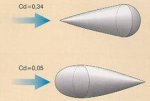
Which object has the lower drag (assuming the same cross sectional area), the top figure or the bottom one?

I suspect many people would instinctively pick the top one with its more streamlined leading edge. Without studying fluid dynamics few would give the answer that not only has the lower shape less drag, it has over 6x less drag!
 

Attachments

  • image.jpg
    image.jpg
    15.2 KB · Views: 0
A good and comprehensible reply may be found here:
http://physics.info/drag/

Please notice that the author shows how the observation made here regarding bicycle riding is somehow not correct!

Daniel

Yes, very interesting thanks. But at the same time distressing that the power needed to overcome drag is actually the cube of relative wind speed, not the square (for bike riding). Or it may not be at all, because he also says that the relationship might be a complex polynomial.

Also interesting to learn the etymology of BASE jumping. I have always wondered why they called it that. I would have thought that jumping off the base of something would be quite boring. Now I know.
 
Last edited:
Fluid dynamics is a fascinating subject.

Humans should be famililar with the behaviour of wind and and water. We live with these forces everyday, but strangely our intuitive estimation of the forces involved in fluid mechanics is often inaccurate.

Which object has the lower drag (assuming the same cross sectional area), the top figure or the bottom one?

I suspect many people would instinctively pick the top one with its more streamlined leading edge. Without studying fluid dynamics few would give the answer that not only has the lower shape less drag, it has over 6x less drag!

Which is presumably why submarines have a bulbous bow, as do those protrusions on large commercial ships - oddly most performance yachts still have knife like bows.
 
Fluid dynamics is a fascinating subject.

Humans should be famililar with the behaviour of wind and and water. We live with these forces everyday, but strangely our intuitive estimation of the forces involved in fluid mechanics is often inaccurate.

Which object has the lower drag (assuming the same cross sectional area), the top figure or the bottom one?

I suspect many people would instinctively pick the top one with its more streamlined leading edge. Without studying fluid dynamics few would give the answer that not only has the lower shape less drag, it has over 6x less drag!
attachment.php


.... and that is the answer to "which way round should I fix my pear anode".
 
If cold air is 7% more dense than warm air does one square the differences in density. Simply because of the development of the thread, I think not - but thought I'd ask the gurus.

No, the effects change directly proportional to density.

I was giving a simple energy/work explanation; you then contradicted with a more complicated, and different explanation. You're not wrong, except in saying my explanation doesn't work.

Your explanation was wrong. Sorry.
 
Yes, very interesting thanks. But at the same time distressing that the power needed to overcome drag is actually the cube of relative wind speed, not the square (for bike riding). Or it may not be at all, because he also says that the relationship might be a complex polynomial.

There is a frequent misuse in the use of the words power and force. In physics their meaning is very precise and quite different while in common life the two words are often interchanged.
Is a bicyclist concerned more about force or more about power? I sincerely do not know, someone tells me...
:)

Daniel
 
Cold air is heavier than warm air so the force on the sails is noticeably greater, this was very apparent when sailing in the UK compared to sailing in the Caribbean.

I find it difficult to believe that 7% 'feels' that different - which means people are very sensitive, or they cannot feel the difference, or its more than 7%. - or even some other effect
 
I suspect we're getting into the interaction of many other effects, including boat design, sea state (we haven't looked at how wind strength affects wave height, all other things being equal: there's another force/energy/drag equation) not to mention (since we're talking about 'feeling') psychological effects of being in the Carribean vs Solent/North Sea/wherever.
 
There is a frequent misuse in the use of the words power and force. In physics their meaning is very precise and quite different while in common life the two words are often interchanged.
Is a bicyclist concerned more about force or more about power? I sincerely do not know, someone tells me...
:)

Daniel


Judging by the number of times they complain about being forced off the road I would say it's the former....
 
Top