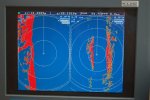
Radar

East Cardinal

Well-Known Member
Joined
7 Dec 2017
Messages
137
Visit site
Following on from the thread on the Azi 39. The radar arch on the boat has raised the question of what radars are fitted to motorboats.
Are they used for traffic avoidance or navigation or conpicuoty?
What sort of price are they?
 
I do not have a radar on my boat but i am very cautious as to what the visibility forecast is before go out to sea, even then, I have been surprised by Mother Nature before with fog suddenly without warning casting a blanket on me.

A radar is of particular value if you are caught in a fog , you will be able to see stationary and moving obstacles around you , even though I have an AIS overlay on my chart plotter which reveals a good number of boat traffic for me so that I can avoid them, sadly a lot of boaters do not have an AIS transceiver, small boats, sailboats, canoes and kayaks can suddenly pop up , not to mention crab pot bouys , Wooden pilons and so on that can do a good hole in your hull if hit at an unlucky angle.

Summary, a radar is very useful , more for some than others and can on occasion save a boat or a life.

As to pricing, just google your preferred reader model and you will have enough links to check out offers google presents from marineshops in your area.
 
Last edited:
Following on from the thread on the Azi 39. The radar arch on the boat has raised the question of what radars are fitted to motorboats.
Are they used for traffic avoidance or navigation or conpicuoty?
What sort of price are they?


Depending on your financial circumstances, need not be new .
The latest newest "Digital" equipment with starship pricing may not make sense on many boats.
Boaters upgrading older equipment frequently sell or trade in perfectly good equipment much of which ends up on Ebay.
Really early stuff with green screens such as " Furano" to more modern colour sets such as Simrad or "Raymarine" can be purchased at prices starting from £200.00 up to £700.00 (ish) for later colour equipment.
This should include the screen and scanner and importantly the cable connecting the two.
Your main installation problem will be running the cable(s) through all the superstructure and then hiding a surplus 10 metres of cable.
Cutting is not recommended, unless you are very very good with soldering iron, have surperb eyesight, the patience of saint and are prepared to ignore the dire warnings of the manufacturer.
 
Depending on your financial circumstances, need not be new .
The latest newest "Digital" equipment with starship pricing may not make sense on many boats.
Boaters upgrading older equipment frequently sell or trade in perfectly good equipment much of which ends up on Ebay.
Really early stuff with green screens such as " Furano" to more modern colour sets such as Simrad or "Raymarine" can be purchased at prices starting from £200.00 up to £700.00 (ish) for later colour equipment.
This should include the screen and scanner and importantly the cable connecting the two.
Your main installation problem will be running the cable(s) through all the superstructure and then hiding a surplus 10 metres of cable.
Cutting is not recommended, unless you are very very good with soldering iron, have surperb eyesight, the patience of saint and are prepared to ignore the dire warnings of the manufacturer.

I'd almost agree, but:

radar overlay on existing plotter is imho more than a nice feature.
it's highly unlikely you're going to get an old analogue radar with the thumb size cable with 20core going NOT cut in half :D
The advantage of the digital radars is that you have an ethernet cable to thread through, just 8 thin wires, special tool to crimp a new ending cost peanuts.
Personally i find the green screen standalone radars a bad joke nowadays.

to answer the OP, use? all three I guess, depending on where you're based. Half the med boats I see around don't have one.

V.
 
Very interesting. My experience was with raw radar and plotting with a China graph to get CPA’s of traffic and many lines for blind pilotage into harbours.
The modern radar set ups and AIS are a massive improvement. Radar input into a chart plotter would be a fabulous tool.
Sadly, I only have a RIB and will use in good weather, so won’t be purchasing a radar, but am interested in the developments since I used radar on a ship in the 1990’s.
 
Navigation and keeping track of other vessels ... but then again, we have a more commercial model (not so pretty), which allow for double antenna speed and dual range display... Have AIS capability (one of my next considerations) and radar/map overlay, but seldom use it as I tend to use PC as chart plotter, and the radar as standalone units on adjacent displays...

This type of unit can be used as Radar, ChartPlotter, Echo Sounder, or as a dual combination of these three... including chart plotter with radar overlay...
 

Attachments

  • DSC_0268_1.jpg
    DSC_0268_1.jpg
    154.3 KB · Views: 0
we got ours off kwakers ,is that a good move what we do with ours is use it when the weather is good so you get use to judging distance and craft ,its no use switching on when foggy and you don't know whats what
 
we got ours off kwakers ,is that a good move what we do with ours is use it when the weather is good so you get use to judging distance and craft ,its no use switching on when foggy and you don't know whats what

Now I know you're telling fibs!

If you got it from Kwackers it almost certainly has already been cannibalised for donor parts :D
 
I have had radar for 28 years.

Current boat a 10 inch plotter and a 10 inch radar, Radar head up plotter north up, its my preference.

I have worked with commercial shipping as well, a trained person can interpret huge amounts from a radar picture, I as an amateur cant, I can only do the basic stuff, even though it is on most of the time I am on the boat.

The best I have seen was an RN helicopter pilot who could pretty well berth it on radar.

AIS is great if everyone has it and its turned on, AIS is not always turned on! It will tell you the name and size of the boat that is going to run you down but it will not show all boats.

When I first used radar 45 years ago it was a navigational aid to work out where you were, now you have a GPS plotter for that and radar is now for port entry in the dark or in fog and mainly for anti collision work.

I am in the process of replacing 16 year old Raymarine kit with new Garmin still a separate Plotter and GPS I don't look forward to overlay, so i will see how that works.

Radar is a different animal, you need to understand what it can and cant show you and its anti collision in fog or night plus narrow confines port or narrows in fog or night.
 
I have a garmin digital radar overlayed on the plotter. While I do not use it much it does come in handy a few time a year. Mainly if you get could in a downpour which can be just as bad as mist it gives it gives that extra margin of safety. I had an older type before but find the digital overlay is much easier to make sense of for someone who does not use the radar often. On a nice sunny day I do turn it on occasionally for practice so I can match what the screen shows and what you see on the water. This way you have a better sense what you are looking at.
 
Just curious, it seems that some people turn the radar on only when they need it, why?

Why the radar is not always on? Is it for saving the electric power, avoid the impact from
micro wave, or what?
 
IIRC it is a legal requirement that if you have radar that it is on while you are underway.

I like to have it on when underway so that I am familiar with the radar picture of regular ports and places I go to.

The radar picture is very different to the plotter picture.
 
Not wishing to highlight this thread but I imagine (like me) a lot of folks have radar but don't use it because they've never learnt how to. I'd like some own boat tuition with my own radar rather than an RYA radar class room course. Anyone here had any specific radar only tuition on there own boat?
 
Just curious, it seems that some people turn the radar on only when they need it, why?

Why the radar is not always on? Is it for saving the electric power, avoid the impact from
micro wave, or what?

If visibility is fine and you're in a motorboat capable of maneuvering easily in familiar waters then why would you want it on all of the time? Nipping from Lymington to Yarmouth you'll have reached your destination by the time it's powered up!
 
If visibility is fine and you're in a motorboat capable of maneuvering easily in familiar waters then why would you want it on all of the time? Nipping from Lymington to Yarmouth you'll have reached your destination by the time it's powered up!
Because you need the familiarity with the machine, the image etc so it is second nature.
 
Because you need the familiarity with the machine, the image etc so it is second nature.

Possibly - though most systems have simulators and trainers so you can do this well before you leave the dock.

I've owned plenty of boats without radar and to be honest don't miss it on those occasions.
 
I have both digital radar and AIS on board, fitted to a (recent) Raymarine MFD.

Even in the Med where fog is rare, I find it a good idea to have both in operation every time, be it for coastal cruising or longer passages to Italian islands, Portofino or Corsica

During trips from the continent to Corsica, where the boat is under autopilot 90% of the time, having radar is really handy : you can easily track those large tankers/ferries trajectory and speed thanks to the ubiquitous MARPA feature, and take necessary measures in advance (at 20 or 40 nm, a 1 or 2° shift is often enough to avoid those monsters). And the radar "sees" the coast before you can, which is always reassuring.

On short trips, I use radar to track small, fast vessels such as ribs or PWCs that always appear out of nowhere (most don't have AIS).

So all in all, a valuable addition to other nav aids. As for teaching yourself radar operation, I'd say it's really easy with modern tools such as MFDs, map overlay features, artifact cancellation and the such. You'll quickly become comfortable with the image it displays, and will be able to tell a flock of birds from a thunderstorm (or an ominous ferry) in no time.

By the way, as Bandit wrote, it is also my understanding that if you have a working radar on board, you're supposed to use it as a tool to monitor your surroundings and avoid collisions at sea.
 
As others have said if your only going to really depend on Radar for genuine safety once or twice a season, your not going to be very 'current' or familiar with it, so having it on all the time at least creates some level of familiarity, rather than once a year at 2am some night in dense fog with lots of big targets moving around nearby when your both tired and slightly confused about how it works, and how you translate what you are seeing to a real and useful situational awareness.
 
Top