Quiz on fast boats design

MapisM

Well-Known Member
Joined
11 Mar 2002
Messages
20,658
Visit site
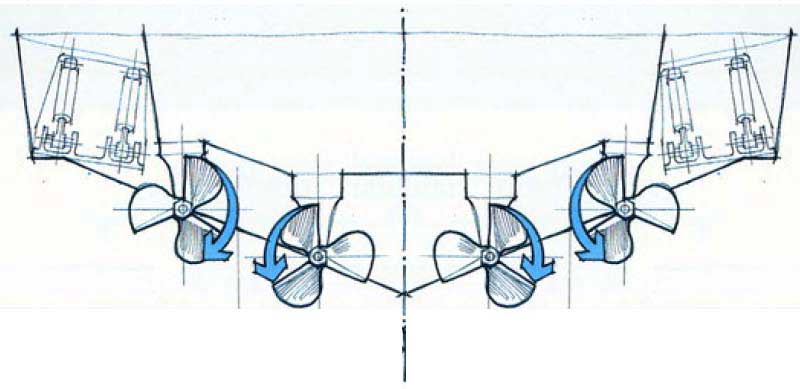
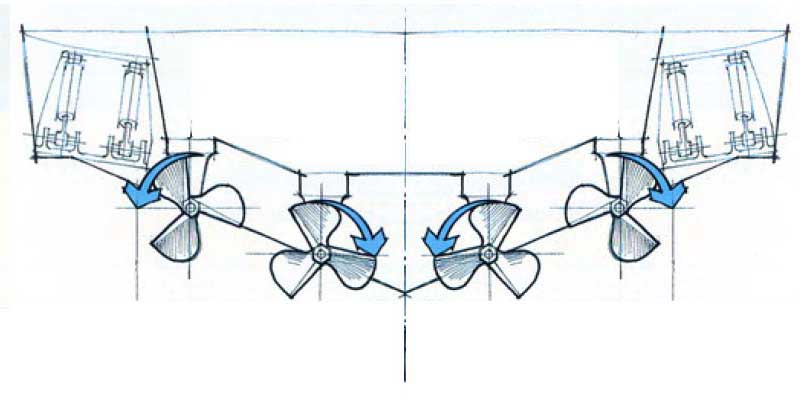
On a 4 engines monohull with surface props, would you go for the port or stbd props rotation? And why?
Or can you think of an even better alternative?
4propsB_zps1b34c804.jpg
 
no reason (other than visuals and symmetry!), but I'd go for option A below, or if I have time to think about it, would go for option B.

OptionA:
4propsB_zps1_symm1.jpg


OptionB:
4propsB_zps1_symm2.jpg


cheers

V.
 
I,d go for option B in the 2nd post .it would give 2x rooster tails in the air ( look pretty) but more importantly 2x thrust /jets of propulsion in the water pushing the boat in more harmony .
In other words better packaging of the water flow = more speed efficiency I think ?
 
doh!

just reread your Q MM, so my sketch of OptionA is what you call port and OptionB is strbrd...
sorry for the confusion, I initially thought that someone would setup in the same hull the mixed setup :rolleyes:

following tico's train of thought, I'd probably opt for OptionB or strbrd.

cheers

V.
 
@Vas: LOL, no worries for the confusion.
In hindsight, I can understand why you misunderstood, anyhow yes, let's call them A and B. Your updated sketches are much clearer.

@gravygraham: nope, it's a Fabio Buzzi drawing, no less! I came through it while reading one of his old articles, and found this (geeky) part interesting, hence the idea of posting the quiz... :)

Oh, and the reason why one is better than the other is still to be nailed...!

PS for Vas: raining a bit here at the moment, will take those pics and measures as soon as it stops...
 
Last edited:
Option B.

Outside props blades travelling down on the outside into the water there by throwing less water up and out of the thrust area.

prop blades travel in the same direction where they are closest to other props = less turbulance perhaps? Just looks right and what looks right usually is right.
 
Just looks right and what looks right usually is right.
LOL, so much for the experience Buzzi had to make to reach the same conclusion! :D
Indeed option B is better, and it's with that setup that the Cesa 1882 won pretty much everything there was to win in offshore powerboat racing.
But I won't spill the beans on the reason yet, also because it has absolutely nothing to see with those mention so far...
Any other guesses? The virtual cigar is still waiting for a winner! :D
 
Interesting question, I think I would go for A as when the boat is on the plane the outer props could be cavitating and option A would mean they are working in cleaner water, also I would expect the stern to get better lift with this setup for the same reason.

But then not a problem I have had to consider, so just a gut feeling.
 
LOL, so much for the experience Buzzi had to make to reach the same conclusion! :D
Indeed option B is better, and it's with that setup that the Cesa 1882 won pretty much everything there was to win in offshore powerboat racing.
But I won't spill the beans on the reason yet, also because it has absolutely nothing to see with those mention so far...
Any other guesses? The virtual cigar is still waiting for a winner! :D

so outsides turn externally and inside internally, therefore props contact points with water surface occur on the outside so increasing stabilising forces as for some crazy reason Buzzi didn't like the boats tendency to have a rocking motion at speed ?
 
I think I would go for A as when the boat is on the plane the outer props could be cavitating and option A would mean they are working in cleaner water, also I would expect the stern to get better lift with this setup for the same reason.
Your comment re. stern lift is indeed interesting.
Yes, you typically get more stern lift with props spinning outward, in "normal" boats with twin engines.
Since with option A the internal props, which are lower in the water, are spinning outward, maybe the effect is the same, at least to some extent.
Buzzi didn't comment on that on the article I read, so I would think that if the effect was there, it was not so relevant for his 4 props boat anyway.

Otoh, cavitation is actually an advantage, with surface propellers.
In fact, it's funny you mentioned it, because FB in the same article explains also how he invented a sort of "secret weapon" for faster acceleration, which gave him a big edge over the competitors for a few years, before also other builders understood and copied his trick.
Below is his drawing of a central trim tab which integrated a couple of air hoses, meant to bring air to the lower props.
This allowed them to cavitate well before the boat was planing, which in turn meant that the engines could immediately reach a higher rpm, hence developing more power and accelerating the boat faster. Amazing, 'innit? :)
Planator_zpsb1998021.jpg
 
so outsides turn externally and inside internally, therefore props contact points with water surface occur on the outside so increasing stabilising forces as for some crazy reason Buzzi didn't like the boats tendency to have a rocking motion at speed ?
Give that man a cigar!
Do tell, did you also read the FB article (which btw is also part of a book he wrote), or did you think about it just looking at the drawing?
I mean, it's not rocket science of course, but it took a while also to FB himself to reach that conclusion, in spite of the fact that it might seem obvious, when you think about it.
He was experiencing sudden snatching rolls at high speed, with that deep-V monohull, and when the boat began to jump from one chine to another, he could only reduce the throttles and/or lower the flaps to stop that. Not what you want on a racing boat.
He tried all sort of things, from a big wing above the cockpit to additional flaps mid-hull, which actually made things worse.
And then he thought to switch the rotation, which made the external props effectively work as stabilizers.
This is the original drawing, complete with his explanatory notes (though in IT, sorry).
4props_zps950c1e7f.jpg
 
Last edited:
Hi M, no there was a time I was quite into my classic speed boats and still have designs to build my own hydroplane and I do have his book. I did have to refer to it I must admit. To be honest this factor did not stick in my mind. But the boat did, what a monster. But what I did recall was his "secret weapon" of gliding as he put it, just a genius at work, a great read and I am glade you have reminded me of it as I have now started re- reading!
 
still have designs to build my own hydroplane
Blimey FF, are you for real? Now, that would be the mother of all build threads!!!
Why don't you blow the dust off those drawings and start an epic winter project?
I for one would follow that with extreme interest!

Re. FB, there's another intriguing part of his racing experiences which I wasn't aware of, and only just read in that article.
Not sure if it's also mentioned in the book, but just in case it isn't:
His monster, as you aptly called her, was equipped with the first prototypes of Seatek diesel engines.
Right after the 1988 Miami-Nassau-Miami, which he won establishing a new record in spite of the rough conditions, a couple of spare engines which were inside their support truck, securely locked in a gated area, waiting to be shipped back to Italy, were stolen.
Inside the truck they had also 20+ s/s lab finished props, tools, gensets and other spare parts. Pretty high value stuff, and not so hard to resell.
But they picked only the engines, which were totally non-marketable prototypes.
FB hired a private detective, which after some time confirmed that the steal had been commissioned by a big US engines manufacturer!!!
He neither mentions the name, nor if the name was actually identified for sure.
But as we all know, there aren't so many marine diesel builders, over the pond.....
 
Last edited:
Blimey FF, are you for real? Now, that would be the mother of all build threads!!!
Why don't you blow the dust off those drawings and start an epic winter project?
I for one would follow that with extreme interest!

Re. FB, there's another intriguing part of his racing experiences which I wasn't aware of, and only just read in that article.
Not sure if it's also mentioned in the book, but just in case it isn't:
His monster, as you aptly called her, was equipped with the first prototypes of Seatek diesel engines.
Right after the 1988 Miami-Nassau-Miami, which he won establishing a new record in spite of the rough conditions, a couple of spare engines which were inside their support truck, securely locked in a gated area, waiting to be shipped back to Italy, were stolen.
Inside the truck they had also 20+ s/s lab finished props, tools, gensets and other spare parts. Pretty high value stuff, and not so hard to resell.
But they picked only the engines, which were totally non-marketable prototypes.
FB hired a private detective, which after some time confirmed that the steal had been commissioned by a big US engines manufacturer!!!
He neither mentions the name, nor if the name was actually identified for sure.
But as we all know, there aren't so many marine diesel builders, over the pond.....

Hi M, well as you well know there are hydroplanes.... and there are hydroplanes. The plans I have are for the very smallest "kneeler" type, see below. I will build one, but not this winter, I have to clear a space in the garage for this project, but I do know someone with a mid 70's 7.5hp Mercury Blue Band which has never been used and is crated in a box that we have agreed will be mine once I build a hydroplane for it to go on! I reckon that will power my daughter along nicely! But as you can see by some of the plans below.... its a job not for the faint hearted, and neither will driving the thing! :calm:

boat


boat
 
Last edited:
The plans I have are for the very smallest "kneeler" type, see below. I will build one, but not this winter.....
Geez, this is amazing stuff indeed!
You're saying "smallest" as if there would be a relationship between the size and the interest in the project.
But when talking of speedboats, the relationship (if any) is actually inverse: the smaller the boat, the most intriguing her driving experience.
When I hear people pretending that helming a big Pershing or Predator at 40 kts is quite impressive, I just can't help laughing out loud, because they have no idea of what driving a speedboat really means.

All the very best for this fantastic project.
I really hope you will be able to go ahead ASAP, keeping us posted on the progress!
 
Top