
Question

martinschulz

Member
Joined
30 May 2001
Messages
35
Location
N 54° 47, 595\' , E 009° 25, 970\'
Visit site
I am a bit loste here.

Rummaging through some Beken-photographs in a book I came across a picture dating back to 1896 titled "racing Forties".
The photographs showed 4 boats almost looking like very large Eastcoast Smack cutters (one being yawl rigged).
Does anybody here have an idea what kind of "class" a Forty is?
I found one hint that suggested that there once was a class called Forty-rater, the yacht MOHAWK being one of them.
 
Hello, Martin,

Much as I hate you for flying your jackyard topsail yesterday, I can only guess at the answer.

The Length and Sail Area Rule came in in 1887.

The formula was :

LxSA
_____
6000

where L was the waterline length in feet and SA was the sail area of the largest rig in square feet.

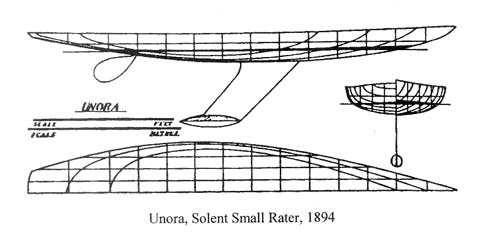
Now, we know that by 1896 yachts of the shape of "Britannia", "Satanita" and "Valkyrie" were being built, because the Rule encouraged overhangs, leading ultimately to this sort of thing (rather modern-looking!):
unora%201894.jpg


but at the start of the Rule some boats left over from the Thames Tonnage Rule must have been about, and I think I recall seeing a picture of the 40-rater "Foxhound" looking very much like an Essex smack, but yawl rigged, with a straight stem and counter stern (the counter was untaxed under the Thames Tonnage Rule, beinmg abaft the sternpost)

(I'm obliged to the Vintage Model yacht Association website for that drawing, and the Rule details)

Now, turning to the 1911 Encyclopaedia Britannica website article on "yachting" we find:

"Length and Sail Area Rule:

" The new system contained no taxes or penalties upon. beam or depth nor upon over all length. The only factors measured were the water-line and the area of the sails. All the old tonnage rules taxed the length and the breadth. The effect of this change of the system measurement was electrical. It crushed the plank-on-edge type completely. There was not another boat of the kind built.

"Revival of Yacht-Racing under Length and Sail Area Rule. Yachtsmen were greatly pleased with the broader and lighter types of yachts that designers began to turn out under the length and sail area rule. They were more comfortable and drier in a seaway than the old vessels. The first large cutters built with considerable beam were Yarana and Petronilla in 1888, and in 1889 the first of Lord Dunravens Valkyries was a vessel that was much admired. Then in 1890 Iverna, a handsome clipper-bowed cutter owned by Mr Jameson, came out and raced against Thistle. Meanwhile, up to 1892 a host of splendid 40-raters had been built; Mohawk, Deerhound, Castanet, Reverie, Creole, Thalia, Corsair, White Slave, Queen Mab and Varuna formed a class the like of which had never been surpassed in British waters. Watson, Fife and Payne were the most successful designers."

Now, if I can just find a photo of one on the Web...
 
Well thanks a lot ACB.

You can probably guess why I am asking this. I am trying to find out wether the Willow Wren was just a singulary Yacht built by Arthur Payne or, more likely a Yacht built according to the common taste and therefore perhaps a classic type.

She was built 1886 so the Sail Area rule couldn't have been the decisive factor in her design. I wondered why she is never mentioned and when I saw the "racing forties" photograph by Beken I thought she might have been one of those.

Would you mind to have a look at the lines of her and tell me what you think?

www.willow-wren.de
 
Built in 1886 she would have been built in the final year of the Tonnage Rule, so she "ought" to be an extreme Plank on Edge, but she isn't!.

Had she been a plank on edge, she would have been immediately outclassed as a racer.

1886 was the last year of the original YRA Rule, sometimes called the 1730 Rule, which was introduced in 1882 by the fledgling YRA as an improvement on the Thames Tonnage rule. It was in fact no improvement at all, and made things worse:

To quote the Vintage Model Yacht Club again:

The YRA formula was

(L+B)2 x B
1730

where L was the waterline length, B was the greatest breadth, wherever found.

Dimensions were taken in feet and the resultant of the top line divided by the 1730 constant to give a measurement in ‘Tons’. There was no necessary relationship between the boats ‘tonnage’ measured in this way and her ‘tonnage’ for customs purposes, let alone her actual displacement. Full size yachts were given handicaps based on their tonnage, though level rating races were also offered for the smaller classes at 5, 10 and 20 tons.

The effect was not what the Rule makers had expected or wanted. Far from curbing the ‘undesirable’ effects of the previous Tonnage Rule, this exacerbated them. Including beam three times over in the calculation put a very heavy tax on it, while leaving depth unmeasured encouraged designers to go steadily deeper to regain stability lost by narrowing the hull. That this Rule more or less coincided with the general adoption of outside ballast in full size yachts only made things worse. The result was characterised as a ‘plank on edge’, or ‘lead mine’. The French referred to them as ‘couloirs lestées’, ‘ballasted corridors’.

The two well known boats built to this Rule were GENESTA and the IREX, both 80 tonners.

GENESTA challenged PURITAN for the America's Cup, and got thrashed.

Maybe WILLOW WREN was built as a cruiser? He shape is "normal" and "healthy" for the period (compare with ORION in McMullen).
 
As a kid I used to stay on a houseboat called Willow Wren at Burnham. She was ferro sheathed & re-rigged a few years ago.
Could this be the same Willow Wren? She looks very similiar.
We also had friends who lived aboard boats called Genesta and Astra, which lay in Priors dock, unrigged and reputedly without their lead keels. Would these have been the ones mentioned earlier?
Astra had a very distinctive long drawn out forward section, I always thought that she looked like a mandolin.
 
True, Willow Wren has been lying in Burham as a Houseboat for some years.
So you are acquainted with the family Frank Madsen?

(the ketch-rig was definetely a mistake and apart from the queer look it didn't work for the Willow Wren. For a year the owner tried a cutter-rig and now is back to the probably traditionalally-right yawl-rig).
 
Top