PV I don't think I should worry??

I'm happy to learn so can you tell me what you use to decided that the battery is fully charged?

I read somewhere that absorption time for a partially discharged battery depends on the state of discharge when charging began which is how the victron works.
 
GHA "The only way round this I could find was set float voltage to absorption voltage"
Do you then switch off the panels after so long? How do you get float?

Living aboard there's never any need to switch to float, this with 300w solar and not too much usage overnight, to about 75/80% for 2 x T105 trojans, 225Ah. If the boat isn't getting used then 'normal' float would be resumed.

With that and some shadow it's still hit and miss to get full on a sunny day, maybe up to 90/95% by late lunch then afternoon to finish up.

This is battery terminal voltage, current has been added to logging now so should be interesting after the panels get connected up again. The ripples are mostly the fridge running so late afternoon there's little power coming in, domestic loads can easily use of what there is. And the victron bases decisions on what's leaving the regulator, it has no idea if all the power is going into the batteries or into a fridge/laptop etc.

28ykN9I.png
 
Last edited:
I'm happy to learn so can you tell me what you use to decided that the battery is fully charged?

I read somewhere that absorption time for a partially discharged battery depends on the state of discharge when charging began which is how the victron works.

IMHO tail current is the only realistic thing to look at, my trojans level off at just under 1% C, but even then temperature can change thinks a lot and small changes in absorption voltage can make a big difference. SG apparently needs a period of rest like voltage to give an accurate reading.

This just now after the batteries were unplugged for an hour or so then back on the mains charger. Settles down at about 1.5/1.6A at 14.8V


YlxLIcE.png
 
GHA Thanks for posting,
I don't have facility to log tail current but have looked at the instantaneous current flow and recall seeing figures reduce to around 2-3 amps before going to float charge. Its something I'll keep a closer eye on when next onboard.

Of course it makes it difficult when you have consumers like fridge and freezer cutting in sporadically.
 
Living aboard there's never any need to switch to float, this with 300w solar and not too much usage overnight, to about 75/80% for 2 x T105 trojans, 225Ah. If the boat isn't getting used then 'normal' float would be resumed.

With that and some shadow it's still hit and miss to get full on a sunny day, maybe up to 90/95% by late lunch then afternoon to finish up.

This is battery terminal voltage, current has been added to logging now so should be interesting after the panels get connected up again. The ripples are mostly the fridge running so late afternoon there's little power coming in, domestic loads can easily use of what there is. And the victron bases decisions on what's leaving the regulator, it has no idea if all the power is going into the batteries or into a fridge/laptop etc.

28ykN9I.png

This will depend on individual systems (bank capacity, usage profile, charging setup etc.). However, I imagine that it is likely to be correct in the majority of cases for those living at anchor.

I have my MPPT & PWM chargers set well above default settings as they'd pretty much stop charging at 85%-90% SOC if left unchanged. Smargauge says 100% and temp. corrected SOC usually gets 95-103% SOC in July. I doubt the regulators ever get to the float stage.

I see min. 11.5V and max. 15V regularly on daily data. Nothing to worry about as min. is just the anchor coming up and max. is from solar when my T105s are pretty well topped up.
 
I'm happy to learn so can you tell me what you use to decided that the battery is fully charged?

I read somewhere that absorption time for a partially discharged battery depends on the state of discharge when charging began which is how the victron works.

The Victron controllers have a very unusual charging algorithm. They don’t attempt to measure absorption time, but use a simple time after the bulk voltage is reached.

This is modified by the initial starting voltage and an aggressive return to bulk.

The true absorption time is modified by many parameters, but the initial SOC only has a minor effect.

The charge current is a much more significant parameter. The challenge with solar system is that the charge current varies significantly. This is not typically measured by the controller. This is why absorption time needs to be modified by the user.
 
Last edited:

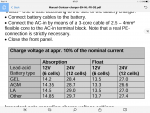
can someone explain in simple terms, looking at the graft there some hours where it being charge at over 14.5 when batteries data suggests not to charge over 14.2
Don't this harm the batteries charging at a much higher volts for some hours ?
 
Last edited:
can someone explain in simple terms, looking at the graft there some hours where it being charge at over 14.5 when batteries data suggests not to charge over 14.2
Don't this harm the batteries charging at a much higher volts for some hours ?

It is said that most boat batteries do not die, they are murdered.

The correct charging profile is important for battery life and even small alterations in the charging voltage will have a significant impact.

Trogen recommend an absorption voltage at 25° C of 14.7v for their flooded batteries.
 
It is said that most boat batteries do not die, they are murdered.

The correct charging profile is important for battery life and even small alterations in the charging voltage will have a significant impact.

Trogen recommend an absorption voltage at 25° C of 14.7v for their flooded batteries.
Thanks for correct me , 14.8 bulk 13.5 float ,
So to throw another question into the pot .
My main charger as setting for LA 14.5 ABS and 13.5 for float
Or
Other type 14.85ABS and 13.7 for float what would you suggest be best for me to set my charger for my new T 145 ?
 

Attachments

  • IMG_1498.PNG
    IMG_1498.PNG
    243.3 KB · Views: 0
Last edited:
Temperature makes a significant difference. Does the charger have temperature compensation? If not what is a typical battery temperature? (I am not sure if your boat is in the UK or Croatia)
 
Last edited:
Top