Purchase system in single line reefing

srah1953

Well-Known Member
Joined
21 Jun 2007
Messages
493
Location
Ireland, Carlingford
Visit site
Hi all
I hope everyone is safe.
I always have a difficulty in getting my head around the purchase system in block and tackles.
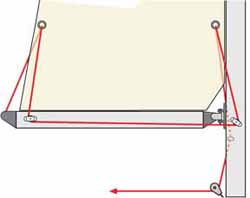
So, in a single line reefing system the reefing line starts at the boom (end), goes up to the leech cringle and back down to the boom end and then forward alongside or inside the boom. At this stage we've created a two to one purchase system.
The line then goes to the front of the boom and up to the luff cringle, from whence it comes back down to wherever it is pulled in.
Am I correct to understand that this gives rise in total to a 3:1 purchase system (ignoring the degree of friction in how it is set up)?
Cheers
 
Not going to try and describe it, but the link is to Selden’s rigging leaflet which shows the path the lines follow. http://www.seldenmast.com/files/1296213340/595-664-SETF.pdf
It‘s actually two length of rope: one from the in boom car to the luff cringle, the second, longer one runs from the cockpit, into the boom, through the in boom car and then to the leach cringle. Gives an overall 2:1 ratio.
 
I can see where you're coming from, but the only mechanical advantage is at each cringle, luff and leech, where, ignoring friction (which you can't!) the force is doubled, so two separate 2:1 purchases.
jiffy-reefing-3a.jpg


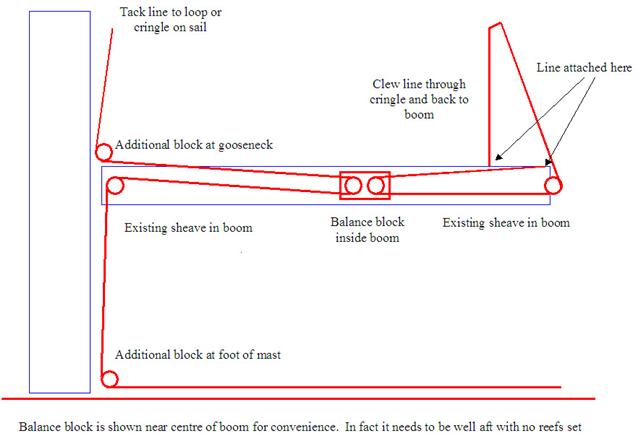
This system does have a multiplication at the balance block, but it's cancelled out by the aft end of the balance block having to pull two lines.

single-line.jpg

I presume the balance block is to prevent tangles inside the boom as, personally, I can't see any other use for it; it just seems to be an additional source of friction. Perhaps someone else would care to enlighten me.

I reckon the best way to get your head around them is to wander through Youtube, looking for the least annoying video that explains them
 
...
I presume the balance block is to prevent tangles inside the boom as, personally, I can't see any other use for it; it just seems to be an additional source of friction. Perhaps someone else would care to enlighten me.

I reckon the best way to get your head around them is to wander through Youtube, looking for the least annoying video that explains them
The balance block removes a lot of friction.
Pulling on the line at the foot of the mast pulls equally on tack and clew.
Tension in the two strings is equal, but they can move independently.
Without the balance block, the tension in the line running along the boom is reduced by the (often considerable) friction at the tack cringle.
And you pull the whole load of string over your sail, risking unnecessary wear.

That's the theory.
Reality may differ, often does with twists inside the boom and so on.
It either works brilliantly or makes you wish for the basic system....
 
Mine is like the first diagram by Stemar. It doesn't, thank god, have the balance block system. There aren't literally "two separate 2:1 purchases" as it is a continuous line. However it does seem to me that the end result is a 3:1 purchase.
It isn't of course a matter of any consequence - just pure curiosity.
Thanks
 
The second diagram posted by Stemar is mine, lifted from my website. I first designed and fitted it in 1992 or 3 and have used it ever since. Z-spars use(d) it as their standard. Mine has never once tangled or clashed, despite extensive use. It makes reefing by one person very easy but admittedly taking reefs out is not quite so friction free.
 
There is a 4:1 ratio between the distance you pull on the line and the distance the sail moves downwards., so it's a 4:1 purchase.

As a rule you can calculate purchase by multiplying the number of moving blocks (or in this case maybe cringles) by 2. NB this rule does not apply to cascade setups.
 
There is a 4:1 ratio between the distance you pull on the line and the distance the sail moves downwards., so it's a 4:1 purchase.

As a rule you can calculate purchase by multiplying the number of moving blocks (or in this case maybe cringles) by 2. NB this rule does not apply to cascade setups.
+1. That makes sense to me. The way I see it, at the start of the reefing procedure, the line is in four "falls" and the end result is that one slab of sail is pulled down.
 
There is a 4:1 ratio between the distance you pull on the line and the distance the sail moves downwards., so it's a 4:1 purchase.

As a rule you can calculate purchase by multiplying the number of moving blocks (or in this case maybe cringles) by 2. NB this rule does not apply to cascade setups.
That depends whether the tack line goes up and is tied to the reef tack (3:1), or up through the reef tack and back to the gooseneck (4:1), which is kind of assumed but not necessarily so.
Even then, the 3 or 4 to 1 is only until one or other corner of the reef reached the limit of its travel, then the tackle reduces to 2:1 on the reef clew and 1 or 2:1 on the reef tack.
If you want to be picky, it's never quite 3 or 4 to 1, because the lines don't all pull parallel to one another.

It's a lot of string to pull in the easy stage of reffing and then not much mechanical advantage.
 
That depends whether the tack line goes up and is tied to the reef tack (3:1), or up through the reef tack and back to the gooseneck (4:1), which is kind of assumed but not necessarily so.
It's not so much assumed as explicitly stated by OP.

I agree that it's not quite a perfect, classic purchase system, but close enough.
 
It's only 2:1.

As students are encouraged, turn the picture upside down and you can see that you're lifting two loads, one at the clew and one at the tack. Each is being lifted by a 2:1 purchase, but with a combined 'fall'. So you will pull in 2x the distance moved for the tack purchase and 2x the distance moved for the clew. So in total, you will pull in 4x the amount of rope, but each of the two loads is only moved with a 2:1 purchase.

The key is that the outboard balancing pulley is rigged to its 'desadvantage' so it cancels out the advantage of the other half of the balancing system.
 
The second diagram posted by Stemar is mine, lifted from my website. I first designed and fitted it in 1992 or 3 and have used it ever since. Z-spars use(d) it as their standard. Mine has never once tangled or clashed, despite extensive use. It makes reefing by one person very easy but admittedly taking reefs out is not quite so friction free.

I have a Z-Spars setup on my 2004 Beneteau. It is set up like Stemar's first diagram except that the lines run inside the boom. I think Z-Spars call it "continuous line reefing". The standard main had blocks fitted only on the luff reef points but also adding them to the leech has made reefing far easier.

To the point in question, if the the distance between the luff and leach is reduced to zero, or the sail is considered 'solid' it can be seen that there is a 4:1 purchase on the sail as a whole. Considering the sail as two separate halves pulled by their own 2:1 purchase would lead to the same total 'pull' on the line being required.
 
You could only argue that the sail was one load if it was rigid, whereas the two corners often work against each other - the tack has to be pulled down and forward whereas the clew needs to go down and back.

If you have a separate 2:1 purchase on the tack and a separate 2:1 purchase on the clew and each of them can be pulled down by force X, the total load is 2X and the amount of rope retrieved is Y. Combining the tackles into a single line reefing system results in the load on the line being 2X and the amount of line still Y - ie there is no mechanical advantage. In fact you have introduced lots of friction so single line reefing systems, especially if lead back to the cockpit, will be less efficient and needing greater work.
 
You could only argue that the sail was one load if it was rigid, whereas the two corners often work against each other - the tack has to be pulled down and forward whereas the clew needs to go down and back.

If you have a separate 2:1 purchase on the tack and a separate 2:1 purchase on the clew and each of them can be pulled down by force X, the total load is 2X and the amount of rope retrieved is Y. Combining the tackles into a single line reefing system results in the load on the line being 2X and the amount of line still Y - ie there is no mechanical advantage. In fact you have introduced lots of friction so single line reefing systems, especially if lead back to the cockpit, will be less efficient and needing greater work.
Surely the length of rope retrieved is 2 x Y, as there are two separate pennants?
 
I still think it's a 3:1 purchase.
In the standard single line set up, there are only 3 lines being shortened - the line from the boom end up to the leech cringle, the line from the leech cringle back down to the boom end and finally the line from the boom front end up to the luff cringle. The line coming back down from the luff cringle is just the pulling in line and, in any diagrams I've seen, isn't counted as part of the purchase system.
For those who think it's 4:1 ask yourself how it could be reduced to 3:1 - what intervening step could be eliminated.
I think if, at the luff, the line after going up to the luff cringle came back down to a block on the boom and was then taken in by being pulled upwards then that would give you a 4:1 purchase.
 
I still think it's a 3:1 purchase.
In the standard single line set up, there are only 3 lines being shortened - the line from the boom end up to the leech cringle, the line from the leech cringle back down to the boom end and finally the line from the boom front end up to the luff cringle. The line coming back down from the luff cringle is just the pulling in line and, in any diagrams I've seen, isn't counted as part of the purchase system.
For those who think it's 4:1 ask yourself how it could be reduced to 3:1 - what intervening step could be eliminated.
I think if, at the luff, the line after going up to the luff cringle came back down to a block on the boom and was then taken in by being pulled upwards then that would give you a 4:1 purchase.
But the distance from the luff cringle to the deck is being shortened, so must be counted. Consider if you just had a line going from the gooseneck, up to the luff cringle, and down to the deck. For every inch the luff moves down you would take in two inches of line, ergo a 2:1 system.

A 3:1 system would require the line to start at the leach cringle.

Edit to add: the direction that the final line is pulled in makes no difference in this case. If you stood at the mast and pulled downwards on the line directly below the luff cringle you would have a 3:1 system rigged to advantage, which is functionally the same as a 4:1 system. Consider that the turning block at the base of the mast does not change the length of line pulled for a given movement of the sail.

Edit 2: why would pulling upwards be different to pulling backwards?
 
Top