Propshaft coupling advice

I am pleased you managed to get what you needed and at what I think a reasonable price, but I am very disappointed with the lack of response from Hamble props. The quality of there products is first class but would appear there PR is lacking the same quality. Jim
Not to worry, I'm sure there was a reason why they couldn't get back to me.

My next dilemma is this:

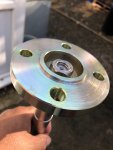
The original coupling, which was very corroded, was rather difficult to measure. The taper was equally difficult to get right (it wasn't a standard size) but the company that made the coupling got it near perfect. It fits on the prop shaft nicely but doesn't go on just far enough. It's about 10mm short which means that my locking nut only goes on half way.

I'm concerned therefore that the nut can loosen over time and the prop shaft makes its way loose and falls off the back of the boat! I believe this would only happen when engaged in reverse etc. but it still concerns me.

To put my mind at ease I intend placing a round anode, on the prop shaft, between the 'P' bracket and stern tube and also inside the boat, between the coupling and the stuffing box.

If the shaft was to come loose, these two would stop it from going very far. It might damage the stuffing box a bit but that's better than having the propeller stuck in the skeg/rudder with water gushing in or losing the shaft completely.

Otherwise what do you reckon? Nut locking glue? A 'retainer' of sorts to stop the nut from turning? The taper and shaft are keyed which helps I suppose.
 

Attachments

  • IMG_0980.jpg
    IMG_0980.jpg
    389.4 KB · Views: 13
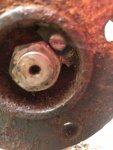
Cut a piece of plate than will fit between the flat of the nut and the inside of the counter bore. The brill and tap into the boss the fix the late in place so the it acts as a tab lock locking the nut to the coupling.

You could also make 2 one each side of the nut .
 
Cut a piece of plate than will fit between the flat of the nut and the inside of the counter bore. The brill and tap into the boss the fix the late in place so the it acts as a tab lock locking the nut to the coupling.

You could also make 2 one each side of the nut .
Good idea. The previous coupling had one that I couldn't get off that's why I had to cut the coupling and fork out for a new one!
 

Attachments

  • IMG_0808.jpg
    IMG_0808.jpg
    212.4 KB · Views: 1
If you are unsure as to the taper fit of the coupling on the shaft you could "blue the fitting to if the fit is less than acceptable you can ese out the taper by removing the high spots with a flap wheel in the coupling.

We have to do that sometimes with a propeller taper to the shaft for out hull inspection.
 
Hi i would also advise you to lap the coupling to the shaft but please do it properly. If done correctly ( with grinding paste and Micrometer blue) the coupling will naturally go further up the taper but please no flapper wheels. You cannot lose you prop shaft as your prop will be stopped by the rudder and more likely without any damage to prop or rudder. I will send you a PM.
 
Hi i would also advise you to lap the coupling to the shaft but please do it properly. If done correctly ( with grinding paste and Micrometer blue) the coupling will naturally go further up the taper but please no flapper wheels. You cannot lose you prop shaft as your prop will be stopped by the rudder and more likely without any damage to prop or rudder. I will send you a PM.
Thanks for the chat. I've sent you the pics etc.
 
why can you not measure the length of thread exposed and then go back to Clement's and get them to deepen the recess ?

Or even just 3/4's of it if you intend to lap the two parts together.

Regards Clive
 
If you take the key out and lock the shaft from turning in the boat you can lap it in situ with grinding paste and running the engine whilst pressing the shaft into the coupling. that way it will be a perfect fit when you reassemble.
You won't need to take too much off, tapers lap together surprisingly quickly.
 
why can you not measure the length of thread exposed and then go back to Clement's and get them to deepen the recess ?

Or even just 3/4's of it if you intend to lap the two parts together.

Regards Clive
Thanks. I'll have a go at lapping and see how I get on. I want to try and avoid more cost, postage back and forth, added cost of turning etc. But again, getting it right is my main aim.
 
If you take the key out and lock the shaft from turning in the boat you can lap it in situ with grinding paste and running the engine whilst pressing the shaft into the coupling. that way it will be a perfect fit when you reassemble.
You won't need to take too much off, tapers lap together surprisingly quickly.
I do actually have a small woodturning lathe in my shed. I suppose I could attach the coupling to it and create a temporary wooden 'P' bracket at the other end of the bench to keep it all straight.

I'll give the lapping by hand a go first.

I had a good chat with Jim.howes who posted earlier and he gave me a lot of valuable advice - thanks Jim!
 
Do not use any power when lapping unless the stationary is originally clamped

Lapping can cause pickup and thus wrench the stationary part violently and if held by hand would rip you had apart.

IMHO lapping is over kill nd not necessary in this fitment. Lapping is only necessary is you need a gas tight joint and in this case there is the danger of pick up and preventing the removal of the coupling.

I had a drill chuck that I lapped the connection and it nearly took my had off and picked up and made it almost impossible to remove the chuck afterwards.
 
Do not use any power when lapping unless the stationary is originally clamped

Lapping can cause pickup and thus wrench the stationary part violently and if held by hand would rip you had apart.

IMHO lapping is over kill nd not necessary in this fitment. Lapping is only necessary is you need a gas tight joint and in this case there is the danger of pick up and preventing the removal of the coupling.

I had a drill chuck that I lapped the connection and it nearly took my had off and picked up and made it almost impossible to remove the chuck afterwards.
Ouch - thanks for the warning!
 
Hi me again, do NOT use any type of machine as could be very dangerous. Put shaft in bench vice vertical and lap coupling onto shaft allowing weight of coupling to do most of the work. Jim
 
Do not use any power when lapping unless the stationary is originally clamped

Lapping can cause pickup and thus wrench the stationary part violently and if held by hand would rip you had apart.

IMHO lapping is over kill nd not necessary in this fitment. Lapping is only necessary is you need a gas tight joint and in this case there is the danger of pick up and preventing the removal of the coupling.

I had a drill chuck that I lapped the connection and it nearly took my had off and picked up and made it almost impossible to remove the chuck afterwards.
You are wrong it is not overkill to lap a coupling / propeller to a shaft it is the correct thing to do. Couplings and propellers rely on the taper to be a good fit(as in morse tapers)to stop them turning on the shaft the key/keyway is a secondary means of stopping the coupling / propeller from turning on the shaft.
 
I agree with Jim .howes that the fit between the coupling and shaft should be snug otherwise the transfer of energy would be directed through the key material or any high spots on the shaft. I would assume the transfer of energy should be consistent over the whole area of contact between the shaft and coupling.
 
I agree with Jim .howes that the fit between the coupling and shaft should be snug otherwise the transfer of energy would be directed through the key material or any high spots on the shaft. I would assume the transfer of energy should be consistent over the whole area of contact between the shaft and coupling.
You are a sensible person with obvious engineering knowledge.
 
Top