
Prop shaft - how can you check it is straight enough when removed from the boat

It is possible to do this at home if you have a large enough table to support the length of the shaft. Make 2 vee blocks, support the shaft in the 2 vee blocks and rotate. You don’t need a dti or clock, just use some stiff wire, then use feeler gauges to check the maximum variation. You can use some wood or plastic for the vee blocks.
This gives you the idea:
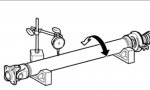
43F478D3-661A-404B-96B9-CAF0EF2CE781.jpeg
 
It is possible to do this at home if you have a large enough table to support the length of the shaft. Make 2 vee blocks, support the shaft in the 2 vee blocks and rotate. You don’t need a dti or clock, just use some stiff wire, then use feeler gauges to check the maximum variation. You can use some wood or plastic for the vee blocks.
This gives you the idea:
View attachment 146985
I like this, simple simple to set up and quite possible for me to try on the dinning room table!!
 
Set up now replicated with V's and a Dial gauge. My worst readings on the Dial gauge show a movement out of round of 0.2 mm in the middle, when supported at the ends and 0.35mm when supported near the middle and measured at the far end. Clearly it's not quite straight, so what is the consensus of the gathered minds?
I'm thinking that I do want to replace the shaft but it may not really be necessary!
Your thoughts gratefully received.
 
Just to add for interest only.
If a dial test indicator shows .2mm the actual run out is .1 (half the reading) as it's measuring the combined high and low points. In engineering, tolerances for concentricity etc can have T.I.R after the allowed tolerance. Total Indicator Runout.
 
Rolling the shaft on a solid kitchen top can give you some indication of the bend. Even better, turn the shaft in situ instead of rolling it, and see if the daylight you see underneath the shaft changes as you rotate it.
 
The only places resembling a bearing are the cutlass bearing , next to the prop and the gear box exit! Standard AWB I belive !
Would guess your shaft is well over 1m long and from what you say the "bend" is towards the aft end. Given that you are trying to deal with vibrations it is worth having the shaft checked and corrected of necessary by a specialist like Hamble Propellers. I had a similar problem with a shaft that had a slight bend from the middle onwards that was enough to cause binding in the cutless. Cost from memory £35 to have it checked and straightened by Lake Engineering which solved the problem.
 
The shaft may be straight, but how is it connected to the gear box? There should be a flexible connection, but if the engine is still not properly aligned it may be applying angular pressure that the coupling is transferring to the shaft. (This happened to me when a local engineer fitted a new engine to our launch which was 20mm out of alignment ). This could be upsetting the frequency.
It may be that a weight, such as a brass bush slid on the shaft, could reduce the vibration. It is a trick used when turning long shafts in a lathe to stop chatter. It could work on a prop shaft, although I have no experience of it. Others may comment on the idea.
 
Last edited:
The shaft may be straight but how is it connected to the gear box? There should be a flexible connection but if the engine is still not properly aligned it may be putting angular pressure on the shaft that the coupling is transferring to the shaft. This could be upsetting the frequency. It may be that a weight such as a brass bush slid on the shaft could reduce the vibration. It is a trick used when turning long shafts in a lathe to stop chatter. It could work on a shaft.
I would be looking at the condition /age of the (4?) engine mounts as well, if only to eliminate a contributing factor
 
I would be looking at the condition /age of the (4?) engine mounts as well, if only to eliminate a contributing factor
As part of realigning the engine we fitted the correct engine mountings . The plumber block at the mid point was shot due to the poor installation & that was changed . The biggest improvement was the correct mountings from Beta. We know because we did not change those initially but changed them after the first test run. We had not realised that the engineers had fitted the wrong ones until speaking to Beta
 
Last edited:
I helped with a restoration on a classic. Owner was concerned about the shaft, so had it checked by a local engineering shop. They put in on a lathe and showed him that it was a 'bit' out. Then put up the RPM to show what the vibration might be...
It certainly vibed.. flew out of the lathe and passed between friend and operative, making a hefty dent in the far wall :oops:
We ordered a new one....
 
I helped with a restoration on a classic. Owner was concerned about the shaft, so had it checked by a local engineering shop. They put in on a lathe and showed him that it was a 'bit' out. Then put up the RPM to show what the vibration might be...
It certainly vibed.. flew out of the lathe and passed between friend and operative, making a hefty dent in the far wall :oops:
We ordered a new one....
?
Crikey
Seeing is believing
 
Thanks again for the useful suggestions, I have now decided to get a new Propeller and a new shaft to go with it. The report from Darglow on the old propellor was fairly clear that it would be better to put money towards a new prop then attempt a second refurbishment of the max prop which they could see had been refurbished before.
It is clear that I need to check the alignment and engine mounts, which all look in reasonable condition, but as I have the prop off and the shaft out this a good time to check it all.
 
I have just bought a new Featherstream from Darglow and the new shaft was made by Lake who matched the taper exactly to the prop.
 

Other threads that may be of interest

Top