Prop rotation when sailing

The magazine carried out these tests with a very chunky 3 blade prop which formed an almost complete disc when viewed head-on. Didn't the magazine article concede that a slimmer, two blade prop in a cutout in the keel or behind a skeg, have a significantly different result?

I lock my Hurth gearbox in reverse simply because that's what the manual directs, with dire warnings of damage if locked in forward.
 
you have induced drag as well as form and profile drag. If it's stopped from rotating the blades stall. This is a high form drag condition but you have lost (most of) the induced drag and the total drag is less (but still very noticeable).

This is the important and perhaps counter-intuitive point. If the prop of an aircraft or boat or whatever is spinning it is taking energy out of the water or airflow which is felt as drag. It will also have drag when stopped but which is greater depends on a few factors. The actual answer (stop or spin) will depend on the speed of the flow (airspeed or boatspeed), the pitch of the prop, the shaft loads (ie what's it turning) and the blade area.

Roughly speaking:
Low shaft load - let it spin.
Large blade area - let it spin.
Low pitch - stop it.
Low speed - stop it.

The actual answer of which is best will vary from boat to boat and prop to prop. It may be that for boats in most cases it's best to let it spin but it's not a simple answer - if you change one of the above conditions enough the answer will change.

In aviation it's usually better to stop the prop (and feather if possible) but even so there are aircraft where it is still most efficient to let the prop free wheel.

As others have pointed out, an auto-rotating helicopter rotor acts as a parachute; a fixed helicopter rotor does not.
The analogy to helicopters auto-rotating is a little bit tenuous (!) the blades are being driven round by the descent and lift (not drag like a parachute) is keeping it in the air. The blades are doing the same as a gliders wing.
 
Last edited:
The magazine carried out these tests with a very chunky 3 blade prop which formed an almost complete disc when viewed head-on. Didn't the magazine article concede that a slimmer, two blade prop in a cutout in the keel or behind a skeg, have a significantly different result?

Yes, but such arrangements are a rarity these days, so they are trying to simulate what happens with arguably the most common arrangement - a 3 bladed prop running in relatively clear water.
 
I don't see how letting the prop spin reduces drag. The forward motion of the boat rotates the prop this must = work, to do work takes energy and must therefore = more drag?

If you cast a spinner into the sea and retrieve it, it take a lot more effort if it s spinning than if it get hooked up. This is because as the spinner rotates the surface area of the spinner covers more ground as the water rushed by, thus causing more friction. I am sure the same principal applies to a propeller.
 
Last edited:
Only if the torque output in their tests is an accurate representation of the input of a gearbox. I don't see any evidence of that.
I will ask my mech eng mates what it might be.

Unless anybody here has any data?

The interesting conclusion is that the drag in both cases is quite high.

I was the one who conducted the video prop drag test. The friction was matched as closely as possible to match that of the gear box on my own boat. It was not just allowed to "spin freely" with no "friction". It took nearly an hour to dial the friction in just right. The shaft angle was also matched as was the depth of prop below the water surface. The results were not even close and mimic just what MIT, Strathclyde and YM found. A typical fixed prop has considerably less drag when allowed to spin..

I will pose the same open invitation here as elsewhere, to the doubters. You pay my hourly rate and we'll test props all day long if you want... It still amazes me that after YM, MIT, and the University of Strathclde, and an actual video of a locked prop causing SIGNIFICANTLY more , folks still don't want to believe the data.. Come see it for yourself...


I have added the direct video link here:
http://youtu.be/jI-UG9RSlJo
 
Last edited:
I was the one who conducted the video prop drag test. The friction was matched as closely as possible to match that of the gear box on my own boat. It was not just allowed to "spin freely" with no "friction". It took nearly an hour to dial the friction in just right. The shaft angle was also matched as was the depth of prop below the water surface. The results were not even close and mimic just what MIT, Strathclyde and YM found. A typical fixed prop has considerably less drag when allowed to spin..

I will pose the same open invitation here as elsewhere, to the doubters. You pay my hourly rate and we'll test props all day long if you want... It still amazes me that after YM, MIT, and the University of Strathclde, and an actual video of a locked prop causing SIGNIFICANTLY more , folks still don't want to believe the data.. Come see it for yourself...


I have added the direct video link here:
http://youtu.be/jI-UG9RSlJo
I didn't notice any data about the mechanical drag/friction on the prop in the papers I read.
I'd still be interested in what that is, numerically.
From a personal viewpoint, it is purely academic, the boat I'm most involved with has a maxprop, and I'd always prefer a folding or feathering prop anyway.

Anecdotal evidence suggest some people observe quite different outcomes, I wonder if the different designs of marine gearbox behave differently in neutral? I don't know much about different gearbox models personally.

Possibly my last word on the subject, to quote one of my more academic crew members: 'The spinning prop must be taking a lot of energy to create all that bleedin' noise!'
:-)
 
This is an interesting thread. Not because it advances the issue of whether a locked prop creates more drag than one that's turning - we know the answer to that - MIT, Strathclyde, YM, Maine Sail, et al have done the work there - but because of what it shows about human nature.

Even when faced with the most overwhelming supporting evidence some people simply will not accept an answer that doesn't coincide with their preconceived notion. Did the Americans really put a man on the moon? is the world flat? does Elvis work down the chip shop? All still debated.

Fascinating.
 
I will pose the same open invitation here as elsewhere, to the doubters. You pay my hourly rate and we'll test props all day long if you want... It still amazes me that after YM, MIT, and the University of Strathclde, and an actual video of a locked prop causing SIGNIFICANTLY more , folks still don't want to believe the data..

I'm quite sure the data is accurate and the solution for most boats is to let it spin. But there is no one size fits all answer (possibly one size fits nearly all, I grant you) I'm simply making it clear that if you change the four conditions I mentioned enough then the point of best efficiency will change. The danger is that people oversimplify the principle but in reality it's a moveable feast. It may well be that all boat props fit into the 'freewheeling is best' side of the spectrum but it IS a spectrum.

In aviation - it's nearly always best to stop it. The exceptions might be fan blades on a jet where the shaft loads are very minimal. Also in aeromodelling: free flight rubber powered contest planes have free wheeling props for best efficiency when the power runs out. The props are high pitch and high blade area with minimal shaft load and low airspeed.

Did you test for different boat speeds? The advance ratio will make a difference to the freewheeling drag. A low pitch prop on a fast boat will make the freewheeling drag greater. It would be interesting to test something at the extreme end of the spectrum (low pitch, small blade area prop on a boat with large frictional shaft load, which also sails particularly fast) and see if the solution changes or there is still a gain by letting it freewheel... we don't need all day, just one best/worst case test :D
 
This is an interesting thread. Not because it advances the issue of whether a locked prop creates more drag than one that's turning - we know the answer to that - MIT, Strathclyde, YM, Maine Sail, et al have done the work there - but because of what it shows about human nature.

Even when faced with the most overwhelming supporting evidence some people simply will not accept an answer that doesn't coincide with their preconceived notion. Did the Americans really put a man on the moon? is the world flat? does Elvis work down the chip shop? All still debated.

Fascinating.

Or maybe a reluctance to deny what we have observed, in one set of circumstances, just because somebody else has observed something else in a different set of circumstances.

I tend to work on the theory that conventional wisdom is based on something, and try to understand why that is no longer valid. The conventional wisdom in this case goes back to racing in the days when folding props were prohibitively expensive and maxprops were unheard of. Gearboxes were probably full of SAE90 in them days. Boat on boat racing is a harsh judge of theories and will punish small amounts of extra drag. I don't think everyone sailing before 1970 was a fool.

But things have changed. Props are different. Gearboxes are full of ATF or some other runny stuff, their internals are different too. Boats are different. But nobody races seriously with a fixed prop these days, so the harsh test in the real world doesn't get done.

Top tip for you Salty John, add cutless bearings to your emporium, a few more are going to be worn out this year!

;-)
 
I don't believe this is a relevant comparison.

If an aircraft prop is turning in the glide it is rotating the engine against considerable resistance and so doing substantial work which it takes from the aircraft's energy, i.e. you have induced drag as well as form and profile drag. If it's stopped from rotating the blades stall. This is a high form drag condition but you have lost (most of) the induced drag and the total drag is less (but still very noticeable). Motor gliders usually have feathering props (some have folding props or retracting engines) and it makes a big difference.

In the case of a boat propeller freewheeling with low resistance, the total propeller drag should be less than if the prop is locked and stalled - unless the part of your transmission that is still rotating has very high frictional losses (as already pointed out by some other posters).

Everyone should have folding or feathering props so that the price can plummet with mass production :rolleyes:

This makes sense. Drag aside - with a prop rotating the boat goes slower that when the shaft is locked and the prop cannot rotate.:)
 
Even when faced with the most overwhelming supporting evidence some people simply will not accept an answer that doesn't coincide with their preconceived notion......

John - I think the real point I am making is precisely the opposite - people should by all means accept the evidence - but avoid making the jump to an oversimplified understanding of the physics that makes it so.

In this kind of subject the presence of lots of different factors make it a bit complex. I'm not saying all the studies done are wrong - simply that they have studied an area where a particular principle (let it freewheel) applies. When it comes to aero and hydrodynamics you need to study the specifics of each case and avoid a rule of thumb mentality. That is if you are concerned about efficiency in the first place :eek:

To be clear - those studies show that for the types of boat and props tested the best thing is to let the prop freewheel. But that does not make it a rule that fits all propeller systems.
 
To be clear - those studies show that for the types of boat and props tested the best thing is to let the prop freewheel. But that does not make it a rule that fits all propeller systems.

No argument there, other than to say that the testing doesn't show that it's best to let the prop freewheel, only that you'll have less drag that way.

Actually the OP was asking about the effect on gearboxes if we take advantage of the lower drag achieved by letting our props freewheel. My blog on the subject addresses this to some extent, which is why I posted the link. There are other reasons you wouldn't want to let the prop rotate - noise for instance or cutless bearing wear.

The studies clearly define the parameters of the testing so no-one should jump to the conclusion that the results can be applied to aircraft, for instance, but it is human nature to do so if it suits a preconceived notion.:)
 
In the days when I used to race a lot I used to lock the two bladed prop in a vertical direction so that much of it was behind the skeg. The prop shaft was marked so could be aligned correctly from inside the boat.
For those with a suitable boat and prop and a gearbox that cannot freewheel it is a technique worth considering, even for a boat crusing.

I have a 2 bladed maxi prop that feathers, i have sometimes aligned it in the same way, not to minimise drag, but to reduce the chance of picking up crab pot lines.
 
No argument there, other than to say that the testing doesn't show that it's best to let the prop freewheel, only that you'll have less drag that way.

Actually the OP was asking about the effect on gearboxes if we take advantage of the lower drag achieved by letting our props freewheel. My blog on the subject addresses this to some extent, which is why I posted the link. There are other reasons you wouldn't want to let the prop rotate - noise for instance or cutless bearing wear.

Quite - I meant best for minimum drag but the wider implications and effect on your gearbox are a bigger considertation for most of us.


The studies clearly define the parameters of the testing so no-one should jump to the conclusion that the results can be applied to aircraft, for instance, but it is human nature to do so if it suits a preconceived notion.:)

That wasn't quite the jump I was referring to :rolleyes:

Put it another way: the induced losses of a freewheeling prop vs the profile and parasite drag of a stopped prop can be plotted on a curve of drag vs rpm for a particular combination of boat and prop and boatspeed. The position of minimum drag will vary depending on the factors I mentioned above. For most boats and most props the least drag condition will be letting it freewheel. But a few boats may fall outside the norm and have less drag with the prop stopped. It really does depend on the way the various factors add up and the effect that has on the drag curve. Anecdotally some posters here report this to be so for their boats.

It is simply not black and white, to stop or not to stop the prop....
It's fine to draw a general conclusion but in this case there can be exceptions to the rule, in theory at least. In fact if your boat is on the edge of that grey area the answer (stop or spin) might vary with your boat speed!
 
Last edited:
Anecdotal evidence suggest some people observe quite different outcomes, I wonder if the different designs of marine gearbox behave differently in neutral? I don't know much about different gearbox models personally.

And it took me a long time to convince a guy I raced PHRF with that locking the prop caused him to slow down. We finally went out one night and experimented for over an hour and a half. In the end he finally admitted that the "speed gain" he experienced was probably due to preconceived old wives tales and not based on actual experimentation and data on his particular boat. He began winning races almost immediately and found the improvement was more than the brand new main he'd just laid out nearly 3k for...;)

Possibly my last word on the subject, to quote one of my more academic crew members: 'The spinning prop must be taking a lot of energy to create all that bleedin' noise!'
:-)


How about the Flex-O-Fold on my own boat that continues to free spin, taking the path of least resistance, when the engine is put in neutral and the engine shut off? The SPLIT SECOND it is locked the blades slam shut. Increasing the "drag" by locking it is the ONLY way this prop folds. On dry land it will gravity close and does not stay open even at the very slight shaft angle.

Also many feathering props continue to free spin and will not lock until forced to by locking them in reverse.

Again this data is not even close. We're not talking .001 differences.
 
Here's some more information on my testing that may not have been seen elsewhere:


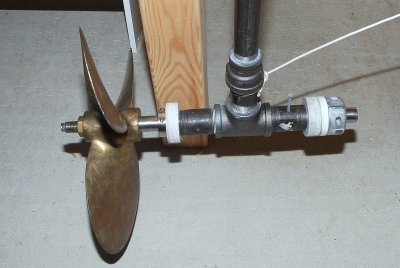
The prop I used was standard three blade fixed sailboat prop. It is made by Michigan Wheel. I call it the "Dumbo ears prop".

This is an age old argument, with a relatively easy test, yet surprisingly no one has done it, not even Practical Sailor..:confused::confused:


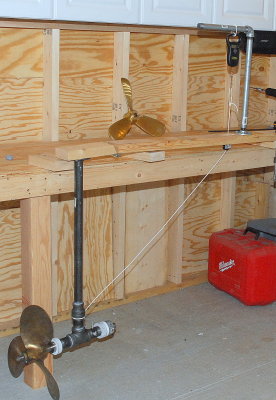
The Test jig:

medium.jpg


The Shaft Mechanism (the nail is the shaft lock):

medium.jpg


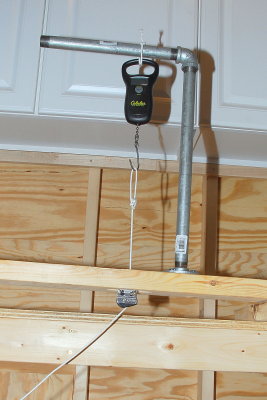
The Drag Measurement Assembly:

medium.jpg


The Hinge Mechanism:

medium.jpg


The Digital 50 Lb. Scale:

medium.jpg


Michigan Wheel Data Updated 4/18/09:

The results of the Michigan Wheel MP prop have been completed. I want to reiterate some points below so there is less confusion.

1) This test was only to determine if a standard Michigan Wheel three blade fixed prop causes more or less drag when towed through the ocean at a similar depth to that of a sailboat and with a comparable shaft resistance to a sailboat (namely mine). It is not to give accurate numbers or data on how much drag the specific prop creates.

2) Drag is relative to the the drag jig I used. The drag jig alone, with no prop, created about 12 lbs. of drag in this configuration at WOT.

3) Because the jig is the 100% the same in both fixed and freewheeling and the ONLY difference between fixed and freewheeling was a 2.5 inch roofing nail the only differences in drag come from the prop not being able to spin and spinning.

4) The motor was always run up to wide open throttle to totally minimize any variability between locked and freewheeling.

5) The pin point accuracy of the scale means little because it is only a control. The same scale was used for both fixed and freewheeling and it was only compared to itself in an A/B situation.

6) The difference between fixed and freewheeling was LARGE so a pound or two here or there means very, very little. Average drag at WOT in freewheeling mode was about 20-25 pounds including the test jigs strut. Subtract the test jig strut drag of 12 pounds and you have a free spinning drag of roughly 8-13 pounds of prop drag.

Average drag in fixed mode including the strut was about 45-50 pounds. Subtract the test jig strut drag of 12 pounds and you have a locked drag of roughly 33-38 pounds. As you can see .001 differences in accuracy do not matter when trying to answer this question. The locked prop resulted in an additional 25 pound difference.

With strut drag left in:
Free Spinning = 20-25 Pounds Drag
Locked = 45-50 Pounds Drag

On the low end of both drag range numbers, 20 pounds free and 45 pounds locked, that is a 125% increase in DRAG by locking the prop!

On the high end of the drag range numbers 25 pounds to 50 pounds that is a 100% increase in drag cause by locking the prop!

Strut drag removed:

Free Spinning = 8-13 Pounds Drag
Locked = 33-38 Pounds Drag


On the low end of both drag range numbers, 8 pounds free and 33 pounds locked, that is a 312.5% increase in DRAG by locking the prop!

On the high end of the drag range numbers 13 pounds to 38 pounds that is a 192% increase in drag cause by locking the prop!


As I said before we're not talking about .001 differences.

When I spun the strut around, with the prop facing forward, and ahead of the struts interference wake, I was surprised that i could not detect a discernible difference in load despite having to move the line a little higher on the strut. If there was a difference it was clearly less than one or two pounds and not noticeable in the scale of things.

7) Freewheeling is little bit of a misnomer. The shaft was not actually allowed to freewheel with minimal to no friction. The friction bearings were tightened and adjusted to closely mimic the friction of my own sailboats shaft. This test was primarily for me and my own curiosity and then secondarily for the sailing community. This is why the depth of the prop in the water matches my CS-36T and the shaft friction was set to begin spinning at about .8 - 1.2 knots which is what it does on my own boat.

8) The results are quite discernible and coincide with those of the MIT study, the University of Strathclyde study. Dave Gerr and some other prop drag tests like the one in a UK magazine just this month.

9) This experiment is about the prop used, a Michigan Wheel three blade "MP" prop. I make NO claims or suggestions about any other fixed type props including a two blade version of the Michigan Wheel MP. If someone wants to send me a two blade MP in a 1" shaft size I will be glad to test it too..;)

10) As far as I know this the ONLY video proof that clearly shows a fixed vs. freewheeling three blade sailboat prop being load tested and compared to itself in both fixed and locked mode.


11) Before you get all fired up because you are a believer that fixed three blade props cause less drag, not more, PLEASE remember that the ONLY difference between the fixed and freewheeling modes was a 2.5" nail passing through both the jig and the 1" shaft to lock it. There is NO possible way that 2.5" nail caused a nearly 100% increase in drag or 25 additional pounds of resistance.;)

12) I need a bigger motor! I was only able to attain a max speed of about 4.2 knots with the jig and prop in the water freewheeling and less in locked mode. I'd like to hit 6.5-7. Most sailors though are concerned about prop drag at less than hull speed. In light winds, and under hull speed, with a fixed three blade Michigan Wheel like this one, you will see less drag when freewheeling.

Edit: I used a 10HP motor and hit 7 Knots but the scale then needed to be bigger as in locked mode it spun past where it should. Free spinning was still less drag by a wide margin. I have not been able to track down a 100 pound scale. If anyone knows of a reasonably priced one please let me know.

13) I also load tested the jig alone, without a prop, at WOT and it had about 12+/- pounds of drag so you would need to subtract approx 12 pounds from the 25 or 50 pound numbers to get the actual prop drag in this test. I think it is safer to say something like "more than double" it is actually closer to 2.9 times more observed drag. I leave the .001's up to MIT but they are really not needed here.

If I subtract the jig drag from the numbers this is what we get.

Locked = Drag 50 Lbs. - Jig Drag 12Lbs. = 38 Lbs. of drag
Free Spin = Drag 25 Lbs. - Jig Drag 12Lbs. = 13 Lbs. of drag

That is a BIG difference!!!

I actually double checked the MIT study again they show the Michigan 3 blade at about 13 pounds of drag at 3.5 knots which is close to the max speed I could get out of it when locked. If you subtract the 12 pounds of test jig drag from the 25 pounds measured on the scale you are within a pound or two of the MIT study. Pretty close and not bad for a back yard hack who did not go to MIT...
wink.gif


Interestingly enough Yachting Monthly just did a similar project and their data also agrees with the University of Strathclyde and MIT as well as my findings:

[mod edit - Sorry we can't have scans from Yachting Monthly being reproduced, copyright infringement....if you want to see them the July issue is available in the shops and via Zinio]


Prop Drag Video (LINK)


Last edited by a moderator:
The fact that folding props do not instantly fold on their own is an absolute red herring. The ones I have had are held open by centrifugal force at anything above half revs (probably less?). That is a key part of their design, to enable them to work in astern.

While I can observe for myself a free spinning prop is very low drag, having demonstrated this by towing a tender with the outboard down, the outboard will only kick up if it is in gear. But I can spin the prop of an outboard in neutral with my little finger.
I can't spin the prop of any yacht that easily, even when the cutless bearing is wet. I've observed this diving to clean yachts, as well as rotating the shaft from inside.
I'm curious as to what the value of that resistance to rotation is, in any engineering units, at any representative speed.
How much friction or rotating drag is in the Maine Sail rig, numerically?
I don't see any controlled drag on the shaft in the rig.
I'm guessing in a real gearbox, the drag is mostly viscous and increases significantly at higher rpm. Has anyone ever measured his properly and published the results?

My impression based on a few yacht is that the prop is rotating way slower when windmilling than if it was driving the boat at that speed. Is it possible to measure this and work out what the slip factor of the prop is in drive and windmill?
 
I think Maine Sail is to be congratualted on such a thorough (and practial!) investigation!

As has been said, my only criticism would be that the "freewheeling" prop probably did have ratehr less resistance to motion that a real one turning a shaft and some gearbox innards. Certainly mine aslo passes througha long stern tube full of grease and a couple of stuffing boxes.

Sadly, I'm not in the water at present, but has anyone considered trying the following:

1. Find a patch of the calmest water possible (harbour or lake, ideally) and with as little tidal flow as possible.

2. Get the boat up to a set speed, and then cut the power, kick it into neutral, and start a stopwatch. Time how long it takes to loose 2-3 knots.

3. Repeat in the opposite direction and average.

4. Do the above a few times to see if consistent results can be established.

5. Do the same again with the prop locked and see if it takes more or less time to get down to the same speed.

That would seem the purest way of checking on any particular boat, and doesn't need any equipment apart from a stopwatch and log. The log doesn't even have to be accurate as long as its reasonably linear and consistent.

(And apologies if that's already been suggested - I haven't read the whole thread)!
 
Top