Prop nuts / anodes

mersey

Well-Known Member
Joined
29 Jan 2008
Messages
393
Visit site
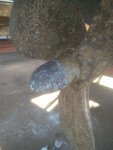
I can't get my prop nuts off, and I suspect its to do with the prop anodes needed to come off first, which I'm also unclear on how to remove, anyone familar with the below setup?


IMG_20160907_173100.jpgIMG_20160907_173016.jpg
 
I can't get my prop nuts off, and I suspect its to do with the prop anodes needed to come off first, which I'm also unclear on how to remove, anyone familar with the below setup?
View attachment 59808View attachment 59807

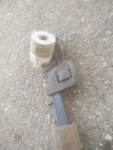
That anode could be screwed into the nut or into the shaft itself. In the latter case this would prevent the nut from being unscrewed, Whatever the case, try unscrewing the anode part using a hefty Stillson wrench like the one in the picture. This is what I used to do when I had such an anode.

012535.jpg
 
IMG_20160907_182229.jpg

Thanks!

Stilson with pipe extension took the port anode and nut off as one piece, starboard still not shifting at all.

Also now can't get the port prop off, wacked it multiple times with one of the wooden blocks they use to rest boats on, it's not moving.
 
View attachment 59810

Thanks!

Stilson with pipe extension took the port anode and nut off as one piece, starboard still not shifting at all.

Also now can't get the port prop off, wacked it multiple times with one of the wooden blocks they use to rest boats on, it's not moving.

Longer pipe for the starboard nut.

Use a prop puller and put some tension on the prop then give the prop a wack with a lump hammer.

6bbc9666-9c19-4f80-86a0-10559de34200_300.jpg
 
Just a thought. Do both props operate in the same direction? On some twin engine installations, one prop rotates clockwise, one counter clockwise. If that is the case, then one prop nut will have normal right handed thread whilst the other will have a left hand thread, thus needing to be undone in the opposite direction. Worth looking at the props to check if this is the case.
Edit:
Looking at the pics you posted, they look as if they are a pair of left and right handed props, so they are likely to have left and right handed threads on the nuts.
 
Last edited:
Just a thought. Do both props operate in the same direction? On some twin engine installations, one prop rotates clockwise, one counter clockwise. If that is the case, then one prop nut will have normal right handed thread whilst the other will have a left hand thread, thus needing to be undone in the opposite direction. Worth looking at the props to check if this is the case.
Edit:
Looking at the pics you posted, they look as if they are a pair of left and right handed props, so they are likely to have left and right handed threads on the nuts.

Would not make any difference as the each prop rotate in different directions in forward and reverse.
 
A warning about whacking propellers with lumps of wood or hammers to drive them off a taper. When you do so the force is being transmitted to the small ball bearing on the output shaft of the gearbox. This will damage it, possibly fatally. Use a puller, once it is tight a sharp tap on the end of its bolt should separate the two.
 
I'm afraid I don't understand that. :confused:

The props are indeed LH and RH so might well have opposite threads on the anode/prop nut.

Richard

Well the initial thought would be that with LH and RH threads the nut would tighten due to the direction of prop rotation for the forward direction of motion, but if you put the prop in reverse the direction of of rotation of the prop is now in the opposite direction which would be trying to undo the prop nut.

So it does not matter which direction the thread is cut there will always be in forward the nut may tend to tighten but the nut will tend to loosen in the reverse direction.
 
Don't forget Roger is in the southern hemisphere where props, like sundials, run in the opposite direction. ;)

Good one Vic

And water does down the plug hole in the opposite direction.

More importantly for us sailors rotating tropical storms also rotate in the opposite direction.
 
my props are counter rotation both with the same direction thread i.e. tighten clockwise. it is the locking washer or split pin which secures it. If you have neither God help you, the seabed is littered with props;)
 
Well the initial thought would be that with LH and RH threads the nut would tighten due to the direction of prop rotation for the forward direction of motion, but if you put the prop in reverse the direction of of rotation of the prop is now in the opposite direction which would be trying to undo the prop nut.

So it does not matter which direction the thread is cut there will always be in forward the nut may tend to tighten but the nut will tend to loosen in the reverse direction.

That's true ...... but since boats props spend 99% of the time in forward and 1% in reverse I wouldn't criticise the designer for playing the percentages if the prop nut was the only thing stopping the prop falling off.

Richard
 
That's true ...... but since boats props spend 99% of the time in forward and 1% in reverse I wouldn't criticise the designer for playing the percentages if the prop nut was the only thing stopping the prop falling off.

Richard

You need to add to you percentage odds the with a prop in forward even without the nut the thrust is the prop would be pushing the prop onto the shaft where as in reverse the thrust of the prop is pulling the prop off the shaft so maybe the reverse is a better /safer design.
 
my props are counter rotation both with the same direction thread i.e. tighten clockwise. it is the locking washer or split pin which secures it. If you have neither God help you, the seabed is littered with props;)

I can't see any locking washer or split pin in Mersey's assembly as the prop nut appears to be embedded in the anode/spinner so it would be impossible to remove anything which is positively stopping the nut coming loose.

The chances are therefore higher that the props will have opposite threads. Unfortunately there appears to be no way of determining this as the shaft thread is not visible.

A call or email to the boat builder (if in business) would be the best solution but if I was in Mersey's situation and force equal to that which removed the first prop was not shifting the second I would apply the same force to the second prop but in the opposite direction. However I would not apply more force just in case I've got it wrong!

I have twin saildrives although the two props are indentical ..... but neither prop has a physical fitment securing the prop nut so if it comes unscrewed the prop falls off and these props therefore rely on the percentage game ..... and being tightened sufficiently.

Richard
 
You need to add to you percentage odds the with a prop in forward even without the nut the thrust is the prop would be pushing the prop onto the shaft where as in reverse the thrust of the prop is pulling the prop off the shaft so maybe the reverse is a better /safer design.

But I have never suggested which direction would be the better engineering solution. All I said was that if the props have opposite rotations then the prop nuts probably have opposite rotations, in the absence of a physical retainer. :confused:

Richard
 
When I saw that my thinking was that the nut and the anode were /should be separate and the anode acted as a conventional friction lock nut to the main nut.

This is Ok IMHO up to a point and this is also indicated by the force needed to remover the port and the fact he is currently unable to remove the starboard nut.

This would not be how I would design a prop fitting. I would use tab washers of split pins.

Mine is an unusual design as having an external LH thread the the nut screws onto with an internal RH thread that a CSK setscrew and CSK washer locks the nut with a LH / RH friction locking mechanism.

This came with the hull and deck when I purchased the boat.
 
Top