prop-defender

bluetooth

Well-Known Member
Joined
30 Dec 2015
Messages
521
Location
Poole
Visit site
Prop-Defender - Ocean Coatings Ltd
Does it work ?

This appeared is a 'new gear' feature appeared in MBY in august and interested me. Ive been aware of many products that claim to stop barnacles and other growth but in reality dont.
One silicone type material was successful about 4 years ago i was told about but then it wasnt produced thereafter - ? eco reasons

Isnt cheap but my SS props and tabs have suffered barnacles and takes about 2kts off my cruising speed (26-24) and at times slows getting on the plane and need lots of tabs. Whilst a 50p wooden spatula is effective 30 minutes hanging off bathing platform for props and hanging under platform for tabs it maybe worthwhile.

Any thoughts ? (im sure there will be !)
 
Prop-Defender - Ocean Coatings Ltd
Does it work ?

This appeared is a 'new gear' feature appeared in MBY in august and interested me. Ive been aware of many products that claim to stop barnacles and other growth but in reality dont.
One silicone type material was successful about 4 years ago i was told about but then it wasnt produced thereafter - ? eco reasons

Isnt cheap but my SS props and tabs have suffered barnacles and takes about 2kts off my cruising speed (26-24) and at times slows getting on the plane and need lots of tabs. Whilst a 50p wooden spatula is effective 30 minutes hanging off bathing platform for props and hanging under platform for tabs it maybe worthwhile.

Any thoughts ? (im sure there will be !)
Sounds good. Do us a favour and test it for us?
 
Prop-Defender - Ocean Coatings Ltd
Does it work ?

This appeared is a 'new gear' feature appeared in MBY in august and interested me. Ive been aware of many products that claim to stop barnacles and other growth but in reality dont.
One silicone type material was successful about 4 years ago i was told about but then it wasnt produced thereafter - ? eco reasons

Isnt cheap but my SS props and tabs have suffered barnacles and takes about 2kts off my cruising speed (26-24) and at times slows getting on the plane and need lots of tabs. Whilst a 50p wooden spatula is effective 30 minutes hanging off bathing platform for props and hanging under platform for tabs it maybe worthwhile.

Any thoughts ? (im sure there will be !)
When I was a kid my uncle used to use sheep oil he heated up and brushed on. I’ve only owned boats in the Med where there seems to be less fouling (?) and where I was advised that the water was too warm to use it....
 
When I was a kid my uncle used to use sheep oil he heated up and brushed on. I’ve only owned boats in the Med where there seems to be less fouling (?) and where I was advised that the water was too warm to use it....
Sheep oil = lanolin. It can be quite effective, but not really a long lasting solution.
 
IMO, nothing sticks to the main props.
I've tried virtually everything.
Lanolin - either in its raw form or in the form of Propshield (a lanolin based product) doesn't work.
And, personally, I wouldn't now even do a free test.
The reason is that most of the coatings stick in the "hard to get to" places but don't stick to the middle and outer edges of the props.
So, the first challenge that any coating has to pass is its ability to completely stick to the prop.
Only then can the supplier look at a material that repels the growth.

My solution is a lift and pressure wash followed by an acid wash.
In our marina, the guys in the boatyard pressure wash the props, rudders and shafts etc first.
And whilst they pressure wash the rest of the boat, we get in there with the acid wash - just rubbing with an acid soaked paint brush is all that is needed to get the props completely clean.
The whole process including lifting and relaunching takes less than a couple of hours.

This year has been a disaster as far as cruising is concerned but last month, I went out to specifically replace the anodes.
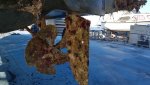
This was what the props looked like after 11 months since the last lift.

20200910_102807.resized.jpg

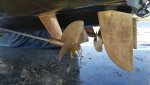
And during the pressure wash/acid wash

20200910_123942.resized.jpg

I had the boat left in the slings during lunch so that I could do the anodes.
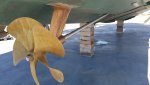
This is the result after a bit of drying out.

20200910_130814.resized.jpg

I did all this completely on my own - with the pressure washer operator of course.

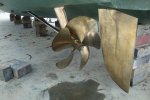
Usually, I polish them

DSC07694.resized.JPG

So, my solution is to spend the money on a lift and scrub as you need it.
No coatings work on the props.
 
This was what the props looked like after 11 months since the last lift.
M, a question a bit o/t, but was the HULL already powerwashed, in the first pic?
I'm asking because it looks remarkably clean, and if the Coppercoat kept it like that after 11 months, it's working better than in my boat.
It does a decent job also on my hull actually - I'm not complaining, overall.
But I launched her in June (clean, obviously), and already now, after less than 4 months, it isn't as clean as yours looks like in the first pic.
 
No P, the first pic was before the pressure wash.
Unfortunately, that pic didn't show the full extent of the growth.
Here is another pic that shows how the Coppercoat is working.

20200910_102703.resized.jpg

And a couple more after the cleaning

20200910_130819.resized.jpg

20200910_143900.resized.jpg

You may remember that in March 2019, I "topped up" the Coppercoat with two more coats.
Actually, I am really please with it.
If nothing else, Coppercoat provides a really tough coating.

BTW - I've been treating thruster tunnels and thruster props with WHITE Trilux
Specifically the white colour of Trilux.
Most of the Trilux has washed off now (applied in March 2019) but it does seem to keep the thruster effective.

Sorry about the thread drift.
 
No P, the first pic was before the pressure wash.
Unfortunately, that pic didn't show the full extent of the growth.
Here is another pic that shows how the Coppercoat is working.
Thanks M, fair enough. That's more similar to how my hull looks like, which actually ain't bad at all, anyway.
I also noticed that occasionally, for some reason, the marine growth finds some small spots on the CC surface where they don't mid sticking, and it grows from there.
On my hull I never had those sort of tufts shown in your pic, but I guess I would have had something similar after such a long timeframe, if it weren't that occasionally, during the summer, I give it a brush while swimming around the boat.

Anyway, overall I agree with you that CC does work well.
Maybe 8 to 9, in a scale of effectiveness where 10 is the Micron stuff, but considering its duration and the side benefit of an epoxy shielded hull, I'd definitely do it again. (y)

Back to the point, I also agree with you that something for props anywhere near as effective as hull a/f is yet to be invented.
Otoh, in the last couple of years I had decent results with Velox Plus.
 
Thanks for thoughts. You'd think at some stage a suitable material will be found. Ill consider testing and feeding back on here.
 
IMO, nothing sticks to the main props.
I've tried virtually everything.
Lanolin - either in its raw form or in the form of Propshield (a lanolin based product) doesn't work.
And, personally, I wouldn't now even do a free test.
The reason is that most of the coatings stick in the "hard to get to" places but don't stick to the middle and outer edges of the props.
So, the first challenge that any coating has to pass is its ability to completely stick to the prop.
Only then can the supplier look at a material that repels the growth.

My solution is a lift and pressure wash followed by an acid wash.
In our marina, the guys in the boatyard pressure wash the props, rudders and shafts etc first.
And whilst they pressure wash the rest of the boat, we get in there with the acid wash - just rubbing with an acid soaked paint brush is all that is needed to get the props completely clean.
The whole process including lifting and relaunching takes less than a couple of hours.

This year has been a disaster as far as cruising is concerned but last month, I went out to specifically replace the anodes.
This was what the props looked like after 11 months since the last lift.

View attachment 99736

And during the pressure wash/acid wash

View attachment 99737

I had the boat left in the slings during lunch so that I could do the anodes.
This is the result after a bit of drying out.

View attachment 99738

I did all this completely on my own - with the pressure washer operator of course.

Usually, I polish them

View attachment 99739

So, my solution is to spend the money on a lift and scrub as you need it.
No coatings work on the props.

That's great for just a couple hours work on the stern gear, what acid product do you use?
 
At a guess Aqua Fuerte which is Euro 1 for 1.5 litres in all Spanish supermarkets!
Yep thats the stuff
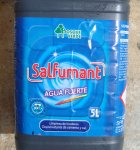
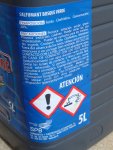
Here's a pic of the bottle

DSC07319.resized.JPG

As jrudge says, we get it in the Spanish supermarkets.

In the early days, we didn't realise how to use the stuff.
Just squirting it on does very little.

The trick when using it is to keep the acid moving.
That means where the acid actually touches the barnacles.
You don't actually need anything abrasive - just keep replacing the acid where it touches the surface.
Most of the time, I use a cheap 3" paint brush and an empty plastic yogurt carton.
I decant some of the Aguafuerte acid into the empty plastic yogurt carton and "paint it onto the props/metalwork.
Then agitate using the paint brush.
As you work it in, it is just like having a little angle grinder - the smooth surface emerges.
Very therapeutic as well as quick.
On the shafts, I tend use a cheap loo brush - again keeping the acid moving.
Do a bit - turn the shaft - do a bit more.

Usually I have two of us but last month, I was on my own.
I drove the boat into the lifting dock at 10:30 - all done by 12:30 - the blocked and kept in the slings during lunch for me to change the anodes.
In fact some friends can round and the anodes only took a few minutes so we all went to lunch over in the marina bar.
Relaunched at 15:00 but usually we are only out of the water for an hour or two.
And, of course once back in the water the props are like new.
On the way back to the berth, I picked up some friends and we took the boat out into the lagoon - straight onto the plane!!!

As I said to MapisM above this is also where Coppercoat comes into its own.
Our pressure washer is quite aggressive so it removes most conventional antifoul.
Coppercoat, being epoxy doesn't come off with the pressure washer.
 
No P, the first pic was before the pressure wash.
Unfortunately, that pic didn't show the full extent of the growth.
Here is another pic that shows how the Coppercoat is working.

View attachment 99754

And a couple more after the cleaning

View attachment 99755

View attachment 99756

You may remember that in March 2019, I "topped up" the Coppercoat with two more coats.
Actually, I am really please with it.
If nothing else, Coppercoat provides a really tough coating.

BTW - I've been treating thruster tunnels and thruster props with WHITE Trilux
Specifically the white colour of Trilux.
Most of the Trilux has washed off now (applied in March 2019) but it does seem to keep the thruster effective.

Sorry about the thread drift.
Just in case people are interested, here are some pics after we "topped up" the Coppercoat 18 months ago

20190304_153001.resized.jpg

20190304_152602.resized.jpg

20190308_164322.resized.jpg
 
Yep thats the stuff
Here's a pic of the bottle

View attachment 99822

As jrudge says, we get it in the Spanish supermarkets.

In the early days, we didn't realise how to use the stuff.
Just squirting it on does very little.

The trick when using it is to keep the acid moving.
That means where the acid actually touches the barnacles.
You don't actually need anything abrasive - just keep replacing the acid where it touches the surface.
Most of the time, I use a cheap 3" paint brush and an empty plastic yogurt carton.
I decant some of the Aguafuerte acid into the empty plastic yogurt carton and "paint it onto the props/metalwork.
Then agitate using the paint brush.
As you work it in, it is just like having a little angle grinder - the smooth surface emerges.
Very therapeutic as well as quick.
On the shafts, I tend use a cheap loo brush - again keeping the acid moving.
Do a bit - turn the shaft - do a bit more.

Usually I have two of us but last month, I was on my own.
I drove the boat into the lifting dock at 10:30 - all done by 12:30 - the blocked and kept in the slings during lunch for me to change the anodes.
In fact some friends can round and the anodes only took a few minutes so we all went to lunch over in the marina bar.
Relaunched at 15:00 but usually we are only out of the water for an hour or two.
And, of course once back in the water the props are like new.
On the way back to the berth, I picked up some friends and we took the boat out into the lagoon - straight onto the plane!!!

As I said to MapisM above this is also where Coppercoat comes into its own.
Our pressure washer is quite aggressive so it removes most conventional antifoul.
Coppercoat, being epoxy doesn't come off with the pressure washer.
I tried some prop cleaner from the Chandler's but that didn't seem to do much.

I guess I'll need to find an equivalent in the UK as I'm sure Agua Fuerte won't be available here.
 
Hi Richard,

I use acid to clean up Hollywood's stern gear, as mentioned above it is so easy. I've tried the Brick /mortar cleaners and they do work well enough but then bought some "Hydrochloric 36" from a specialist chemical company and that is super quick at removing the deposits left after the lift jetwash (I only use on the stern gear and platform mechanism). I think the effectiveness is all down to the acid %age. With the brick cleaners the 1st one I used was Everbuild , I think from Wickes, but then I found a higher %age one from Jewsons, Their own make , and that worked better. But then I got this "36" and that is just great, but be careful it is also really really wicked stuff, it almost snarls at you when you pour it into a jug. I also just paint brush it on and keep it moving and fizzing/foaming. Wash off with copious quantities of water. Also, all of them obvs demand full protective gear.
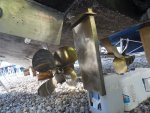
Here's a couple of pics showing the sterngear afterjetwash and then after acid clean and some polishing, you can see how the acid has cleaned away deposits and before polishing on some blades of the s/b prop (a couple have been polished in that pic) and P bracket.
 

Attachments

  • Sterngear after jetwash Sept 2020 2MP.JPG
    Sterngear after jetwash Sept 2020 2MP.JPG
    367 KB · Views: 14
  • Sterngear mid polish Sept 2020 2MP.JPG
    Sterngear mid polish Sept 2020 2MP.JPG
    300.9 KB · Views: 14
Last edited:
Here is another pic of the bottle

DSC07320.resized.JPG

As you can see , in Spanish, it is called acido clorhidrico which translates into hydrochloric acid in English.
And the concentration is 20%

I have heard of people using stronger concentrations and saying that they work even better.
Maybe the "Hydrochloric 36" mentioned above is 36% ?????

Safety
Yes, you do have to be very careful with the stuff.
Usually, I only wear shorts and Tee shirts but I also wear eye protection glasses and thick rubber gauntlet gloves.
I buy the gloves locally from our local fisherman's co-op - dirt cheap and really "up to the job"
You can tell that it is nasty stuff.
After an hour or so, the only parts left to do are the tops of the P Brackets (the P Bracket's flange that screws to the bottom of the boat).
To do these, you have to paint the Aguafuerte upside down.
This means that the acid runs down the brush and over the gloves.
We try to roll the gauntlet part of the glove to stop it running any further but I always get some on my skin.
And after a while, it itches.
I really wouldn't want to get it in my eyes.

EDIT
Oh yes - any that drops onto the concrete fizzes as it reacts with the cement.
 
Top