Procedure for sharing a bouy

SimonFa

Well-Known Member
Joined
25 Feb 2013
Messages
6,434
Location
Me North Dorset. Venezia in Portland.
Visit site
Reading around I find many mentions of sharing buoys. In my short sailing career not only have I not used many buoys, I've never shared one. I have rafted a number of times and last week single handed for the first time.

So, what's the the best way to g about sharing a buoy, especially if there's nobody aboard the boat your going to be sharing the buoy with and you're single handed? I presume it's the same as rafting then attaching to the buoy?

Thanks in advance for the advice.

Simon
 
One important point to remember - shift your boat back or forward relative to theirs so that your masts are not in line. It doesn't take much of a roll to swing the two masts towards each other - make sure they will overlap instead of colliding. I've seen a yacht nearly dismasted (limping to the nearest yard with a halyard standing in for a shroud) by failing to do this.

Pete
 
Assuming it's a single buoy and similar boat to yours the approach should straight be forward. The other boat should be lying to the wind and or tide whichever the stronger.
Like you say, approach like rafting with a centre line first (or may be bow line) and bow and stern line at the ready. When secured alongside pass a rope from your bow to the buoy. This may not be easy as the other boat may have the pick up buoy on board. One of the clever devices for passing a rope through a ring could be useful here. In a high freeboad boat.
If the other boat is moored fore and aft to two buoys study the tide and wind carefully as in some places the tide may run across the mooring. As always Have the forces and have them help you.
 
Last edited:
Thanks all, excellent and prompt advice as always.

@prv I'm always careful when I go in to Lymington Town Quay and it always surprises me how many boats don't think about masts. I even had to ask a school boat who was rafting on me to move his boat a bit. (And for a bit of thread drift, it turned out to be the boat I did my Coastal Skipper week on.)
 
Last edited:
I would be wary of rafting on a buoy without first finding out what loading it was designed for, easy to drag a mooring laid for a small boat. If suitable, all above advice is good.
 
I wondered about that.
On Windermere (yes, I know it's just a puddle) buoys are not common property and attaching to just any mooring buoy will have the Wardens snapping at your heels.
Two boats on a buoy is very likely to lift the sinker. Boats up to about 26 ft use one sinker and moorings for larger boats lay 2 sinkers. You can't tell just by looking the buoy.
 
When rafting on a single buoy I come alongside the other boat and rig breast ropes at bow and stern plus pressings to prevent fore & aft movement then put a line to the buoy and adjust the length so we are both taking some of the strain. (Multihulls don't need to consider mast clashes but we need to arrange the buoy line to the hull nearest our berth companion).
 
I wondered about that.
On Windermere (yes, I know it's just a puddle) buoys are not common property and attaching to just any mooring buoy will have the Wardens snapping at your heels.
Two boats on a buoy is very likely to lift the sinker. Boats up to about 26 ft use one sinker and moorings for larger boats lay 2 sinkers. You can't tell just by looking the buoy.

by contrast:

Visitors Moorings

Itchenor
There are six visitors' moorings off Itchenor jetty which can take up to six vessels each depending on size.​
 
sometimes, just strong forward thrust to thread yourself in, then adjust mooring ropes at leisure :)


margherite_zpse8a1ff73.jpg
 
Cor! That looks like Yarmouth....! :rolleyes:

Much less space in Yarmouth.
I have rafted on buoys in many places, Fowey and Salcombe spring to mind.
Ideally, pick a big boat that already has a little boat on the other side.
Generally, you need to arrange the two boats parallel, with the loads shared so that both are aligned with the current, particularly if it's strong as in Salcombe. It can be useful to take a spring from amidships or even stern cleat to the buoy, to take most of the load without pulling the bows together.
This can help put lower loads on the fenders.
Always have a direct line from your bow to the buoy, so the other boat can leave while you are ashore.

As has been said, don't have the masts in line or they will clash with every passing wash.
 
In addition to all the excellent comments I would add be prepared for a swell to set in. Sharing a bouy in any swell can be a really unpleasant experience - do not under estimate it. There is a significant risk of damage to the boats (albeit maybe just cosmetic) and if it happens in the night a great deal of noise, crunching and grinding. ;-)

All this means have you escape planned if at all possible so you can free yourself of the bouy and raft as that may be the only recourse.

I know form experience from one very interupted night in Aderney!

PS you also realise that fenders can never be too large!!
 
PS you also realise that fenders can never be too large!!

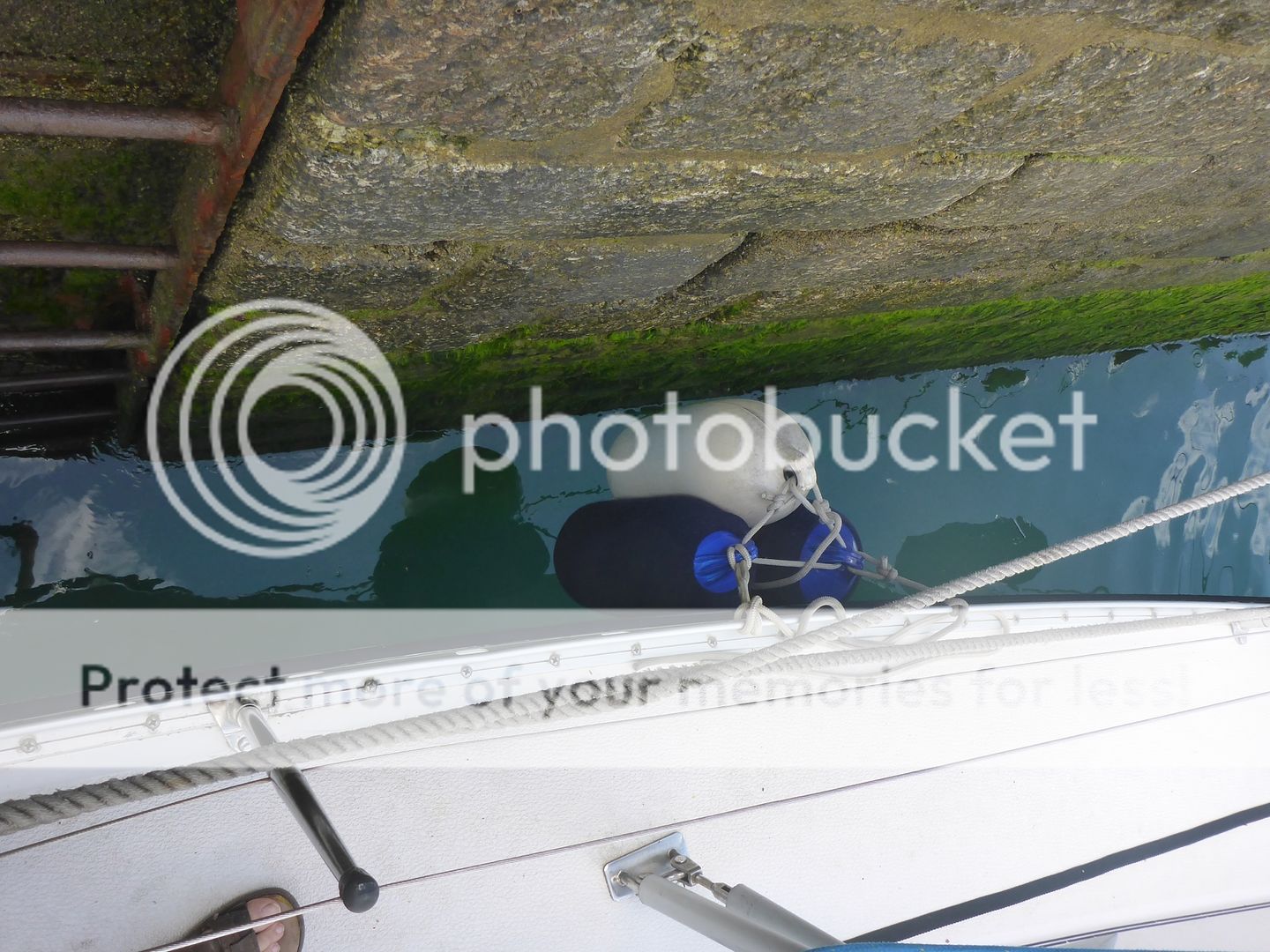
Possibly my technique for jaggy walls could come in handy?

8673AC61-63BA-440A-857A-CCAC4BECB2C2_zpspsdieydj.jpg


(In fact the homemade yokohamas weren't necessary on this particular wall, but I wasn't sure what was going to be revealed as the tide went down)

Pete
 
We have an enormous fender (I believe the bloke who gave it to me may have acquired it from somebody who knew somebody who thought it might have fallen off a very large Mobo, if you see what I mean) which we hang horizontally when rafted on a buoy. It magically avoids squeaking when there is a swell.
 
Possibly my technique for jaggy walls could come in handy?

8673AC61-63BA-440A-857A-CCAC4BECB2C2_zpspsdieydj.jpg


(In fact the homemade yokohamas weren't necessary on this particular wall, but I wasn't sure what was going to be revealed as the tide went down)

Pete
Presume you need to tie them together at the bottom too?

One year I went on a cruise to the West Country, departing straight from the Camber Dock in Portsmouth. That resulted in me having my couple of stout fender board aboard, so I spent half the week looking for walls to tie up to.

Can you still buy those fenders that are like an Avon dinghy thwart in a canvas sack?
 
Top