Princess v55, 2000, MAN engine 800hp, hammering noise, what is the cause?

I will revert (and hear your videos) asap - I just can't stand typing a lot on mobile devices... :ambivalence:
Just heard the videos properly, and if I should bet, my money would be on the drive plate rather than pump/injectors (or anything else strictly engine-related).
The engine sound itself is pretty good, to me. Practically identical to my engines, anyway.
I'll follow up your PM request in a minute.

PS: in your boots, one thing I would definitely do is stop doing any engine further tests PDQ, particularly under load.
Second thing would be to look for a very experienced MAN engineer - someone who does NOT come to the boat with the portable computer. I'm 99% sure that for anyone intimately familiar with these engines it wouldn't take more than a few minutes to tell which of our guesses (or any other) is the right one.
 
Last edited:
I had a similar knocking noise on one of my KAD42s on an earlier boat. It turned out to be a faulty injector and It occurred only when warm. I could feel a distinkt jolt on the injector tube feeding the faulty injector which made it easy to find the faulty one and try out the effect of replacing it.
 
Last edited:
Hi again! Here comes un update.

I have now listened with the stethoscope. Not uncomplicated.

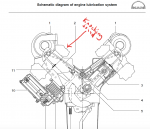
It is cleat that some cylinders have a more knocking/harsher sound than others, and that is true for both engines. However, the knocking, louder sound, almost a bit like exhaust pipe leaking, is most pronounced when I have the stethoscope pressed on this engine part.

Se image below.

I don't know what the part does. It is approx 4 dm long and connected to the cylinders. There is one on each side of the V, but only the one to the starboard on the starboard engine has this knocking clearly pronounced. I cant tell from where on the 4 dm part it is most pronounced, it could also come from the part connected to it from the front, but it is difficult to get a good press point with the stethoscope on that part as it is below the large intercooler that sits on top.

I also attach a new youtube sound recording where I think I have got the knocking sound most clearly defined. I'm moving the mobile from front of engine to back to front again, and I think it is clear that the knocking comes from front parts of engine, even if I believe it to be more clear in reality than on the recording. But as it likely comes from somewhere below the Intercooler, the acoustics play games. And the whole engine room actually play games with the sound...

Thoughts much appreciated.

knocking sound.png

Updated recording of knocking sound
https://www.youtube.com/watch?v=ooy7AX3Jm0A

Rgds / Yossy
 
Inside of the V that box looks like the inlet manifold that your red arrow points to on the diagram.
The exhaust manifold is on the out side of the V .
If I interpreted the diagram correctly ?

If the knock is definitely there or thereabout and not any where near the bell housing / gearbox then I think it’s likely to be some sort of aberrant detonation .

Could be a injector not letting the correct amount of fuel in with one squirt .
Maybe that cylinder needs 4/6 cycles at 600 rpm .

At this low rpm the EGT s and cylinder pressure / temps are too low to detonate the incorrect fuel released from the faulty injector.
600 rpm = 300 cycles of a 4 Stroke , 5 of the 8 on the power stroke each second.
That period banging has a period of a second or just a tad less ? So it’s missing 4/5 chances of firing , sort of filling up until the remnants left after 4/5 cylinder evacuations + a bit more from the failed injector gives an explosion.

At the earlier Vids @ higher rpm s than tick over say 1750 the combined temps + pressure + EGT are such that normal detonation starts to take place thus decreases the period down so at worst it misses every other not every 4/5 or at best fires normally with less power so the “bang “ seems to decrease .

Another theory ( if you are sure it’s not the drive plate ) is a sticky inlet valve .
It’s not quite closing tight thus loosing cylinder pressure and thus temp at tickover so the fuel can’t explode with one go but as above takes 4/5 cycles and eventually it bangs with an aberrant fuel / air mix and resonates back into the box with the red arrow .

As the rpms rise the period of 4/5 failed explosions decreases as above so the “banging “ seems to decrease .

How hard did you run them on the first trip out ?
And I assume clean hull and props - just serviced at the start of the season ?
 
Last edited:
Inside of the V that box looks like the inlet manifold that your red arrow points to on the diagram.
The exhaust manifold is on the out side of the V.
If I interpreted the diagram correctly ?
You did.

Ref. the noise source, I don't feel competent enough to comment further.
But I'd be very surprised if eventually injector(s) would be the culprit.

Wishing Yossy all the very best for an easy fix, I for one will be interested to hear about his final findings.
Please keep us posted! :encouragement:
 
Portofino thank you for your analysis on my limited input :encouragement:

The boat has clean hull and propps and is actually in water all year around in the nordics. With ice free harbor and heating inside engine rooms etc.

First time I drove it a shorter trip and couldn't hold myself and gave it almost full gas after maybe 30 min of cruising. The boat then performed well.

Second trip a week later or so the knocking came...

I'm located in Sweden and it is difficult for me to find MAN professionals that can service the boat. Last year I serviced the port engine and replaced a faulty turbo, but for different reason we never got to the SB engine. And before that it has been serviced, and I also did a larger service a couple of years back.

/Yossy
 
Portofino that knocking sound is very similar to mine! No doubt about that. I think mine is a little softer and with lower frequency? Or could that be because my engine is just running at a lower rpm at idle?
Anyway the injectors are coming off for service. I will let you know how it goes.
:encouragement:
 
Top